

ADVERTISEMENT

The leader of Lebanon's Hezbollah militant group warns archenemy Israel against wider war

Published Jun 20, 2024 12:42 am

BEIRUT (AP) — Lebanon’s Hezbollah has new weapons and intelligence capabilities that could help it target more critical positions deeper inside Israel in case of an all-out war, the militant group's leader warned on Wednesday.
AP24171590238521.jpg
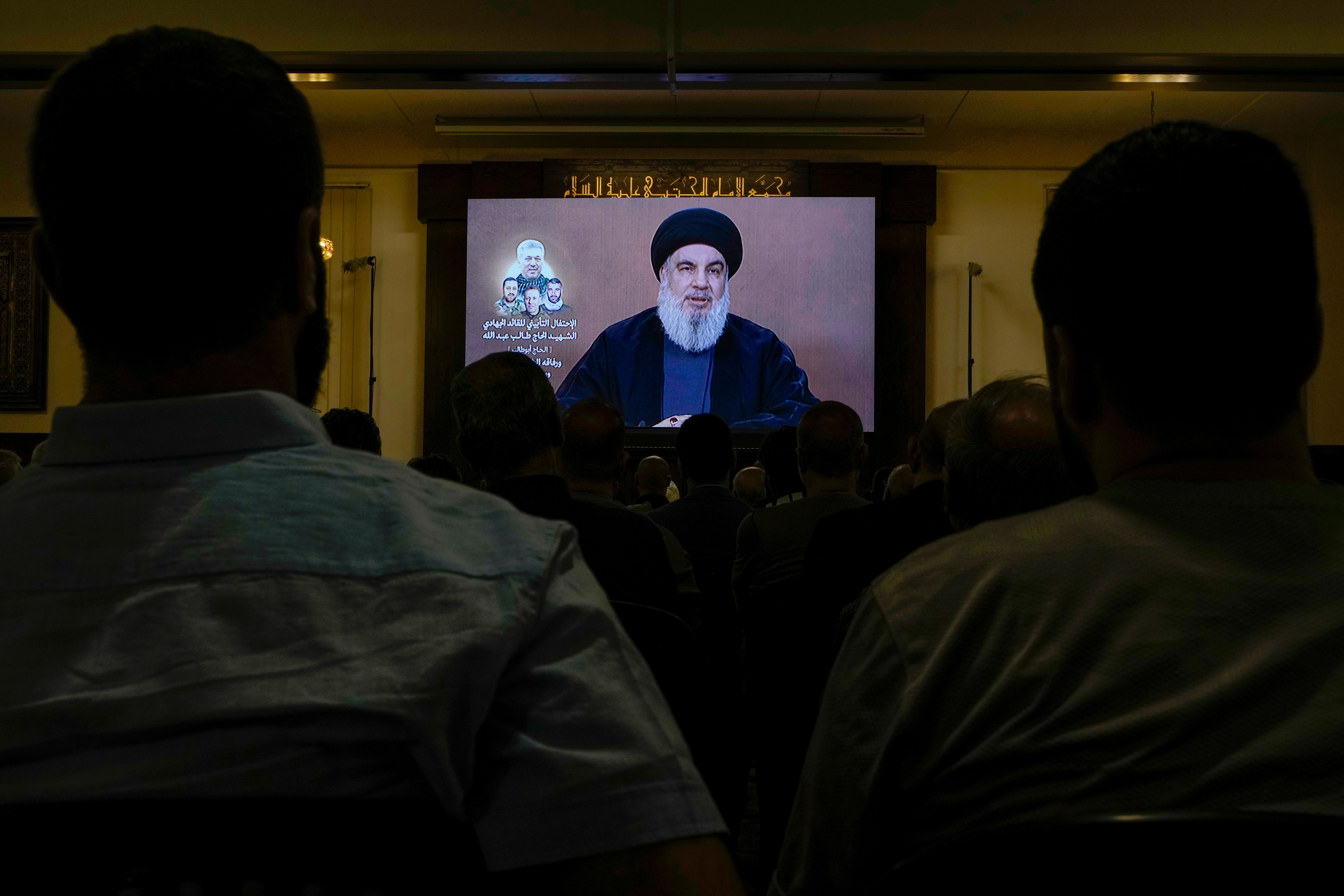
Hezbollah supporters watch a speech given by Hezbollah leader Sayyed Hassan Nasrallah on a screen during a ceremony to commemorate the death of senior Hezbollah commander Taleb Sami Abdullah, 55, who was killed last week by an Israeli strike in south Lebanon, in the southern Beirut suburb of Dahiyeh, Lebanon, Wednesday, June 19, 2024. (AP Photo/Bilal Hussein)

Hassan Nasrallah’s comments came as the monthslong cross-border conflict simmering between Hezbollah and Israel appears to be reaching a boiling point and a day after a top U.S. envoy met Lebanese officials in his latest attempt to ease tensions.

"We now have new weapons. But I won’t say what they are," he said in a televised address commemorating a top Hezbollah commander killed in an Israeli airstrike in southern Lebanon last week. “When the decision is made, they will be seen on the front lines.”

Hezbollah has used locally made explosive drones for the first time since the start of the Israel-Hamas war in Gaza last October, as well as surface-to-air missiles to chase off Israeli jets.

Nasrallah said in 2021 that Hezbollah has 100,000 fighters but now he claimed the number is much higher, without elaborating. He also said he has rejected offers from allied countries and militias in the region that could add tens of thousands to his ranks.

A nearly 10-minute-long video allegedly filmed by a Hezbollah surveillance drone and released Tuesday shows parts of Haifa — a city far from the Israel-Lebanon border. Nasrallah in his speech Wednesday said Hezbollah has much more footage — an apparent threat it could reach sites deep in Israel.

Israel’s military chief, Lt. Gen. Herzi Halevi, visited Israeli air-defense soldiers near the border with Lebanon on Wednesday, saying Israel was aware of Hezbollah's capabilities demonstrated in the video and has solutions for these threats.

“We of course have infinitely greater capabilities,: he said and added, ”I think the enemy is only familiar with a few of them and (we) will confront them at the right time.”

Hezbollah, an ally of the Palestinian militant group Hamas, has been exchanging strikes with Israel almost daily since the war in Gaza erupted on Oct. 7, with the aim to pull Israeli forces away from the embattled Gaza Strip.

Hezbollah's attacks escalated after Israel expanded its offensive last month into the southern Gaza city of Rafah and spiked further last week after an Israeli strike killed high-ranking Hezbollah commander Taleb Sami Abdullah, the most senior militant killed so far during the Israel-Hamas war.

Also Tuesday, the Israeli army said it has “approved and validated” plans for an offensive in Lebanon, although the decision to actually launch such an operation would have to come from the country's political leadership.

The warnings by both sides followed a visit by President Joe Biden's senior adviser Amos Hochstein, who this week met with officials in Lebanon and Israel in his latest attempt to deescalate tensions. Hochstein told reporters in Berlin on Tuesday that it was a “very serious situation” and that a diplomatic solution to prevent a larger war was “urgent.”

Nasrallah said a wider war with Lebanon would have regional implications and that Hezbollah would attack any other country in the region that assisted Israel in the war effort, citing Cyprus, which has hosted Israeli forces for training exercises. He suggested Cyprus might allow Israel to use its bases in event of a wider war.

In response, Cypriot President Nikos Christodoulides said his island nation “is in no way involved” in any military operations in the region. Cyprus is “part of the solution, not part of the problem” he said, pointing out the Cyprus-Gaza maritime corridor used to deliver aid to the Palestinian territory.

Only a cease-fire in Gaza would halt the Lebanon-Israel border fighting or the attacks on Western and Israel-linked targets from Yemen's Houthi rebels and Iraqi militias allied with Hezbollah.

Israel views Hezbollah as its most direct threat, and the two fought a 34-day war in 2006 that ended in a stalemate. Hebollah's military capabilities have significantly grown since then, and the United States and Israel estimate the group, along with other Lebanese militant factions, has about 150,000 missiles and rockets. Hezbollah also has been working on precision-guided missiles.

Hezbollah said at least four of its fighters were killed in Israeli strikes on Wednesday as Hochstein returned to Israel for a new round of meetings there.

Lebanese state media reported the strikes along the border and near the coastal city of Tyre, about 30 kilometers (20 miles) away. The Israeli military said two Hezbollah launches damaged several vehicles in northern Israel.

Kamel Mohanna, the head of the Amel Association, an NGO providing health services in different areas of Lebanon, said the association health center in the town of Khiam was hit and damaged by the Israeli shelling.

Israeli strikes have killed more than 400 people in Lebanon, most of them Hezbollah and other militants, but also over 80 civilians and non-combatants. In northern Israel, 16 soldiers and 11 civilians have been killed by strikes launched from Lebanon.

Related Tags

WORLDNEWS
ADVERTISEMENT
.most-popular .layout-ratio{ padding-bottom: 79.13%; } @media (min-width: 768px) and (max-width: 1024px) { .widget-title { font-size: 15px !important; } }

{{ articles_filter_1561_widget.title }}

.most-popular .layout-ratio{ padding-bottom: 79.13%; } @media (min-width: 768px) and (max-width: 1024px) { .widget-title { font-size: 15px !important; } }

{{ articles_filter_1562_widget.title }}

.most-popular .layout-ratio{ padding-bottom: 79.13%; } @media (min-width: 768px) and (max-width: 1024px) { .widget-title { font-size: 15px !important; } }

{{ articles_filter_1563_widget.title }}

{{ articles_filter_1564_widget.title }}

.mb-article-details { position: relative; } .mb-article-details .article-body-preview, .mb-article-details .article-body-summary{ font-size: 17px; line-height: 30px; font-family: "Libre Caslon Text", serif; color: #000; } .mb-article-details .article-body-preview iframe , .mb-article-details .article-body-summary iframe{ width: 100%; margin: auto; } .read-more-background { background: linear-gradient(180deg, color(display-p3 1.000 1.000 1.000 / 0) 13.75%, color(display-p3 1.000 1.000 1.000 / 0.8) 30.79%, color(display-p3 1.000 1.000 1.000) 72.5%); position: absolute; height: 200px; width: 100%; bottom: 0; display: flex; justify-content: center; align-items: center; padding: 0; } .read-more-background a{ color: #000; } .read-more-btn { padding: 17px 45px; font-family: Inter; font-weight: 700; font-size: 18px; line-height: 16px; text-align: center; vertical-align: middle; border: 1px solid black; background-color: white; } .hidden { display: none; }
function initializeAllSwipers() { // Get all hidden inputs with cms_article_id document.querySelectorAll('[id^="cms_article_id_"]').forEach(function (input) { const cmsArticleId = input.value; const articleSelector = '#article-' + cmsArticleId + ' .body_images'; const swiperElement = document.querySelector(articleSelector); if (swiperElement && !swiperElement.classList.contains('swiper-initialized')) { new Swiper(articleSelector, { loop: true, pagination: false, navigation: { nextEl: '#article-' + cmsArticleId + ' .swiper-button-next', prevEl: '#article-' + cmsArticleId + ' .swiper-button-prev', }, }); } }); } setTimeout(initializeAllSwipers, 3000); const intersectionObserver = new IntersectionObserver( (entries) => { entries.forEach((entry) => { if (entry.isIntersecting) { const newUrl = entry.target.getAttribute("data-url"); if (newUrl) { history.pushState(null, null, newUrl); let article = entry.target; // Extract metadata const author = article.querySelector('.author-section').textContent.replace('By', '').trim(); const section = article.querySelector('.section-info ').textContent.replace(' ', ' '); const title = article.querySelector('.article-title h1').textContent; // Parse URL for Chartbeat path format const parsedUrl = new URL(newUrl, window.location.origin); const cleanUrl = parsedUrl.host + parsedUrl.pathname; // Update Chartbeat configuration if (typeof window._sf_async_config !== 'undefined') { window._sf_async_config.path = cleanUrl; window._sf_async_config.sections = section; window._sf_async_config.authors = author; } // Track virtual page view with Chartbeat if (typeof pSUPERFLY !== 'undefined' && typeof pSUPERFLY.virtualPage === 'function') { try { pSUPERFLY.virtualPage({ path: cleanUrl, title: title, sections: section, authors: author }); } catch (error) { console.error('ping error', error); } } // Optional: Update document title if (title && title !== document.title) { document.title = title; } } } }); }, { threshold: 0.1 } ); function showArticleBody(button) { const article = button.closest("article"); const summary = article.querySelector(".article-body-summary"); const body = article.querySelector(".article-body-preview"); const readMoreSection = article.querySelector(".read-more-background"); // Hide summary and read-more section summary.style.display = "none"; readMoreSection.style.display = "none"; // Show the full article body body.classList.remove("hidden"); } document.addEventListener("DOMContentLoaded", () => { let loadCount = 0; // Track how many times articles are loaded const offset = [1, 2, 3, 4, 5, 6, 7, 8, 9, 10]; // Offset values const currentUrl = window.location.pathname.substring(1); let isLoading = false; // Prevent multiple calls if (!currentUrl) { console.log("Current URL is invalid."); return; } const sentinel = document.getElementById("load-more-sentinel"); if (!sentinel) { console.log("Sentinel element not found."); return; } function isSentinelVisible() { const rect = sentinel.getBoundingClientRect(); return ( rect.top < window.innerHeight && rect.bottom >= 0 ); } function onScroll() { if (isLoading) return; if (isSentinelVisible()) { if (loadCount >= offset.length) { console.log("Maximum load attempts reached."); window.removeEventListener("scroll", onScroll); return; } isLoading = true; const currentOffset = offset[loadCount]; window.loadMoreItems().then(() => { let article = document.querySelector('#widget_1690 > div:nth-last-of-type(2) article'); intersectionObserver.observe(article) loadCount++; }).catch(error => { console.error("Error loading more items:", error); }).finally(() => { isLoading = false; }); } } window.addEventListener("scroll", onScroll); });

Sign up by email to receive news.