ADVERTISEMENT

Bangkok Pride Parade unites city in support of LGBTQ+ community

Published Jun 2, 2024 05:57 am
thailand.jpg
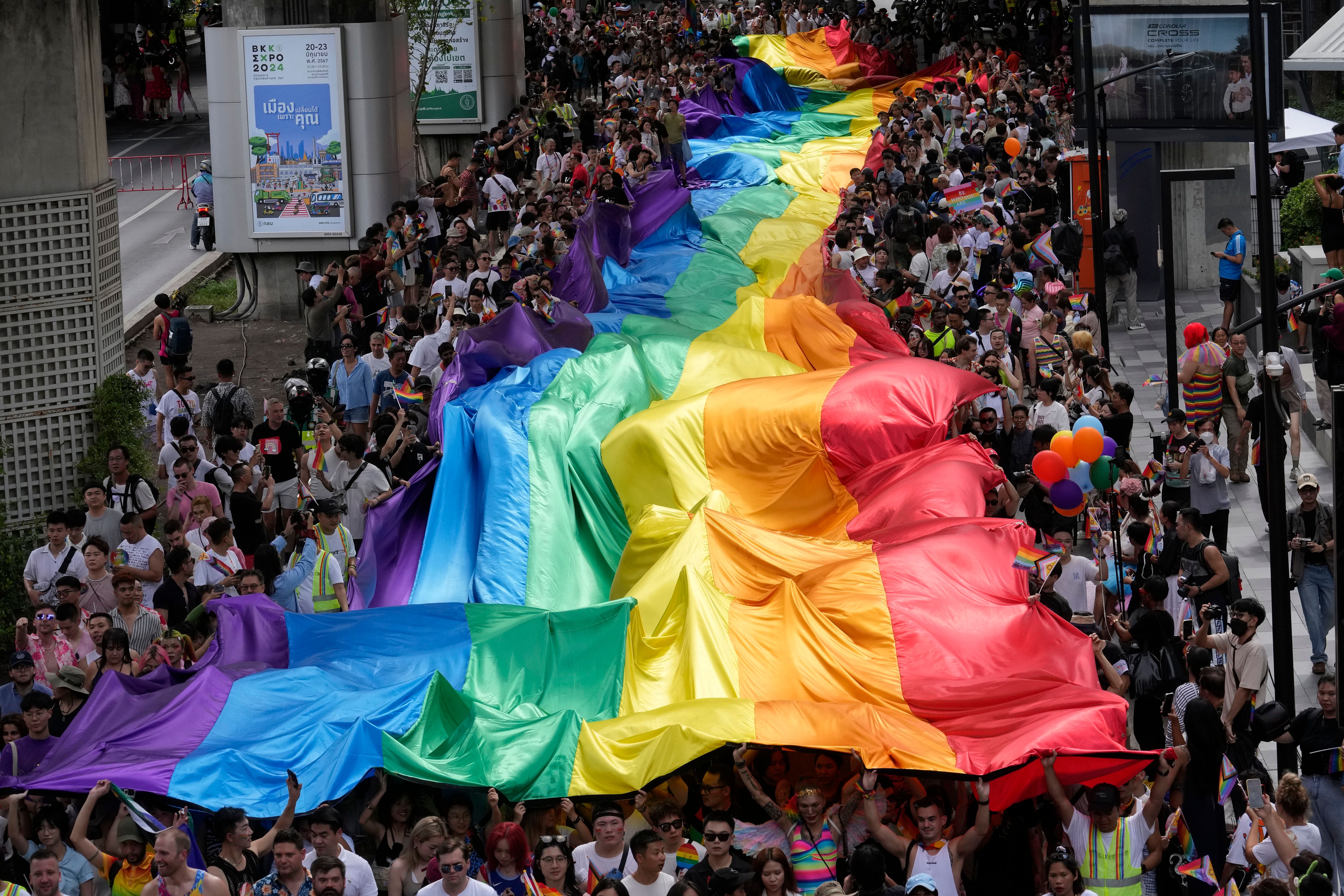
Participants hold a rainbow flag during the Pride Parade in Bangkok, Thailand, Saturday, June 1, 2024. Thailand is kicking off its celebration for the LGBTQ+ community's Pride Month with a parade on Saturday, as the country is on the course to become the first nation in Southeast Asia to legalize marriage equality. (AP Photo/Sakchai Lalit)

BANGKOK (AP) — Thailand kicked off its celebration of the LGBTQ+ community's Pride Month with a parade Saturday, as the country is on course to become the first nation in Southeast Asia to legalize marriage equality.
The annual Bangkok Pride Parade Can filled one side of a major thoroughfare with a colorful parade for several hours in one of the Thai capital's busiest commercial districts. Pride Month celebrations have been endorsed by politicians, government agencies and some of the country's biggest business conglomerates, which have become official partners or sponsors for the celebration.
Ann "Waaddao" Chumaporn, who has been organizing Bangkok Pride since 2022, said in a recent interview with The Associated Press that she hopes the parade can be "a platform that allows everyone to call out for what they want and express who they really are."
Waaddao thinks Thai society has shifted a lot from a decade ago, and the issue has now become a fashionable social and business trend.
Thanks in part to her work, a marriage equality bill granting full legal, financial and medical rights for marriage partners of any gender could become reality sometime this year.
But the public celebration of gender diversity was not always so popular in Thailand despite its long-standing reputation as an LGBTQ+ friendly country.
The first big celebration for the community in Thailand was held on Halloween weekend in 1999 and called the "Bangkok Gay Festival." It was organized by Pakorn Pimton, who said that after seeing Pride parades on his overseas travels, he wanted Thailand to have one, too.
It was hard organizing such an event back then, when Thai society was much less open, he said.
"Everyone told me, even my boyfriend, that it would be impossible," he said in an interview with AP.
Organizing such an event in a public space requires permission from authorities, and it didn't go that smoothly for Pakorn, yet he eventually pulled it off.
Pakorn said some police officers treated him well, but there were others who gave him dirty looks, or were dismissive. He recalled hearing one officer say, "Why do you even need to do this? These katoey ..."
"Katoey," whose rough equivalent in English would be "ladyboy," has generally been used as a slur against transgender women or gay men with feminine appearances, although the word now has been claimed by the community.
After getting the permit, Pakorn, who then was actively working in show business, said he tried contacting television stations for advertising and finding sponsors for his project, but they all rejected him.
"There were no mobile phones, no Facebook, no nothing. There were only posters that I had to put up at gay bars," he said.
Because of that, Pakorn said, he was bewildered to see thousands of people, not only Thais but many foreigners, take to downtown Bangkok's streets for that first celebration in colorful and racy costumes, carrying balloons and dancing on fancy floats.

thailand1.jpg
Thailand's Prime Minister Srettha Thavisin, center, raises his hand during the Pride Parade in Bangkok, Thailand, Saturday, June 1, 2024. Thailand is kicking off its celebration for the LGBTQ+ community's Pride Month with a parade on Saturday, as the country is on the course to become the first nation in Southeast Asia to legalize marriage equality. (AP Photo/Sakchai Lalit)

The event got attention from both domestic and international media as both Thailand's first gay parade and one of the first in Asia. It was described as energetic and chaotic, not least because the police did not completely close it off from traffic, resulting in marchers, dancers and floats weaving their way through moving buses, cars and motorbikes.
Pakorn organized it for several more years but eventually stopped.
Only recently did the political significance behind the term "Pride" gain much importance in the event, said Vitaya Saeng-Aroon, director of an advocacy group Diversity In Thailand.
Previously, there were not a lot of organized LGBTQ+ communities who joined in, "so there were no messages in the parade. It became like a party just for fun," he said.
Now the parade carries a more political tone because the observance has been organized by people like Waaddao who have long worked to raise awareness on gender equality and diversity.
For her part, Waaddao said she became inspired to organize the parade after taking part in the youth-led pro-democracy protests that sprang up across the country in 2020. She said she had previously been carrying out her advocacy work mostly in conference rooms, but those protests convinced her that street action can also advance a political agenda.
Although the pro-democracy movement lost steam due to the coronavirus pandemic and repression, Waaddao decided to continue the struggle for equal marriage and gender equality, ushering in a new era for Pride activities in 2022.
That was the year that several draft bills for marriage equality or civil partnership were introduced in Parliament. Although none managed to pass during the government then in power, a marriage equality bill sponsored by the current administration is expected to get through second and third readings by the Senate later this month, its last legislative hurdle before getting royal endorsement and becoming law.
 

ADVERTISEMENT
.most-popular .layout-ratio{ padding-bottom: 79.13%; } @media (min-width: 768px) and (max-width: 1024px) { .widget-title { font-size: 15px !important; } }

{{ articles_filter_1561_widget.title }}

.most-popular .layout-ratio{ padding-bottom: 79.13%; } @media (min-width: 768px) and (max-width: 1024px) { .widget-title { font-size: 15px !important; } }

{{ articles_filter_1562_widget.title }}

.most-popular .layout-ratio{ padding-bottom: 79.13%; } @media (min-width: 768px) and (max-width: 1024px) { .widget-title { font-size: 15px !important; } }

{{ articles_filter_1563_widget.title }}

{{ articles_filter_1564_widget.title }}

.mb-article-details { position: relative; } .mb-article-details .article-body-preview, .mb-article-details .article-body-summary{ font-size: 17px; line-height: 30px; font-family: "Libre Caslon Text", serif; color: #000; } .mb-article-details .article-body-preview iframe , .mb-article-details .article-body-summary iframe{ width: 100%; margin: auto; } .read-more-background { background: linear-gradient(180deg, color(display-p3 1.000 1.000 1.000 / 0) 13.75%, color(display-p3 1.000 1.000 1.000 / 0.8) 30.79%, color(display-p3 1.000 1.000 1.000) 72.5%); position: absolute; height: 200px; width: 100%; bottom: 0; display: flex; justify-content: center; align-items: center; padding: 0; } .read-more-background a{ color: #000; } .read-more-btn { padding: 17px 45px; font-family: Inter; font-weight: 700; font-size: 18px; line-height: 16px; text-align: center; vertical-align: middle; border: 1px solid black; background-color: white; } .hidden { display: none; }
function initializeAllSwipers() { // Get all hidden inputs with cms_article_id document.querySelectorAll('[id^="cms_article_id_"]').forEach(function (input) { const cmsArticleId = input.value; const articleSelector = '#article-' + cmsArticleId + ' .body_images'; const swiperElement = document.querySelector(articleSelector); if (swiperElement && !swiperElement.classList.contains('swiper-initialized')) { new Swiper(articleSelector, { loop: true, pagination: false, navigation: { nextEl: '#article-' + cmsArticleId + ' .swiper-button-next', prevEl: '#article-' + cmsArticleId + ' .swiper-button-prev', }, }); } }); } setTimeout(initializeAllSwipers, 3000); const intersectionObserver = new IntersectionObserver( (entries) => { entries.forEach((entry) => { if (entry.isIntersecting) { const newUrl = entry.target.getAttribute("data-url"); if (newUrl) { history.pushState(null, null, newUrl); let article = entry.target; // Extract metadata const author = article.querySelector('.author-section').textContent.replace('By', '').trim(); const section = article.querySelector('.section-info ').textContent.replace(' ', ' '); const title = article.querySelector('.article-title h1').textContent; // Parse URL for Chartbeat path format const parsedUrl = new URL(newUrl, window.location.origin); const cleanUrl = parsedUrl.host + parsedUrl.pathname; // Update Chartbeat configuration if (typeof window._sf_async_config !== 'undefined') { window._sf_async_config.path = cleanUrl; window._sf_async_config.sections = section; window._sf_async_config.authors = author; } // Track virtual page view with Chartbeat if (typeof pSUPERFLY !== 'undefined' && typeof pSUPERFLY.virtualPage === 'function') { try { pSUPERFLY.virtualPage({ path: cleanUrl, title: title, sections: section, authors: author }); } catch (error) { console.error('ping error', error); } } // Optional: Update document title if (title && title !== document.title) { document.title = title; } } } }); }, { threshold: 0.1 } ); function showArticleBody(button) { const article = button.closest("article"); const summary = article.querySelector(".article-body-summary"); const body = article.querySelector(".article-body-preview"); const readMoreSection = article.querySelector(".read-more-background"); // Hide summary and read-more section summary.style.display = "none"; readMoreSection.style.display = "none"; // Show the full article body body.classList.remove("hidden"); } document.addEventListener("DOMContentLoaded", () => { let loadCount = 0; // Track how many times articles are loaded const offset = [1, 2, 3, 4, 5, 6, 7, 8, 9, 10]; // Offset values const currentUrl = window.location.pathname.substring(1); let isLoading = false; // Prevent multiple calls if (!currentUrl) { console.log("Current URL is invalid."); return; } const sentinel = document.getElementById("load-more-sentinel"); if (!sentinel) { console.log("Sentinel element not found."); return; } function isSentinelVisible() { const rect = sentinel.getBoundingClientRect(); return ( rect.top < window.innerHeight && rect.bottom >= 0 ); } function onScroll() { if (isLoading) return; if (isSentinelVisible()) { if (loadCount >= offset.length) { console.log("Maximum load attempts reached."); window.removeEventListener("scroll", onScroll); return; } isLoading = true; const currentOffset = offset[loadCount]; window.loadMoreItems().then(() => { let article = document.querySelector('#widget_1690 > div:nth-last-of-type(2) article'); intersectionObserver.observe(article) loadCount++; }).catch(error => { console.error("Error loading more items:", error); }).finally(() => { isLoading = false; }); } } window.addEventListener("scroll", onScroll); });

Sign up by email to receive news.