






 Philippines
National
PH envoy urges PCA member-states to use dispute settlement facilities
Philippines
National
PH envoy urges PCA member-states to use dispute settlement facilities
PH envoy urges PCA member-states to use dispute settlement facilities
By Raymund Antonio and Raymund Antonio


Philippine Ambassador to The Netherlands Eduardo Malaya urged member-states to use the Permanent Court of Arbitration’s (PCA) dispute settlement facilities to preserve and maintain peace, stability, and rule of law amid the challenges facing the world’s regions.
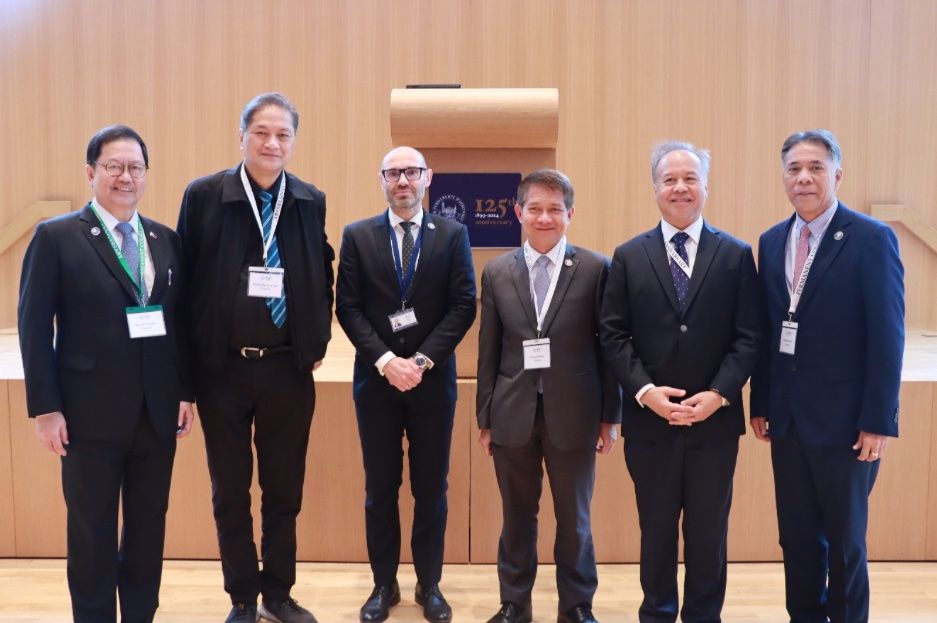
(From left) Solicitor General Menardo Guevarra, Dean Antonio Gabriel La Viña, Secretary General Czepelak, Ambassador Eduardo Malaya, Judge Raul Pangalangan, and Dean Sedfrey Candelaria during the Permanent Court of Arbitration’s (PCA) 125th year anniversary celebration at the Peace Palace in The Hague. (Photo courtesy of Amb. Malaya)
In his remarks during the opening session of the organization’s 125th year anniversary at the Peace Palace in The Hague, the envoy underscored the PCA’s contribution to the maintenance of peace and the development of international law.
“The PCA can be proud of its significant contributions to the peaceful settlement of disputes, as cited by the UN General Assembly in a unanimous resolution in August last year, as well as in the development of international law,” Malaya, who is also the acting President of the PCA Administrative Council, said.
He added that member-states must “more proactively support the PCA and its activities, and fully utilize its dispute settlement facilities in the interest of the maintenance and preservation of peace and the promotion of justice.”
In 2016, the Philippines was awarded a victory by an arbitral tribunal constituted under Annex VII of the United Nations Convention on the Law of the Sea (UNCLOS) with the PCA serving as registry over its opposition against China’s sweeping territorial and maritime claims in the West Philippine Sea.
In his remarks, Malaya also stressed the importance of international laws and dispute settlement facilities such as the PCA and the International Court of Justice (ICJ) in the states’ “diplomatic efforts to obtain and maintain peace.”
“With the resurgence of grave armed conflicts around the world, including in the doorsteps of Europe, it is our generation’s turn to carry on this solemn trust and collective duty to do our utmost for the cause of peace and justice and the rule of law, with the PCA – ‘accessible to all’ and ‘at all times’ — at the heart of this endeavor,” he added.
With the theme “A Court Fit for Its Time: Pursuing the Evolution of the Permanent Court of Arbitration for the Fulfilment of its Promise,” the event was attended by some 163 Members of the Court and Legal Advisers, representing 110 of the 123 Contracting Parties of the organization.
Malaya attended the event along with other Members of the Court from the Philippines, namely former ICC Judge Raul Pangalangan, former Ateneo Law Dean Sedfrey Candelaria, and former Ateneo School of Government Dean Antonio Gabriel La Vina.
Solicitor General Menardo Guevarra was also present as the Philippines’ legal adviser, accompanied by Assistant Solicitor General George Ortha and Senior State Solicitor Joel Villaceran.
According to the PCA, the Members of the Court are “potential arbitrators appointed by each Contracting Party who have known competency in questions of international law, of the highest moral reputation and disposed to accept the duties of arbitrators.”
It also constitutes a “national group” and is entitled to nominate candidates for the election to the International Court of Justice and other international tribunals, and the Nobel Peace Prize.
Established by the 1899 Convention on the Pacific Settlement of International Disputes, the PCA is the only intergovernmental organisation with the mandate to facilitate arbitration, conciliation, fact-finding and other dispute settlement resolution proceedings among various combinations of State, State entities, intergovernmental organisations and other private parties.
It has 123 Contracting Parties, including the Philippines which joined the PCA in 2010.
In 2023, the PCA received a record-breaking 82 new cases and handled 246 proceedings. It has one of the biggest caseloads among international courts and tribunals.