

ADVERTISEMENT

UK Labour leader Keir Starmer says he'll end the era of 'gestures and gimmicks' if he wins power

Published Jun 13, 2024 01:27 pm

MANCHESTER, England (AP) — The left-of-center politician aiming to become Britain’s prime minister in three weeks’ time said Thursday he will lead a government that’s both “pro-business and pro-worker” and restore stability after years of economic and political turmoil.
AP24165441434285.jpg
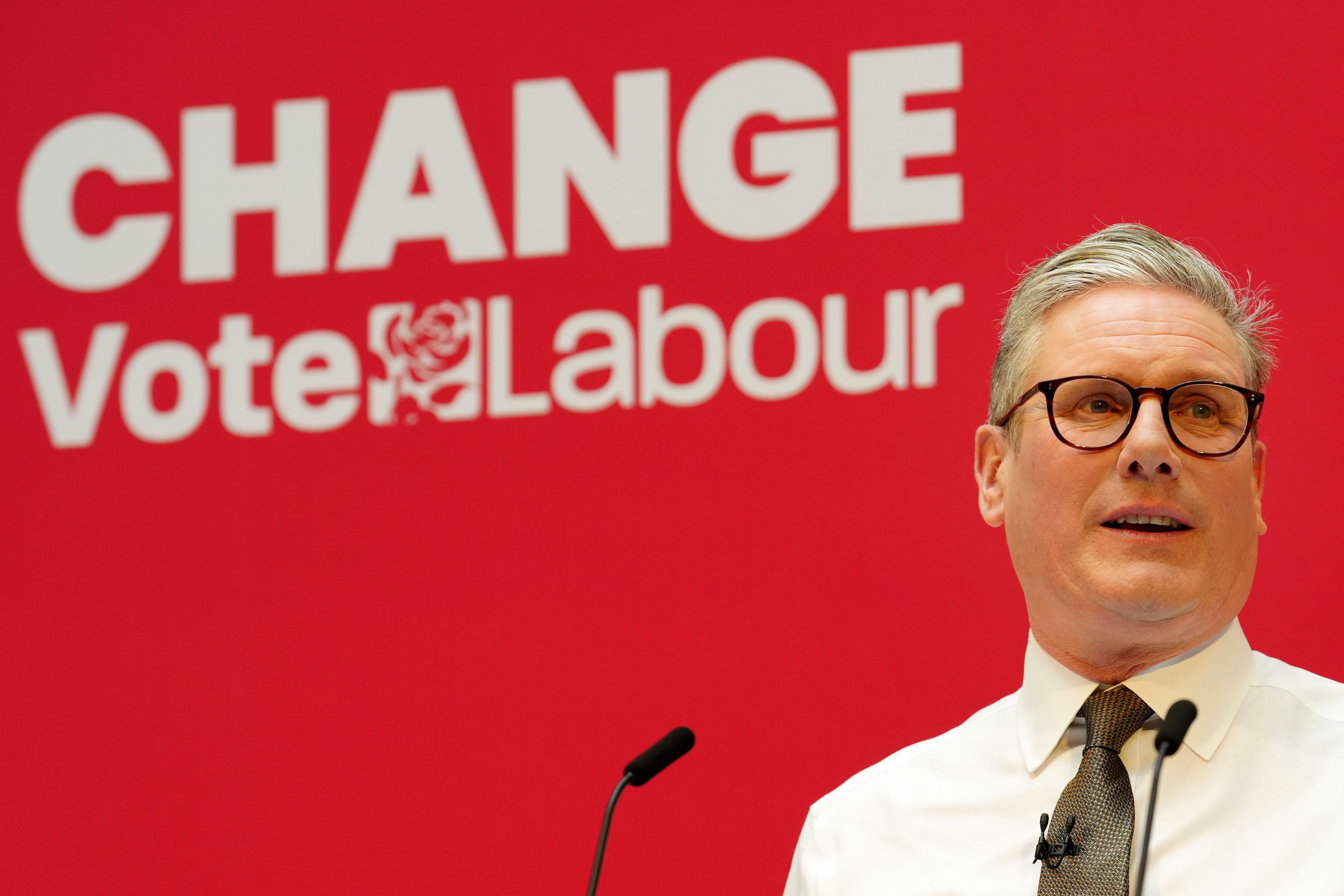
Britain's Labour Party leader Keir Starmer speaks on stage at the launch of The Labour party's 2024 general election manifesto in Manchester, England, Thursday, June 13, 2024. The election will take place on July 4. (AP Photo/Jon Super)

Labour Party leader Keir Starmer said that if he’s elected on July 4, he will end the “desperate era of gestures and gimmicks” of the Conservative Party’s turbulent tenure.

Launching Labour’s election manifesto in the northwest England city of Manchester, Starmer said a Labour government would “stop the chaos, turn the page and start to rebuild our country.”

Next month British voters will elect lawmakers to fill all 650 seats in the House of Commons, and the leader of the party that can command a majority — either alone or in coalition — will become prime minister. Labour currently has a double-digit lead in opinion polls over Prime Minister Rishi Sunak ’s governing Conservatives, who have been in power for 14 years under five different prime ministers.

The Conservatives jettisoned two prime ministers without an election in quick succession in 2022: first Boris Johnson, felled by scandals, then Liz Truss, who rocked the economy with drastic tax-slashing plans and lasted just seven weeks in office.

Starmer, a former chief prosecutor who is widely seen as competent but dull, is trying to turn his stolid image into an asset. His core message is that he has transformed Labour from its high-taxing, big-spending days under former leader Jeremy Corbyn into a party of the stable center.

Starmer said his platform was “a manifesto for wealth creation,” and acknowledged that a Labour government would face “hard choices” about public spending.

“We cannot play fast and loose with the public finances,” he said. He said he rejected the idea that “the only levers are tax and spend,” and would get the economy expanding after years of sluggish growth.

Starmer’s cautious economic approach dismays some in his party, who want bolder change, but has won the support of many business leaders.

Starmer called the party's platform a manifesto for “wealth creation,” and its ambitious goals were largely long-term ones: establishing a new industrial policy, developing a 10-year infrastructure strategy, building 1.5 million new homes.

Labour pledged to improve ties with Britain’s former partners in the European Union, but ruled out a return to the bloc’s frictionless single market and customs union.

The plan's spending commitments were modest. The manifesto forecasts that taxes will rise by 7.4 billion pounds ($9.25 billion) by 2028-29, through measures including by closing loopholes related to the recent abolition of the “non-domiciled” tax status, which has allowed some wealthy individuals to avoid paying U.K. taxes. The party is also planning to extend a windfall tax on energy companies.

Starmer said personal taxes would not rise under a Labour government, but that did not stop the Conservatives casting Labour as the high-tax party.

“If you think they’ll win, start saving,” Sunak wrote on X, formerly Twitter.

Starmer spoke at the headquarters of the Co-op, a Manchester-founded cooperative society that has grown into a large retail and services empire. He introduced several voters, including a father whose family of four live in a one-bedroom apartment, and Nathaniel Dye, a man with terminal cancer campaigning for faster treatment.

The only unscripted moment came from a demonstrator calling for Labour to have tougher climate change policies, who was swiftly removed.

Sunak released the Conservative manifesto — the party's key handbook of promises — on Tuesday, pledging to cut taxes and reduce immigration if the Conservative Party is reelected.

Labour's 131-page manifesto included previously announced plans, with little in the way of last-minute treats to woo voters.

“It’s not about rabbits out of a hat, it's not about pantomime,” Starmer said. “I’m running as a candidate to be prime minister, not a candidate to run the circus.”

Related Tags

WORLDNEWS
ADVERTISEMENT
.most-popular .layout-ratio{ padding-bottom: 79.13%; } @media (min-width: 768px) and (max-width: 1024px) { .widget-title { font-size: 15px !important; } }

{{ articles_filter_1561_widget.title }}

.most-popular .layout-ratio{ padding-bottom: 79.13%; } @media (min-width: 768px) and (max-width: 1024px) { .widget-title { font-size: 15px !important; } }

{{ articles_filter_1562_widget.title }}

.most-popular .layout-ratio{ padding-bottom: 79.13%; } @media (min-width: 768px) and (max-width: 1024px) { .widget-title { font-size: 15px !important; } }

{{ articles_filter_1563_widget.title }}

{{ articles_filter_1564_widget.title }}

.mb-article-details { position: relative; } .mb-article-details .article-body-preview, .mb-article-details .article-body-summary{ font-size: 17px; line-height: 30px; font-family: "Libre Caslon Text", serif; color: #000; } .mb-article-details .article-body-preview iframe , .mb-article-details .article-body-summary iframe{ width: 100%; margin: auto; } .read-more-background { background: linear-gradient(180deg, color(display-p3 1.000 1.000 1.000 / 0) 13.75%, color(display-p3 1.000 1.000 1.000 / 0.8) 30.79%, color(display-p3 1.000 1.000 1.000) 72.5%); position: absolute; height: 200px; width: 100%; bottom: 0; display: flex; justify-content: center; align-items: center; padding: 0; } .read-more-background a{ color: #000; } .read-more-btn { padding: 17px 45px; font-family: Inter; font-weight: 700; font-size: 18px; line-height: 16px; text-align: center; vertical-align: middle; border: 1px solid black; background-color: white; } .hidden { display: none; }
function initializeAllSwipers() { // Get all hidden inputs with cms_article_id document.querySelectorAll('[id^="cms_article_id_"]').forEach(function (input) { const cmsArticleId = input.value; const articleSelector = '#article-' + cmsArticleId + ' .body_images'; const swiperElement = document.querySelector(articleSelector); if (swiperElement && !swiperElement.classList.contains('swiper-initialized')) { new Swiper(articleSelector, { loop: true, pagination: false, navigation: { nextEl: '#article-' + cmsArticleId + ' .swiper-button-next', prevEl: '#article-' + cmsArticleId + ' .swiper-button-prev', }, }); } }); } setTimeout(initializeAllSwipers, 3000); const intersectionObserver = new IntersectionObserver( (entries) => { entries.forEach((entry) => { if (entry.isIntersecting) { const newUrl = entry.target.getAttribute("data-url"); if (newUrl) { history.pushState(null, null, newUrl); let article = entry.target; // Extract metadata const author = article.querySelector('.author-section').textContent.replace('By', '').trim(); const section = article.querySelector('.section-info ').textContent.replace(' ', ' '); const title = article.querySelector('.article-title h1').textContent; // Parse URL for Chartbeat path format const parsedUrl = new URL(newUrl, window.location.origin); const cleanUrl = parsedUrl.host + parsedUrl.pathname; // Update Chartbeat configuration if (typeof window._sf_async_config !== 'undefined') { window._sf_async_config.path = cleanUrl; window._sf_async_config.sections = section; window._sf_async_config.authors = author; } // Track virtual page view with Chartbeat if (typeof pSUPERFLY !== 'undefined' && typeof pSUPERFLY.virtualPage === 'function') { try { pSUPERFLY.virtualPage({ path: cleanUrl, title: title, sections: section, authors: author }); } catch (error) { console.error('ping error', error); } } // Optional: Update document title if (title && title !== document.title) { document.title = title; } } } }); }, { threshold: 0.1 } ); function showArticleBody(button) { const article = button.closest("article"); const summary = article.querySelector(".article-body-summary"); const body = article.querySelector(".article-body-preview"); const readMoreSection = article.querySelector(".read-more-background"); // Hide summary and read-more section summary.style.display = "none"; readMoreSection.style.display = "none"; // Show the full article body body.classList.remove("hidden"); } document.addEventListener("DOMContentLoaded", () => { let loadCount = 0; // Track how many times articles are loaded const offset = [1, 2, 3, 4, 5, 6, 7, 8, 9, 10]; // Offset values const currentUrl = window.location.pathname.substring(1); let isLoading = false; // Prevent multiple calls if (!currentUrl) { console.log("Current URL is invalid."); return; } const sentinel = document.getElementById("load-more-sentinel"); if (!sentinel) { console.log("Sentinel element not found."); return; } function isSentinelVisible() { const rect = sentinel.getBoundingClientRect(); return ( rect.top < window.innerHeight && rect.bottom >= 0 ); } function onScroll() { if (isLoading) return; if (isSentinelVisible()) { if (loadCount >= offset.length) { console.log("Maximum load attempts reached."); window.removeEventListener("scroll", onScroll); return; } isLoading = true; const currentOffset = offset[loadCount]; window.loadMoreItems().then(() => { let article = document.querySelector('#widget_1690 > div:nth-last-of-type(2) article'); intersectionObserver.observe(article) loadCount++; }).catch(error => { console.error("Error loading more items:", error); }).finally(() => { isLoading = false; }); } } window.addEventListener("scroll", onScroll); });

Sign up by email to receive news.