

ADVERTISEMENT

Korda makes 10 on one hole, posts 80 in U.S. Women's Open

Published May 31, 2024 02:39 am

At A Glance

  • Nelly Korda was not even three holes into the U.S. Women's Open when she dropped to a crouch and bowed her head in disbelief after her third straight shot — all of them from inside 70 feet away — tumbled into a stream.
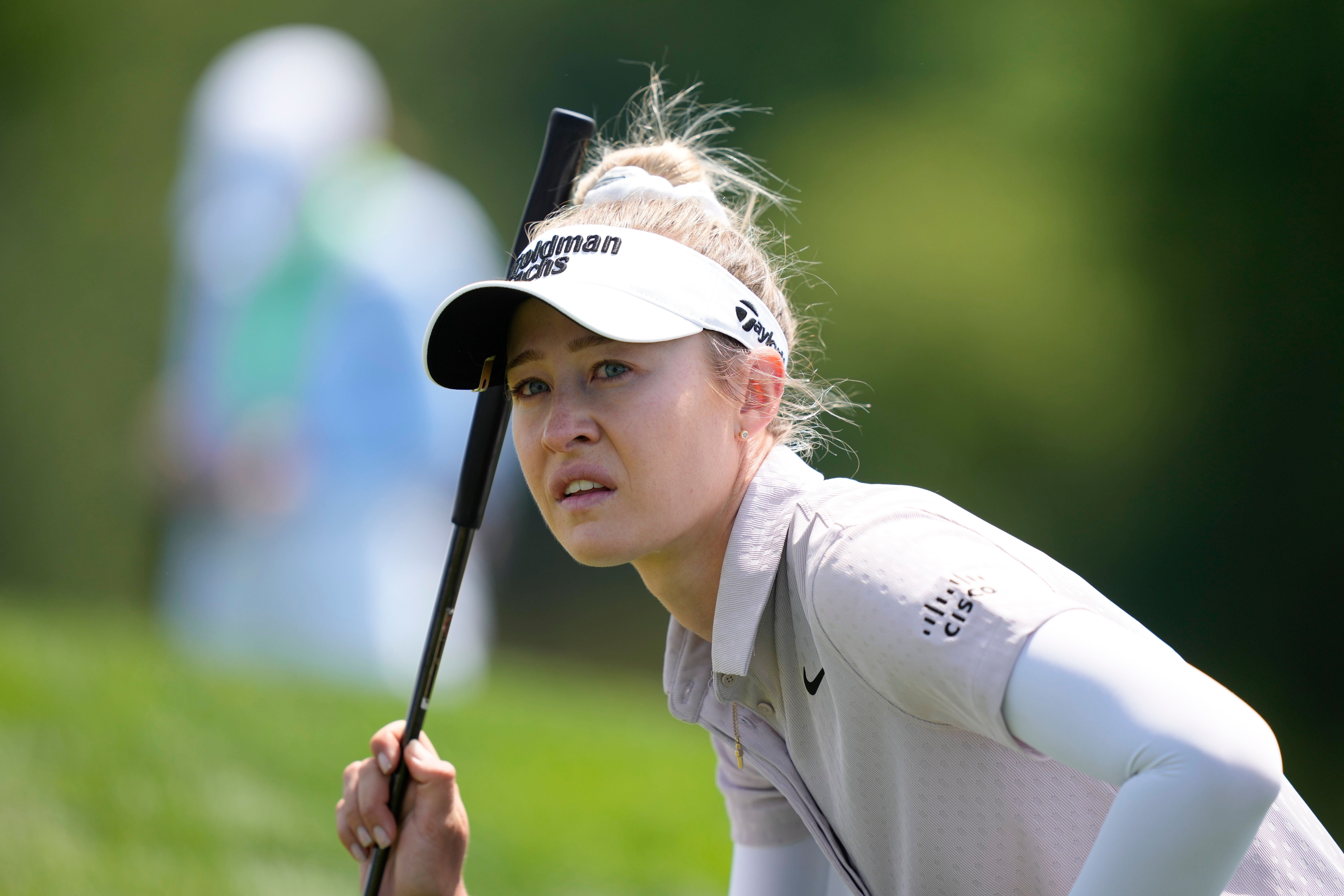
LANCASTER (AP) — Nelly Korda was not even three holes into the U.S. Women’s Open when she dropped to a crouch and bowed her head in disbelief after her third straight shot — all of them from inside 70 feet away — tumbled into a stream.

AP24151577743827.jpg
Nelly Korda measures her putt on the second green during the first round of the U.S. Women's Open golf tournament at Lancaster Country Club, Thursday, May 30, in Lancaster, Pa. (AP Photo/Matt Rourke)

She walked off the par-3 12th hole at Lancaster Country Club with a 10.

It didn’t get much better from there.

“Making a 10 on a par 3 will definitely not do you any good at a U.S. Open,” Korda said when her nightmare start to the biggest championship in women’s golf ended with an 80, leaving her 12 shots out of the lead.

“Just a bad day in the office.”

Korda came into the U.S. Women’s Open as an overwhelming favorite, with six victories in her last seven tournaments, including a major that tied an LPGA record for five wins in a row.

That’s what made the most imperfect 10 so shocking.

It didn’t help that two groups were on the tee at the 161-yard 12th hole — Korda had about a 25-minute wait — and she watched trouble unfold before she pulled a club. In the group ahead, Gaby Lopez came up short of the water. Ingrid Lindblad’s tee shot rolled into the water.

Korda curiously chose 6-iron — most players not as long as her hit 7-iron — and it took a hard hop into a back bunker. And then the trouble began.

Korda said she had a leaf under her golf ball, and the bunker shot came out a little hot and rolled — and rolled — past the front pin, off the false front and disappeared into the stream.

“Couldn’t really do anything about that,” she said. “Yeah, just hit some really bad chips, over and over again.”

She played a low pitch up the slope, but it banged into the hill and rolled back down into the water. She took another penalty drop, played another low pitch that was only slightly better, still not nearly enough to avoid rolling back into the water.

She got it right the third time, only to miss an 8-foot putt and take septuple-bogey 10. Korda walked off the green, removed her visor and placed her hand over her forehead for a few seconds, then headed to the 13th tee.

A video crew kept the camera fixed on the walking scorer as “+1” was changed to a “+8” next to her name.

She still had 15 holes ahead of her on a course that didn’t present a lot of scoring chances. Only three players from the morning wave broke par at 1-under 69. Her objective?

“I just didn’t really want to shoot 80,” Korda said. “And I just kept making bogeys.”

It was her second straight round of 80 in the U.S. Women’s Open, separated by 11 months and some 3,000 miles — Korda shot 80 in the final round at Pebble Beach last summer.

The only higher rounds in her career were 81 — one at the 2014 Kraft Nabisco Championship when she was 15, the other at the 2013 U.S. Women’s Open at age 14.

The 12th hole was playing the toughest for the opening round. The tee was moved forward and the pin was in the front of a green that slopes from back to front, with a slightly more severe pitch that sends balls into the creek.

It was playing nearly a full stroke over par as the afternoon groups began play. There also was some suspect execution on Korda’s part, starting with the club selection.

Sei Young Kim also watched the group ahead hit into the water, though that helped her realize the wind was stronger than it might have felt. She had 8-iron in her hand and then switched to a 7-iron, which she hit to 18 feet behind the flag.

Korda was between 7-iron and 6-iron, and took the stronger club, then moved back one length of the club.

“I just didn’t really know what to hit,” she said. “Sometimes it’s not really good seeing the girls play in front of you because of them — Gaby up short of the water, and I think Ingrid went into the water. It was just a tough day.”

She also flirted with trouble by playing the low pitch instead of a safer shot behind the hole.

Turns out that was only the start of her problems. She laid up in the rough on the par-5 13th and had to two-putt from 55 feet for par. She missed a 3-foot par putt on the 15th and a 5-foot par putt on the 17th.

Korda didn’t make her first birdie until her 12th hole, No. 3, when she holed a 12-foot putt and smiled with a mock celebration. Two holes later, however, she missed a 4-foot par putt and then nearly found the water on the par-3 sixth, leading to bogey.

Related Tags

US Women’s Open championship Nelly Korda
ADVERTISEMENT
.most-popular .layout-ratio{ padding-bottom: 79.13%; } @media (min-width: 768px) and (max-width: 1024px) { .widget-title { font-size: 15px !important; } }

{{ articles_filter_1561_widget.title }}

.most-popular .layout-ratio{ padding-bottom: 79.13%; } @media (min-width: 768px) and (max-width: 1024px) { .widget-title { font-size: 15px !important; } }

{{ articles_filter_1562_widget.title }}

.most-popular .layout-ratio{ padding-bottom: 79.13%; } @media (min-width: 768px) and (max-width: 1024px) { .widget-title { font-size: 15px !important; } }

{{ articles_filter_1563_widget.title }}

{{ articles_filter_1564_widget.title }}

.mb-article-details { position: relative; } .mb-article-details .article-body-preview, .mb-article-details .article-body-summary{ font-size: 17px; line-height: 30px; font-family: "Libre Caslon Text", serif; color: #000; } .mb-article-details .article-body-preview iframe , .mb-article-details .article-body-summary iframe{ width: 100%; margin: auto; } .read-more-background { background: linear-gradient(180deg, color(display-p3 1.000 1.000 1.000 / 0) 13.75%, color(display-p3 1.000 1.000 1.000 / 0.8) 30.79%, color(display-p3 1.000 1.000 1.000) 72.5%); position: absolute; height: 200px; width: 100%; bottom: 0; display: flex; justify-content: center; align-items: center; padding: 0; } .read-more-background a{ color: #000; } .read-more-btn { padding: 17px 45px; font-family: Inter; font-weight: 700; font-size: 18px; line-height: 16px; text-align: center; vertical-align: middle; border: 1px solid black; background-color: white; } .hidden { display: none; }
function initializeAllSwipers() { // Get all hidden inputs with cms_article_id document.querySelectorAll('[id^="cms_article_id_"]').forEach(function (input) { const cmsArticleId = input.value; const articleSelector = '#article-' + cmsArticleId + ' .body_images'; const swiperElement = document.querySelector(articleSelector); if (swiperElement && !swiperElement.classList.contains('swiper-initialized')) { new Swiper(articleSelector, { loop: true, pagination: false, navigation: { nextEl: '#article-' + cmsArticleId + ' .swiper-button-next', prevEl: '#article-' + cmsArticleId + ' .swiper-button-prev', }, }); } }); } setTimeout(initializeAllSwipers, 3000); const intersectionObserver = new IntersectionObserver( (entries) => { entries.forEach((entry) => { if (entry.isIntersecting) { const newUrl = entry.target.getAttribute("data-url"); if (newUrl) { history.pushState(null, null, newUrl); let article = entry.target; // Extract metadata const author = article.querySelector('.author-section').textContent.replace('By', '').trim(); const section = article.querySelector('.section-info ').textContent.replace(' ', ' '); const title = article.querySelector('.article-title h1').textContent; // Parse URL for Chartbeat path format const parsedUrl = new URL(newUrl, window.location.origin); const cleanUrl = parsedUrl.host + parsedUrl.pathname; // Update Chartbeat configuration if (typeof window._sf_async_config !== 'undefined') { window._sf_async_config.path = cleanUrl; window._sf_async_config.sections = section; window._sf_async_config.authors = author; } // Track virtual page view with Chartbeat if (typeof pSUPERFLY !== 'undefined' && typeof pSUPERFLY.virtualPage === 'function') { try { pSUPERFLY.virtualPage({ path: cleanUrl, title: title, sections: section, authors: author }); } catch (error) { console.error('ping error', error); } } // Optional: Update document title if (title && title !== document.title) { document.title = title; } } } }); }, { threshold: 0.1 } ); function showArticleBody(button) { const article = button.closest("article"); const summary = article.querySelector(".article-body-summary"); const body = article.querySelector(".article-body-preview"); const readMoreSection = article.querySelector(".read-more-background"); // Hide summary and read-more section summary.style.display = "none"; readMoreSection.style.display = "none"; // Show the full article body body.classList.remove("hidden"); } document.addEventListener("DOMContentLoaded", () => { let loadCount = 0; // Track how many times articles are loaded const offset = [1, 2, 3, 4, 5, 6, 7, 8, 9, 10]; // Offset values const currentUrl = window.location.pathname.substring(1); let isLoading = false; // Prevent multiple calls if (!currentUrl) { console.log("Current URL is invalid."); return; } const sentinel = document.getElementById("load-more-sentinel"); if (!sentinel) { console.log("Sentinel element not found."); return; } function isSentinelVisible() { const rect = sentinel.getBoundingClientRect(); return ( rect.top < window.innerHeight && rect.bottom >= 0 ); } function onScroll() { if (isLoading) return; if (isSentinelVisible()) { if (loadCount >= offset.length) { console.log("Maximum load attempts reached."); window.removeEventListener("scroll", onScroll); return; } isLoading = true; const currentOffset = offset[loadCount]; window.loadMoreItems().then(() => { let article = document.querySelector('#widget_1690 > div:nth-last-of-type(2) article'); intersectionObserver.observe(article) loadCount++; }).catch(error => { console.error("Error loading more items:", error); }).finally(() => { isLoading = false; }); } } window.addEventListener("scroll", onScroll); });

Sign up by email to receive news.