






 World
Ukraine gets more military aid from Europe but Putin warns of consequences if Russian soil is hit
World
Ukraine gets more military aid from Europe but Putin warns of consequences if Russian soil is hit
Ukraine gets more military aid from Europe but Putin warns of consequences if Russian soil is hit


LISBON, Portugal (AP) — Ukrainian President Volodymyr Zelenskyy received a second $1 billion promise of military aid in as many days Tuesday during a whirlwind tour of three European Union countries, while President Vladimir Putin warned that hitting Russian soil with Western-supplied weapons could set the war on a dangerous new path.
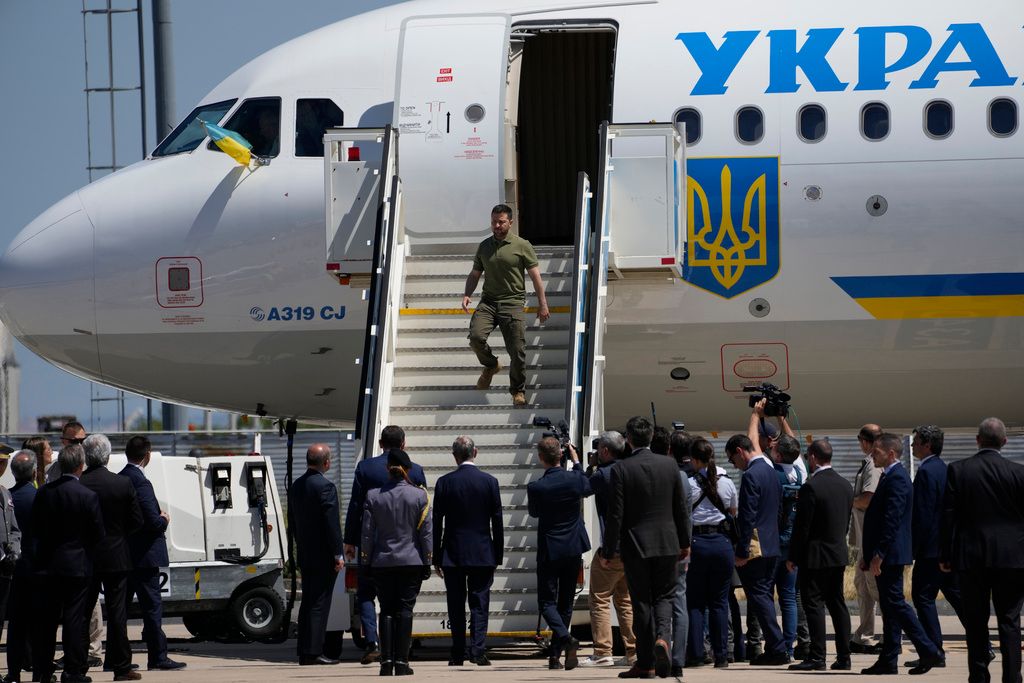
Ukrainian President Volodymyr Zelenskyy steps down from a plane on arrival at the military airport in Lisbon, Tuesday, May 28, 2024. (AP Photo/Armando Franca)
The aid pledge for 2024 came from Belgium, which topped up the money with a commitment to give Ukraine 30 F-16 fighter jets in the next four years.
“Our task is to use the first F-16 on the battlefield this year and in such way fortify our positions,” Zelenskyy said.
He later traveled to Portugal, where he said it was important that Ukraine’s supporters don’t allow themselves to be misled by Russia and that “we don’t grow tired of the war.”
The onslaught by the Kremlin's better-equipped forces that is unfolding in eastern and northeastern Ukraine as summer approaches has brought Ukraine its biggest military test since Russia’s full-scale invasion began in February 2022.
Slow deliveries of support by its Western partners, especially a lengthy delay in U.S. military aid, have left Ukraine at the mercy of Russia’s bigger army and air force.
European countries have been discussing the possibility of deploying troops to Ukraine in support roles, while talk of giving seized Russian assets to Ukraine has further angered Moscow.
Putin has repeatedly warned the West against deeper involvement in the fighting, holding out the specter of a nuclear conflict.
The use of Western-supplied long-range weapons by Ukraine to strike Russian territory could bring a dangerous escalation, Putin said Tuesday, speaking to reporters while on a trip to Uzbekistan.
The use of such weapons would rely on Western intelligence data and imply the involvement of NATO military personnel, Putin said, warning the alliance that they should be aware of the possible consequences.
“Representatives of countries that are NATO members, particularly in Europe, should be aware of what they are playing with,” he said, adding that “countries with small territory and dense populations” should be particularly careful.
The Netherlands promised to quickly assemble with key EU partners a Patriot air defense system, which Zelenskyy sees as key in stopping Russia from hitting Ukraine's power gridand civilian areas, as well as military targets, with devastating glide bombs.
NATO chief Jens Stoltenberg welcomed the move but insisted much more work was needed.
“We have seen some progress, but more progress and more air defense systems are urgently needed in Ukraine,” Stoltenberg said as he headed into a meeting of EU defense ministers.
Before returning to Ukraine, Zelenskyy visited Portugal and signed another bilateral agreement. Portugal is one of Western Europe’s poorest countries and has a small military compared with its bigger EU partners. Portuguese Prime Minister Luis Montenegro said Portugal is sending a further 126 million euros ($137 million) in military and financial aid to Kyiv as part of a broad cooperation plan.
On Monday, Zelenskyy signed a security agreement with Spain that allocates 1 billion euros ($1.1 billion) of military aid to Ukraine in 2024, and 5 billion euros ($5.4 billion) by 2027.
The bilateral aid is essential since the 27-nation bloc is again struggling to overcome Hungary's objections to the EU itself providing billions of euros in military aid to Kyiv.
An estimated 6.5 billion euros ($7 billion) are stalled by the Hungarian government of Prime Minister Viktor Orban, considered Russia’s staunchest ally in the EU. Single member states have wide veto powers, and Hungary has long held up funds aimed at boosting Ukraine’s defenses.
“That’s the sad thing that we have the cash, we have the capacity, but we are still pending decisions to implement” aid decisions for Ukraine, said EU foreign policy chief Josep Borrell.
Zelenskyy met with Belgian Prime Minister Alexander De Croo, and as well as the immediate money, he obtained a security agreement aimed at providing guarantees of military help until Ukraine joins NATO.
Since Russia launched a spring offensive in the northeastern Kharkiv region, Zelenskyy has insisted Ukraine urgently needs seven more U.S.-made Patriot air defense systems.
Putin says the Kremlin's forces are seeking to establish a “buffer zone” in Kharkiv to prevent Ukraine launching attacks across the border there.
Dutch Defense Minister Kajsa Ollongren, meeting with her EU colleagues, said a Patriot system will be built “in a short time frame.” The Netherlands has the core components for a Patriot system and other EU nations will contribute other key parts and munitions.
“Ukraine is also fighting Europe's fight,” she said.
Zelenskyy was to visit Belgium and Spain earlier this month but postponed all his foreign trips after Russia launched its Kharkiv offensive and left Ukrainian forces reeling.
In other developments, the U.N.'s atomic agency’s chief was in Russia's westernmost territory of Kaliningrad to talk about safety issues involving the Zaporizhzhia Nuclear Power Plant in Ukraine.
The plant has been occupied by the Russian forces since early in the war, and all of its reactors have been in a cold shutdown. Frequent shelling around Europe's largest nuclear plant has raised global concerns over nuclear security.
International Atomic Energy Agency Director-General Rafael Grossi met with Alexei Likhachyov, head of Russia’s state nuclear energy corporation Rosatom. The Russian state news agency RIA Novosti quoted Grossi as saying that “common understanding” has been reached on the steps that are necessary to enhance the plant’s security, but restarting it “seems impossible” at the moment.
Likhachyov echoed his sentiment on restarting the plant, but also vowed its current state is “absolutely safe.”