







4.6 million Filipinos affected by El Niño — DSWD


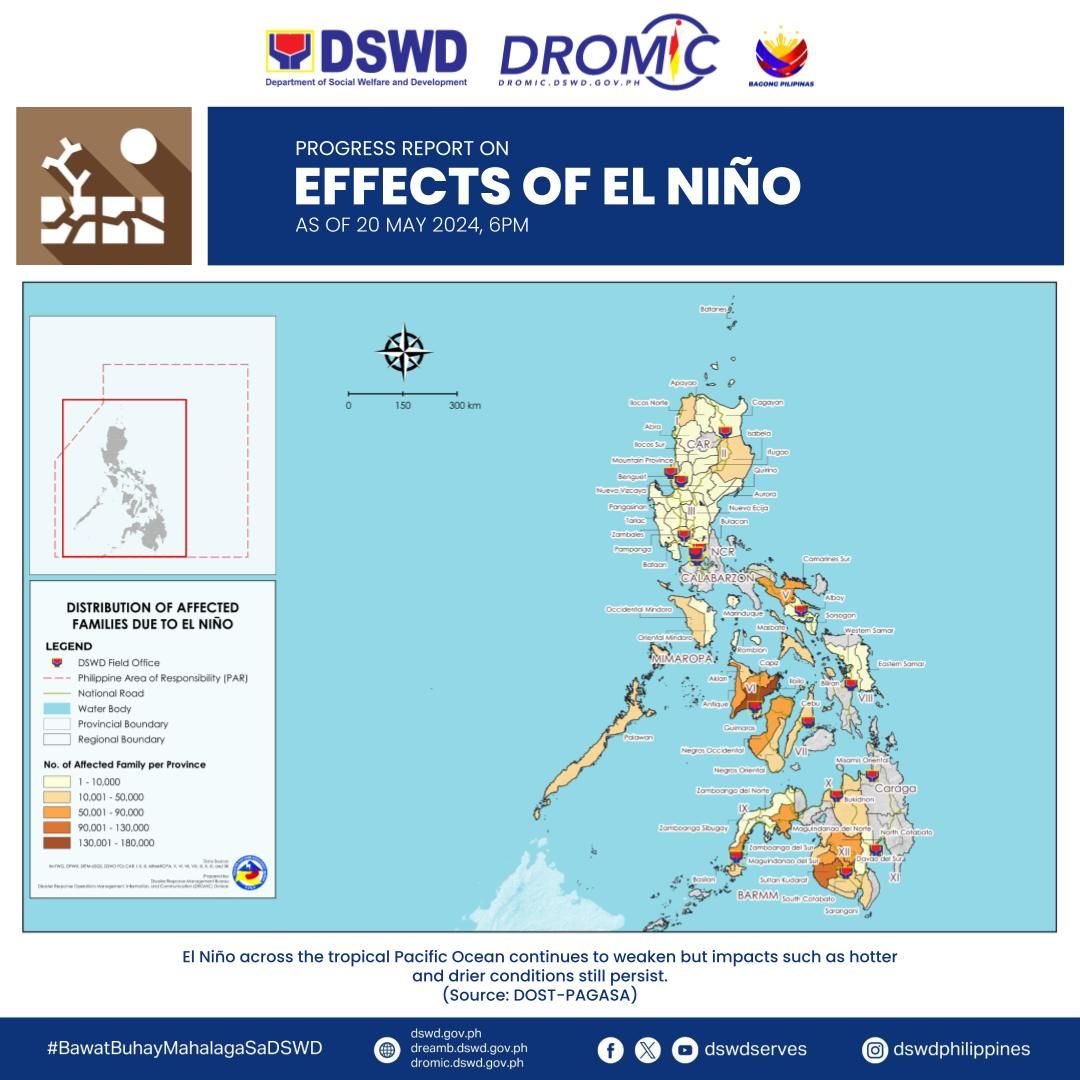
The Department of Social Welfare and Development (DSWD) said the El Niño phenomenon has affected at least 4.6 million Filipinos or 1.2 million households nationwide.
Based on the DSWD-Disaster Response Operations Monitoring and Information Center (DROMIC) report on Tuesday, May 21, those affected were from 6,141 barangays in Ilocos Region, Cagayan Valley, Central Luzon, Mimaropa (Oriental Mindoro, Occidental Mindoro, Marinduque, Romblon, Palawan), Bicol, Western Visayas, Eastern Visayas, Central Visayas, Zamboanga Peninsula, Northern Mindanao, Davao Region, Soccsksargen, Cordillera Administrative Region, and Bangsamoro Autonomous Region in Muslim Mindanao.
A total of P465.61 million worth of humanitarian assistance has been given to the affected families, of which P424.39 million were from DSWD, P33 million from local government units (LGUs), P1.7 million from non-government organizations (NGOs), and P6.4 million from its other partners.
DSWD still has P529.43 million in quick response funds available at the DSWD Central Office, while P78.49 million are available at DSWD field offices.
There are also around 298,000 family food packs available in disaster response centers, of which, 232,000 food packs are available at the National Resource Operations Center in Pasay City, and 65,000 food packs at the Visayas Disaster Resource Center in Mandaue City.
Likewise, 1.3 million food packs are available at all DSWD field offices.
PAGASA confirmed the presence of El Niño in July 2023.
The climate phenomenon has caused significant reductions in rainfall and drier-than-usual conditions, which led to dry spells and droughts across the country.