

ADVERTISEMENT

Meralco urges caution as 'Bill Reveal Challenge' trends on social media

Sharing Meralco bills online poses significant security risks, warns Secuna CEO

Published May 16, 2024 06:32 am

At A Glance

  • Revealing the Customer Account Number (CAN) on Meralco bills can expose users to identity theft and unauthorized access.
  • AJ Dumanhug, CEO of Secuna, warns that sharing the CAN allows others to potentially see your home address and access your Meralco account.
  • Meralco emphasizes the importance of protecting personal information and advises against posting images of bills online.
  • Malicious actors could use the CAN to commit fraud, make unauthorized bill payments, or launch social engineering attacks.
  • Meralco is actively educating customers on safeguarding their personal data and promoting responsible online behavior.
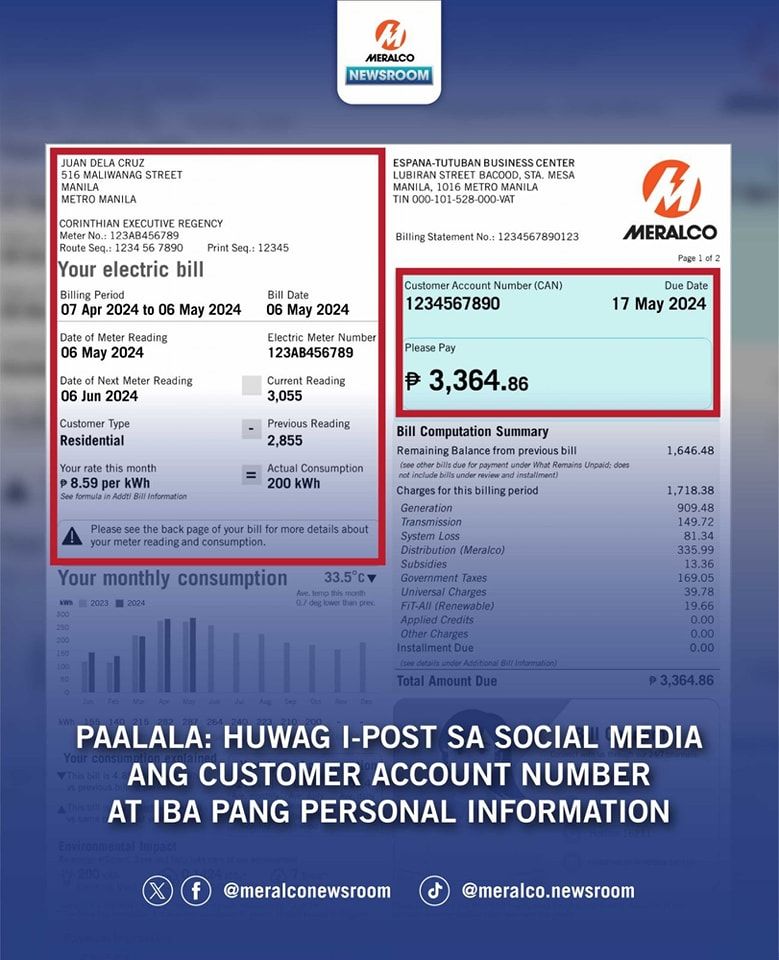
meralco.jpg
Avoid sharing your Meralco bill with the Customer Account Number (CAN) and other details online. Keeping this information private helps prevent identity theft and unauthorized access. 


A trend known as the "Meralco bill reveal challenge" has gained traction on social media platforms. Participants in this challenge post images of their bills without covering their Customer Account Number (CAN), which is typically found on their Meralco electricity bills. However, Meralco is cautioning customers about the potential risks associated with sharing such sensitive information online.

The "Bill Reveal Challenge" is a social media trend encouraging users to share their current electric bills in response to the country's ongoing heat wave. While the intention behind this challenge might be lighthearted or driven by a sense of fun, it poses significant security risks that participants should pay attention to.

AJ Dumanhug, co-founder and CEO of Secuna, an internet security company in the country, warns social media users about this. He said:  

"Please do not share your Meralco Customer Account Number (CAN) or your actual Meralco bill. Someone could see your home address if they enroll your CAN on https://online.meralco.com.ph/. I can't remember if there's a need to verify if you are the owner of the CAN, but it doesn't seem like there is. I'm also unsure if someone else can enroll your CAN if it's already enrolled in the owner's account." (A few minutes after Dumanhug's warning, the URL he shared was no longer accessible). 

Understanding the CAN's importance is crucial. The CAN is a unique identifier tied to a Meralco account, and revealing it can expose customers to potential fraud or unauthorized access. Malicious actors could misuse this information in several ways, such as committing identity theft, making unauthorized bill payments, or launching social engineering attacks to gather more personal information.

In its social media post, Meralco said protecting personal information is important and that it values customer privacy and data protection. The CAN and other details from the electricity bill can provide insights into consumption patterns, billing history, and other sensitive data. Keeping this information private is crucial to avoid any potential misuse.

Adopting best practices for safeguarding personal information is essential. Customers should avoid sharing their CAN and refrain from posting photos of their Meralco bill or any other documents containing sensitive information. It's also important to be cautious on social media, recognizing that once information is online, controlling who accesses it becomes challenging. Before posting, consider the potential consequences of publicly sharing personal details.

Meralco further said that it is actively working to educate its customers about the importance of safeguarding their personal data. The company emphasizes responsible online behavior and encourages customers to remain vigilant. By fostering awareness and promoting best practices, Meralco aims to help its customers protect themselves from the risks associated with sharing sensitive information online.

While participating in online challenges can be fun, it's essential to prioritize your privacy and security. Protecting your personal information, including your Meralco account details, is a shared responsibility. Let's all be mindful of what we share online and take steps to keep our data safe.

Remember: Think before you reveal!

ADVERTISEMENT
.most-popular .layout-ratio{ padding-bottom: 79.13%; } @media (min-width: 768px) and (max-width: 1024px) { .widget-title { font-size: 15px !important; } }

{{ articles_filter_1561_widget.title }}

.most-popular .layout-ratio{ padding-bottom: 79.13%; } @media (min-width: 768px) and (max-width: 1024px) { .widget-title { font-size: 15px !important; } }

{{ articles_filter_1562_widget.title }}

.most-popular .layout-ratio{ padding-bottom: 79.13%; } @media (min-width: 768px) and (max-width: 1024px) { .widget-title { font-size: 15px !important; } }

{{ articles_filter_1563_widget.title }}

{{ articles_filter_1564_widget.title }}

.mb-article-details { position: relative; } .mb-article-details .article-body-preview, .mb-article-details .article-body-summary{ font-size: 17px; line-height: 30px; font-family: "Libre Caslon Text", serif; color: #000; } .mb-article-details .article-body-preview iframe , .mb-article-details .article-body-summary iframe{ width: 100%; margin: auto; } .read-more-background { background: linear-gradient(180deg, color(display-p3 1.000 1.000 1.000 / 0) 13.75%, color(display-p3 1.000 1.000 1.000 / 0.8) 30.79%, color(display-p3 1.000 1.000 1.000) 72.5%); position: absolute; height: 200px; width: 100%; bottom: 0; display: flex; justify-content: center; align-items: center; padding: 0; } .read-more-background a{ color: #000; } .read-more-btn { padding: 17px 45px; font-family: Inter; font-weight: 700; font-size: 18px; line-height: 16px; text-align: center; vertical-align: middle; border: 1px solid black; background-color: white; } .hidden { display: none; }
function initializeAllSwipers() { // Get all hidden inputs with cms_article_id document.querySelectorAll('[id^="cms_article_id_"]').forEach(function (input) { const cmsArticleId = input.value; const articleSelector = '#article-' + cmsArticleId + ' .body_images'; const swiperElement = document.querySelector(articleSelector); if (swiperElement && !swiperElement.classList.contains('swiper-initialized')) { new Swiper(articleSelector, { loop: true, pagination: false, navigation: { nextEl: '#article-' + cmsArticleId + ' .swiper-button-next', prevEl: '#article-' + cmsArticleId + ' .swiper-button-prev', }, }); } }); } setTimeout(initializeAllSwipers, 3000); const intersectionObserver = new IntersectionObserver( (entries) => { entries.forEach((entry) => { if (entry.isIntersecting) { const newUrl = entry.target.getAttribute("data-url"); if (newUrl) { history.pushState(null, null, newUrl); let article = entry.target; // Extract metadata const author = article.querySelector('.author-section').textContent.replace('By', '').trim(); const section = article.querySelector('.section-info ').textContent.replace(' ', ' '); const title = article.querySelector('.article-title h1').textContent; // Parse URL for Chartbeat path format const parsedUrl = new URL(newUrl, window.location.origin); const cleanUrl = parsedUrl.host + parsedUrl.pathname; // Update Chartbeat configuration if (typeof window._sf_async_config !== 'undefined') { window._sf_async_config.path = cleanUrl; window._sf_async_config.sections = section; window._sf_async_config.authors = author; } // Track virtual page view with Chartbeat if (typeof pSUPERFLY !== 'undefined' && typeof pSUPERFLY.virtualPage === 'function') { try { pSUPERFLY.virtualPage({ path: cleanUrl, title: title, sections: section, authors: author }); } catch (error) { console.error('ping error', error); } } // Optional: Update document title if (title && title !== document.title) { document.title = title; } } } }); }, { threshold: 0.1 } ); function showArticleBody(button) { const article = button.closest("article"); const summary = article.querySelector(".article-body-summary"); const body = article.querySelector(".article-body-preview"); const readMoreSection = article.querySelector(".read-more-background"); // Hide summary and read-more section summary.style.display = "none"; readMoreSection.style.display = "none"; // Show the full article body body.classList.remove("hidden"); } document.addEventListener("DOMContentLoaded", () => { let loadCount = 0; // Track how many times articles are loaded const offset = [1, 2, 3, 4, 5, 6, 7, 8, 9, 10]; // Offset values const currentUrl = window.location.pathname.substring(1); let isLoading = false; // Prevent multiple calls if (!currentUrl) { console.log("Current URL is invalid."); return; } const sentinel = document.getElementById("load-more-sentinel"); if (!sentinel) { console.log("Sentinel element not found."); return; } function isSentinelVisible() { const rect = sentinel.getBoundingClientRect(); return ( rect.top < window.innerHeight && rect.bottom >= 0 ); } function onScroll() { if (isLoading) return; if (isSentinelVisible()) { if (loadCount >= offset.length) { console.log("Maximum load attempts reached."); window.removeEventListener("scroll", onScroll); return; } isLoading = true; const currentOffset = offset[loadCount]; window.loadMoreItems().then(() => { let article = document.querySelector('#widget_1690 > div:nth-last-of-type(2) article'); intersectionObserver.observe(article) loadCount++; }).catch(error => { console.error("Error loading more items:", error); }).finally(() => { isLoading = false; }); } } window.addEventListener("scroll", onScroll); });

Sign up by email to receive news.