ADVERTISEMENT

Critically endangered Philippine eagle rescued in Apayao—DENR

Published Apr 7, 2024 08:08 am
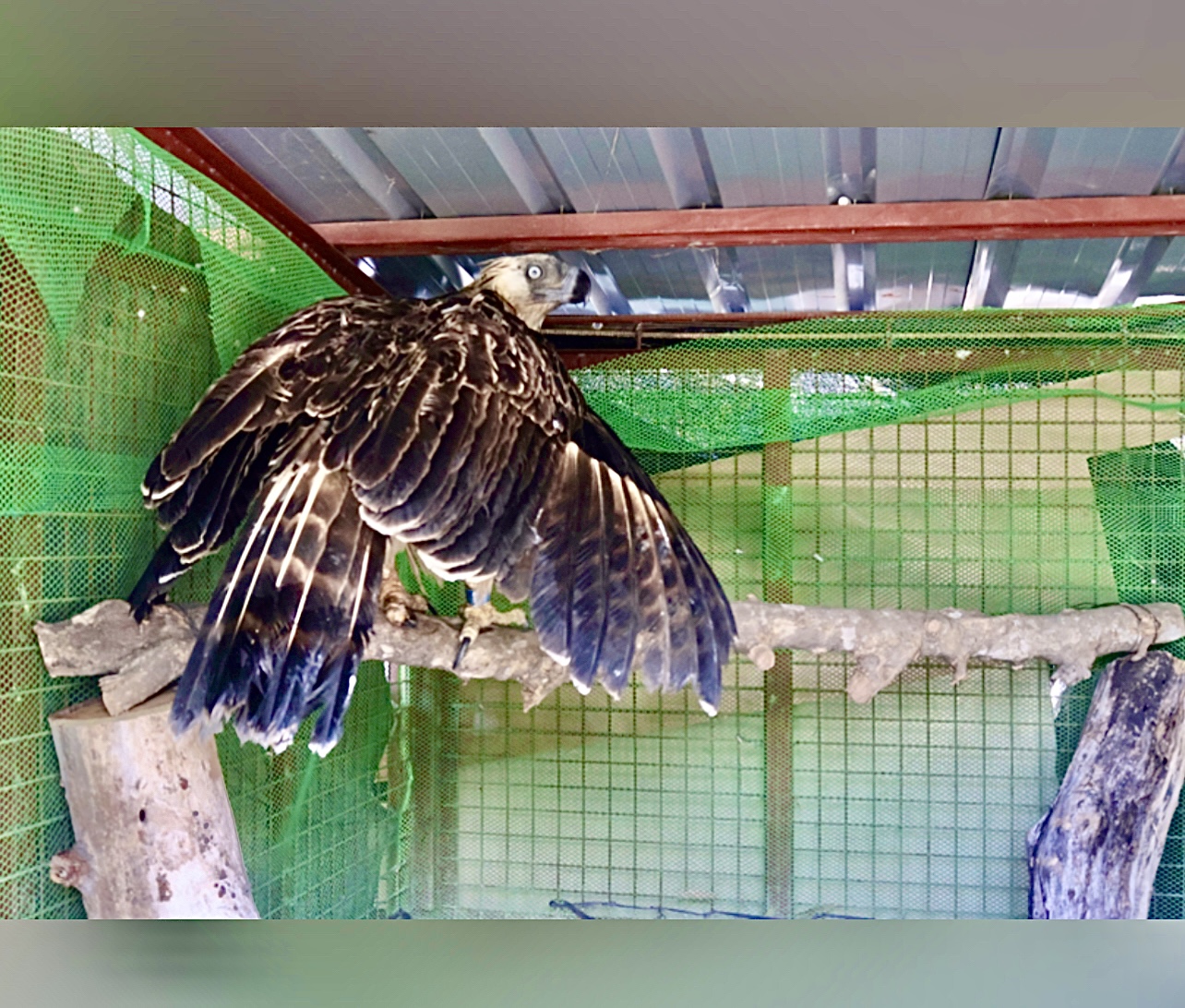
IMG_7435.jpeg
(Photo courtesy of PEF)

A critically endangered Philippine eagle has been rescued by authorities from a farmer in Barangay Bulu, Kabugao town in Apayao, the Department of Environment and Natural Resources (DENR) announced on Sunday, April 7.

Philippine Eagle Foundation (PEF) director for operations, Dr. Jayson Ibañez, said the joint rescue operation was conducted by the DENR, local governments of Apayao and Kabugao, PEF, and concerned citizens on March 19.

According to PEF, 38-year-old Ariel Puglay Silaw, a farmer, told authorities that he accidentally caught a Philippine eagle on March 16 in a nylon noose trap or "silo" he set up to catch wild pigs in the forests of Mt. Mabagyaw.

Silaw reportedly went to the City Environment & Natural Resources Office (CENRO) Conner to report that he accidentally caught a critically endangered bird.

Ibañez said the the farmer housed the eagle in a small wooden crate with planks of wood. Silaw said he fed the eagle duck meat.

Around 5 a.m. of March 19, Rainier Balbuena of  Provincial Environment & Natural Resources(PENRO) Apayao, PEF staff Guiller Opiso and Susanna Legaspi and Provincial Veterinarians in Apayao  went to the house of the farmer to rescue the eagle.

The PEF noted that the rescued eagle was docile and did not resist capture, indicating that the eagle is “weak and might be in pain.”

Per Ibanez, the rescue team immediately brought the bird to in Laoag City for x-ray, medical assessment and temporary rehabilitation.  

During the X-ray of the bird taken at the Ranada Hospital, three air gun bullets were found embedded in the eagle's skin and visible in the plates.

“The absence of fresh entry wounds suggest that the bird was shot a considerably long time ago. Fortunately, no bone fractures were noted,” Ibanez reported.

Upon physical examination of the eagle, it was discovered that “the bird had inflamed left shank (leg) with slight hematoma, ruffled feathers indicating stress, a prominent “brood patch” indicating that the eagle is female and may be incubating an egg or brooding a very young chick when captured, and maggots and flies at its inguinal region.”

Veterinarians reportedly administered first aid and gave fluids, antibiotics and vitamins to the injured eagle.

Ibanez said the veterinarians secured blood samples and cloacal and oral swabs, too.

“The samples were then brought to the Regional Animal Disease Diagnostic Laboratory (RADDL) of the Bureau of Animal Industry in Carig, Tuguegarao City for Avian Flu and New Castles Disease Screening. Blood samples were also sent to the UP Diliman Institute of Biology in Quezon City for confirmatory DNA sexing,” he added.

Rowell Taraya, PEF’s field biologist,  did the feather count and found complete sets of left and right feather wings with a growing primary feather at the right wing, and complete set of tail feathers with one distorted feather at the right side.

The injured eagle was nursed back to health by authorities.

Ibañez said the eagle has now fully recovered and is cleared of Avian Flu and New Castles Disease by BAI Region 2.

The eagle, he said, is set to be released back to her suspected territory in Kabugao on April 12.

“A solar-powered GPS-GSM tracker will be installed on her backpack style before her release,” the PEF director stated.

The Philippine eagle (Pithecophaga jefferyi), one of the rarest and most powerful birds of prey in the world, is critically endangered.

It was classified as critically endangered based on assessments made by organizations such as the International Union for Conservation of Nature (IUCN).

The IUCN Red List, widely regarded as the most comprehensive inventory of species' conservation status worldwide, assesses the extinction risk of thousands of species and continuously updates their classifications based on the most recent scientific data and conservation assessments.

The Republic Act No. 9147  or the Wildlife Resources Conservation and Protection Act provides legal protection for the Philippine eagle, making it illegal to hunt, kill, capture, possess, sell, transport, or trade the bird without proper authorization.

As such, the Philippine eagle is listed in Appendix I of the Convention on International Trade in Endangered Species of Wild Fauna and Flora (CITES), which prohibits international trade in this species except under exceptional circumstances for scientific research or conservation purposes.

ADVERTISEMENT
.most-popular .layout-ratio{ padding-bottom: 79.13%; } @media (min-width: 768px) and (max-width: 1024px) { .widget-title { font-size: 15px !important; } }

{{ articles_filter_1561_widget.title }}

.most-popular .layout-ratio{ padding-bottom: 79.13%; } @media (min-width: 768px) and (max-width: 1024px) { .widget-title { font-size: 15px !important; } }

{{ articles_filter_1562_widget.title }}

.most-popular .layout-ratio{ padding-bottom: 79.13%; } @media (min-width: 768px) and (max-width: 1024px) { .widget-title { font-size: 15px !important; } }

{{ articles_filter_1563_widget.title }}

{{ articles_filter_1564_widget.title }}

.mb-article-details { position: relative; } .mb-article-details .article-body-preview, .mb-article-details .article-body-summary{ font-size: 17px; line-height: 30px; font-family: "Libre Caslon Text", serif; color: #000; } .mb-article-details .article-body-preview iframe , .mb-article-details .article-body-summary iframe{ width: 100%; margin: auto; } .read-more-background { background: linear-gradient(180deg, color(display-p3 1.000 1.000 1.000 / 0) 13.75%, color(display-p3 1.000 1.000 1.000 / 0.8) 30.79%, color(display-p3 1.000 1.000 1.000) 72.5%); position: absolute; height: 200px; width: 100%; bottom: 0; display: flex; justify-content: center; align-items: center; padding: 0; } .read-more-background a{ color: #000; } .read-more-btn { padding: 17px 45px; font-family: Inter; font-weight: 700; font-size: 18px; line-height: 16px; text-align: center; vertical-align: middle; border: 1px solid black; background-color: white; } .hidden { display: none; }
function initializeAllSwipers() { // Get all hidden inputs with cms_article_id document.querySelectorAll('[id^="cms_article_id_"]').forEach(function (input) { const cmsArticleId = input.value; const articleSelector = '#article-' + cmsArticleId + ' .body_images'; const swiperElement = document.querySelector(articleSelector); if (swiperElement && !swiperElement.classList.contains('swiper-initialized')) { new Swiper(articleSelector, { loop: true, pagination: false, navigation: { nextEl: '#article-' + cmsArticleId + ' .swiper-button-next', prevEl: '#article-' + cmsArticleId + ' .swiper-button-prev', }, }); } }); } setTimeout(initializeAllSwipers, 3000); const intersectionObserver = new IntersectionObserver( (entries) => { entries.forEach((entry) => { if (entry.isIntersecting) { const newUrl = entry.target.getAttribute("data-url"); if (newUrl) { history.pushState(null, null, newUrl); let article = entry.target; // Extract metadata const author = article.querySelector('.author-section').textContent.replace('By', '').trim(); const section = article.querySelector('.section-info ').textContent.replace(' ', ' '); const title = article.querySelector('.article-title h1').textContent; // Parse URL for Chartbeat path format const parsedUrl = new URL(newUrl, window.location.origin); const cleanUrl = parsedUrl.host + parsedUrl.pathname; // Update Chartbeat configuration if (typeof window._sf_async_config !== 'undefined') { window._sf_async_config.path = cleanUrl; window._sf_async_config.sections = section; window._sf_async_config.authors = author; } // Track virtual page view with Chartbeat if (typeof pSUPERFLY !== 'undefined' && typeof pSUPERFLY.virtualPage === 'function') { try { pSUPERFLY.virtualPage({ path: cleanUrl, title: title, sections: section, authors: author }); } catch (error) { console.error('ping error', error); } } // Optional: Update document title if (title && title !== document.title) { document.title = title; } } } }); }, { threshold: 0.1 } ); function showArticleBody(button) { const article = button.closest("article"); const summary = article.querySelector(".article-body-summary"); const body = article.querySelector(".article-body-preview"); const readMoreSection = article.querySelector(".read-more-background"); // Hide summary and read-more section summary.style.display = "none"; readMoreSection.style.display = "none"; // Show the full article body body.classList.remove("hidden"); } document.addEventListener("DOMContentLoaded", () => { let loadCount = 0; // Track how many times articles are loaded const offset = [1, 2, 3, 4, 5, 6, 7, 8, 9, 10]; // Offset values const currentUrl = window.location.pathname.substring(1); let isLoading = false; // Prevent multiple calls if (!currentUrl) { console.log("Current URL is invalid."); return; } const sentinel = document.getElementById("load-more-sentinel"); if (!sentinel) { console.log("Sentinel element not found."); return; } function isSentinelVisible() { const rect = sentinel.getBoundingClientRect(); return ( rect.top < window.innerHeight && rect.bottom >= 0 ); } function onScroll() { if (isLoading) return; if (isSentinelVisible()) { if (loadCount >= offset.length) { console.log("Maximum load attempts reached."); window.removeEventListener("scroll", onScroll); return; } isLoading = true; const currentOffset = offset[loadCount]; window.loadMoreItems().then(() => { let article = document.querySelector('#widget_1690 > div:nth-last-of-type(2) article'); intersectionObserver.observe(article) loadCount++; }).catch(error => { console.error("Error loading more items:", error); }).finally(() => { isLoading = false; }); } } window.addEventListener("scroll", onScroll); });

Sign up by email to receive news.