ADVERTISEMENT

Philippines to hold joint patrol with Australia, Japan, United States

Published Apr 6, 2024 02:40 am
joint patrol wps.jpg
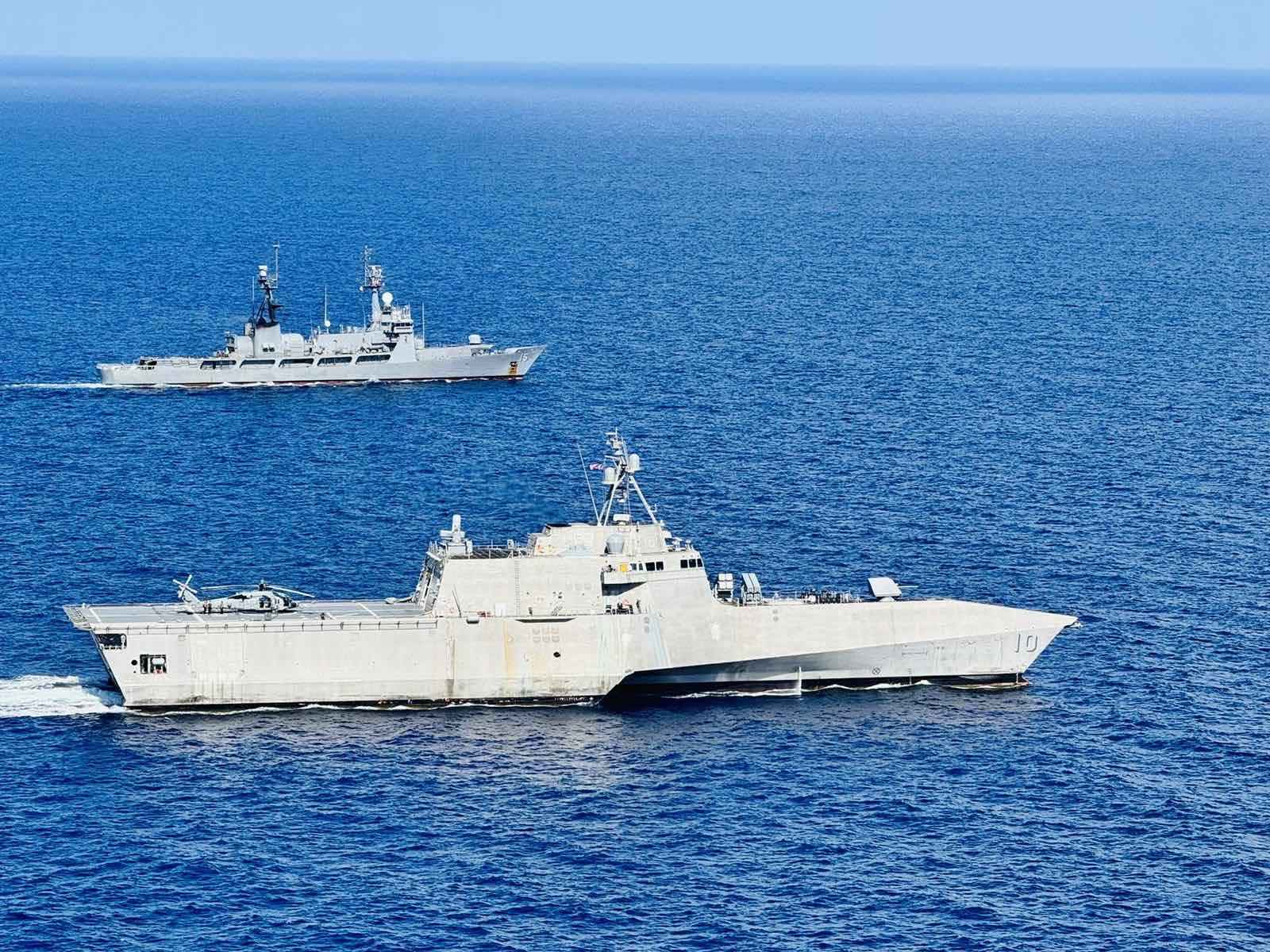
Philippine Navy ship BRP Gregorio del Pilar (PS15) and US Navy ship USS Gabrielle Giffords (LCs 10) sail together in the West Philippine Sea during the third Maritime Cooperative Activity (MCA) on Feb. 9, 2024. (Photo courtesy of Armed Forces of the Philippines)

The Philippines will hold a joint patrol operation with Australia, Japan, and the United States in its exclusive economic zone (EEZ) on Sunday, April 7, in what is perceived as the latest move by the four nations to counter China's growing presence in the region.

The patrol operation, dubbed as a Maritime Cooperative Activity (MCA), will be conducted by naval/maritime and air force units from the four countries, according to a joint statement by Department of National Defense (DND) Sec. Gilberto Teodoro Jr., Australia's Deputy Prime Minister and Minister for Defence Richard Marles, Japan's Minister for Defence Minoru Kihara, and US Secretary of Defense Lloyd James Austin III.

It will encompass the boundary of the Western Command (WesCom)'s area of responsibility in Palawan and the Northern Luzon Command (NoLCom).

Five ships will join the patrol namely BRP Greogorio del Pilar and BRP Ramon Alcaraz from the Philippines; littoral combat ship USS Mobile from the United States; HMAS Warramunga from Australia; and Japanese destroyer Akebono.

While on patrol, the vessels will engage in an array of activities including communication exercise, officer of the watch maneuver, and photo exercise.

The four defense chiefs said that the MCA will be held "in a manner that is consistent with international law as well as domestic laws and rules of respective nations, and with due regard to the safety of navigation and the rights and interests of other states."

They added that the four countries uphold the right to freedom of navigation and overflight, and respect for maritime rights under international law as reflected in the United Nations Convention on the Law of the Sea (UNCLOS). 

"We stand with all nations in safeguarding the international order – based on the rule of law – that is the foundation for a peaceful and stable Indo-Pacific region. Our four nations reaffirm the position regarding the 2016 South China Sea Arbitral Tribunal Award as a final and legally binding decision on the parties to the dispute," the statement read.

According to Teodoro, the MCA will be a first in a series of activities among the four countries, and is in line with the DND's Comprehensive Archipelagic Defense Concept (CADC).

"The Comprehensive Archipelagic Defense Concept (CADC) that we are implementing includes strengthening and deepening cooperation and interoperability with all nations, big and small, to maintain regional peace and stability as well as good order at sea based on international law, principally UNCLOS," he said.

"The series of bilateral and multilateral MCA is a step in building our country’s capacity for individual and collective self-defense," he added.

The MCA is expected to raise the eyebrow of China, which has continued to establish a strong presence in the South China Sea.

This, despite a 2016 arbitral ruling which invalidated China's sweeping claims in the South China Sea, and favored the Philippines' claims over its 200-nautical mile EEZ which includes the West Philippine Sea (WPS).

US defense chief Austin believes that every country "should be free to conduct lawful air and maritime operations" without getting intimidated by another state.

"These activities with our allies Australia, Japan, and the Philippines underscore our shared commitment to ensuring that all countries are free to fly, sail, and operate wherever international law allows. Our operations together support peace and stability at the heart of our shared vision for a free and open region," he stressed.

The Philippines and US have conducted three MCAs since last year but this is the first time that they will be joined by Japan and Australia.

"Japan believes that the issue concerning the South China Sea is directly related to the peace and stability of the region and is a legitimate concern of the international community including Japan, Australia, the Philippines, and the United States, and thus Japan opposes any unilateral changes to the status quo by force, such attempts as well as any actions that increase tensions in the South China Sea," Kihara emphasized.

Meanwhile, Marles said that the Australian government has been committed to working with their partners to uphold the global rules-based order.

"Australia has consistently emphasized the importance for all states to be able to exercise rights and freedoms, including freedom of navigation, in a manner consistent with international law, particularly the United Nations Convention on the Law of the Sea," he said.

"This Maritime Cooperative Activity with our partners; the Philippines, Japan and the United States demonstrates our unwavering commitment to working together to maintain a peaceful, stable and prosperous region," he added.

Related Tags

PH-Japan Maritime Cooperative Activity Exclusive economic zone West Philippine Sea (WPS) PH-China PH-US South China Sea joint patrol PH-Australia ties
ADVERTISEMENT
.most-popular .layout-ratio{ padding-bottom: 79.13%; } @media (min-width: 768px) and (max-width: 1024px) { .widget-title { font-size: 15px !important; } }

{{ articles_filter_1561_widget.title }}

.most-popular .layout-ratio{ padding-bottom: 79.13%; } @media (min-width: 768px) and (max-width: 1024px) { .widget-title { font-size: 15px !important; } }

{{ articles_filter_1562_widget.title }}

.most-popular .layout-ratio{ padding-bottom: 79.13%; } @media (min-width: 768px) and (max-width: 1024px) { .widget-title { font-size: 15px !important; } }

{{ articles_filter_1563_widget.title }}

{{ articles_filter_1564_widget.title }}

.mb-article-details { position: relative; } .mb-article-details .article-body-preview, .mb-article-details .article-body-summary{ font-size: 17px; line-height: 30px; font-family: "Libre Caslon Text", serif; color: #000; } .mb-article-details .article-body-preview iframe , .mb-article-details .article-body-summary iframe{ width: 100%; margin: auto; } .read-more-background { background: linear-gradient(180deg, color(display-p3 1.000 1.000 1.000 / 0) 13.75%, color(display-p3 1.000 1.000 1.000 / 0.8) 30.79%, color(display-p3 1.000 1.000 1.000) 72.5%); position: absolute; height: 200px; width: 100%; bottom: 0; display: flex; justify-content: center; align-items: center; padding: 0; } .read-more-background a{ color: #000; } .read-more-btn { padding: 17px 45px; font-family: Inter; font-weight: 700; font-size: 18px; line-height: 16px; text-align: center; vertical-align: middle; border: 1px solid black; background-color: white; } .hidden { display: none; }
function initializeAllSwipers() { // Get all hidden inputs with cms_article_id document.querySelectorAll('[id^="cms_article_id_"]').forEach(function (input) { const cmsArticleId = input.value; const articleSelector = '#article-' + cmsArticleId + ' .body_images'; const swiperElement = document.querySelector(articleSelector); if (swiperElement && !swiperElement.classList.contains('swiper-initialized')) { new Swiper(articleSelector, { loop: true, pagination: false, navigation: { nextEl: '#article-' + cmsArticleId + ' .swiper-button-next', prevEl: '#article-' + cmsArticleId + ' .swiper-button-prev', }, }); } }); } setTimeout(initializeAllSwipers, 3000); const intersectionObserver = new IntersectionObserver( (entries) => { entries.forEach((entry) => { if (entry.isIntersecting) { const newUrl = entry.target.getAttribute("data-url"); if (newUrl) { history.pushState(null, null, newUrl); let article = entry.target; // Extract metadata const author = article.querySelector('.author-section').textContent.replace('By', '').trim(); const section = article.querySelector('.section-info ').textContent.replace(' ', ' '); const title = article.querySelector('.article-title h1').textContent; // Parse URL for Chartbeat path format const parsedUrl = new URL(newUrl, window.location.origin); const cleanUrl = parsedUrl.host + parsedUrl.pathname; // Update Chartbeat configuration if (typeof window._sf_async_config !== 'undefined') { window._sf_async_config.path = cleanUrl; window._sf_async_config.sections = section; window._sf_async_config.authors = author; } // Track virtual page view with Chartbeat if (typeof pSUPERFLY !== 'undefined' && typeof pSUPERFLY.virtualPage === 'function') { try { pSUPERFLY.virtualPage({ path: cleanUrl, title: title, sections: section, authors: author }); } catch (error) { console.error('ping error', error); } } // Optional: Update document title if (title && title !== document.title) { document.title = title; } } } }); }, { threshold: 0.1 } ); function showArticleBody(button) { const article = button.closest("article"); const summary = article.querySelector(".article-body-summary"); const body = article.querySelector(".article-body-preview"); const readMoreSection = article.querySelector(".read-more-background"); // Hide summary and read-more section summary.style.display = "none"; readMoreSection.style.display = "none"; // Show the full article body body.classList.remove("hidden"); } document.addEventListener("DOMContentLoaded", () => { let loadCount = 0; // Track how many times articles are loaded const offset = [1, 2, 3, 4, 5, 6, 7, 8, 9, 10]; // Offset values const currentUrl = window.location.pathname.substring(1); let isLoading = false; // Prevent multiple calls if (!currentUrl) { console.log("Current URL is invalid."); return; } const sentinel = document.getElementById("load-more-sentinel"); if (!sentinel) { console.log("Sentinel element not found."); return; } function isSentinelVisible() { const rect = sentinel.getBoundingClientRect(); return ( rect.top < window.innerHeight && rect.bottom >= 0 ); } function onScroll() { if (isLoading) return; if (isSentinelVisible()) { if (loadCount >= offset.length) { console.log("Maximum load attempts reached."); window.removeEventListener("scroll", onScroll); return; } isLoading = true; const currentOffset = offset[loadCount]; window.loadMoreItems().then(() => { let article = document.querySelector('#widget_1690 > div:nth-last-of-type(2) article'); intersectionObserver.observe(article) loadCount++; }).catch(error => { console.error("Error loading more items:", error); }).finally(() => { isLoading = false; }); } } window.addEventListener("scroll", onScroll); });

Sign up by email to receive news.