






 Philippines
National
Philippines-Japan-US trilateral summit to promote regional peace, not poke bears — DFA
Philippines
National
Philippines-Japan-US trilateral summit to promote regional peace, not poke bears — DFA
Philippines-Japan-US trilateral summit to promote regional peace, not poke bears — DFA


At A Glance
- In a pre-departure briefing in Malacañan on Friday, April 5, Siriban said the elevation of the Philippines-Japan-US partnership into this trilateral cooperation has the peace, stability, and prosperity of the Indo-Pacific at the forefront.
The upcoming summit between the Philippines, Japan, and the United States of America (USA) is aimed at promoting peace and security in the region and economic cooperation and is not directed at any country, the Department of Foreign Affairs (DFA) insisted.
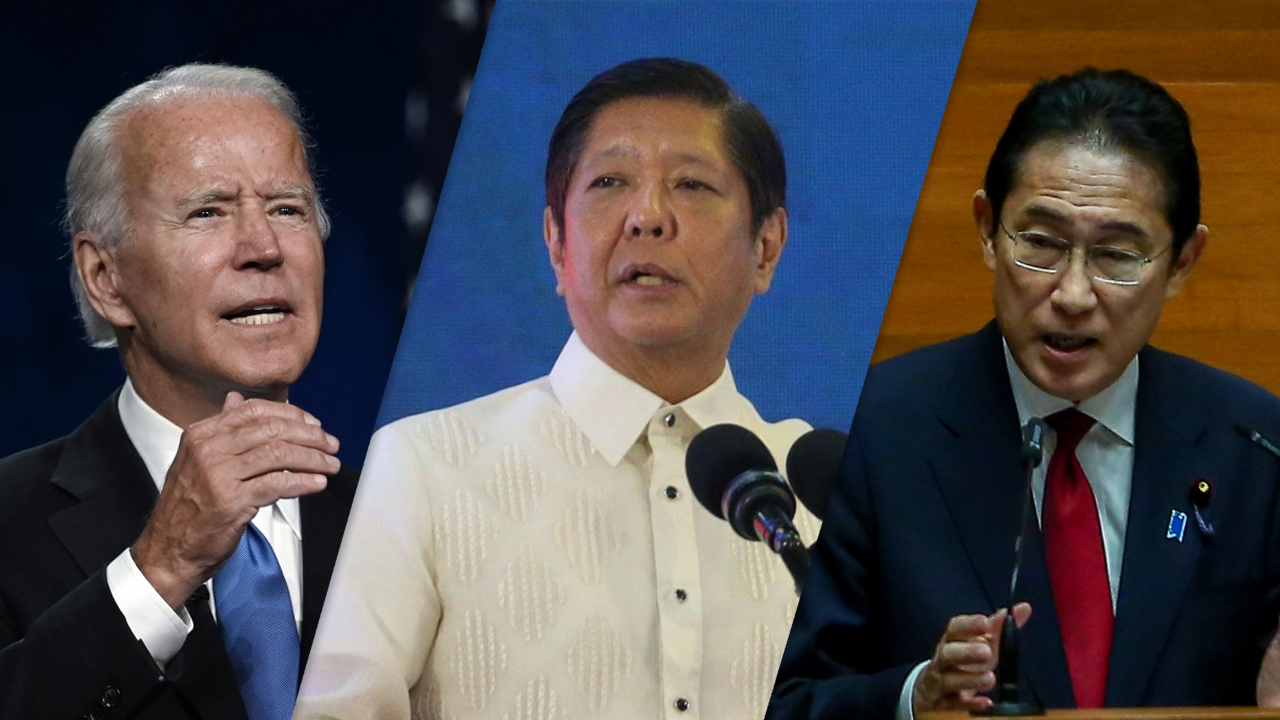
DFA Acting Deputy Undersecretary for Bilateral Relations and Association of Southeast Asian Nations (ASEAN) Affairs Hans Mohaimin Siriban said this ahead of President Marcos' trip to Washington, DC, from Apri 11 to 12 to meet US President Joseph Biden and Japanese Prime Minister Kishida Fumio, and other meetings.
In a pre-departure briefing in Malacañan on Friday, April 5, Siriban said the elevation of the Philippines-Japan-US partnership into this trilateral cooperation has the peace, stability, and prosperity of the Indo-Pacific at the forefront.
"This trilateral meeting is a natural progression of the three parties' existing robust, excellent, bilateral cooperation," he said. "Their enduring friendship and alliance, shared values, shared interest, and shared respect for the rules-based international order."
Siriban further explained that the trilateral summit is not aimed at "poking the bear" but is focused on economic cooperation.
"This trilateral cooperation is not directed at any country. It is, really, a deepening of existing strong bilateral alliances that we have had and, of course, if you look at the areas of discussion that are being looked at, the primary focus, really, is on economic cooperation— building on economic resilience," he said.
"We are looking at an expanded platform where we can look at synergies where our three countries can cooperate in enhancing the economic resilience of the Philippines, especially in the areas of strategic and critical infrastructure," he added.
For those who think otherwise, Siriban said the Philippines is keeping its communication lines open and is willing to engage relevant stakeholders to address the situation in the region, particularly the developments in the disputed parts of the South China Sea.
"We have continuing dialogues with our neighbors. This trilateral summit is one of those dialogues and consultations that we have," he said.
"Our lines of communication are always open and we keep on engaging and we will keep on engaging all the relevant stakeholders in the region," he added.
According to Siriban, the Philippines is looking at cooperation with Japan and the US in terms of addressing climate change as one of the outcomes of the upcoming summit.
"The Philippines is one of the countries most severely affected by climate change so we are looking at actions, at activities that help address and mitigate the impact of climate change, and help the Philippines adapt to climate change," he said.
"We are looking at clean energy, cooperation on clean energy, green energy, renewables. We're also looking at expanding our cooperation on important industries for the Philippines such as critical minerals and semiconductors," he added,
Despite this, the DFA official said that security would not be taking the backseat in the meeting.
"The security environment will also have to be taken into consideration because for economic resilience and economic growth to happen, we also have to take into account the peace and security of the region," Siriban said.
"In this aspect, the trilateral cooperation also hopes to enhance cooperation in this respect," he added.
In his meeting with the new Japanese Ambassador to the Philippines Endo Kazuya on Thursday, April 4, President Marcos said the Philippines and Japan are working to strengthen their trilateral engagements with the US, which include defense, economic, and technology, among others.
"These are building blocks that I think are good for the region, for our countries of course, but for the region," he said.
"Let’s just do the work to continue to keep the peace that is to make the most important part all of that we do," he added.