

ADVERTISEMENT

Booming cold drink sales mean more plastic waste. So Starbucks redesigned its cups

Published Apr 25, 2024 12:35 am

Booming sales of cold drinks at Starbucks has created a problem: growing amounts of plastic waste from the single-use cups that Frappuccinos, refreshers, cold brews, and other iced drinks are served in. 

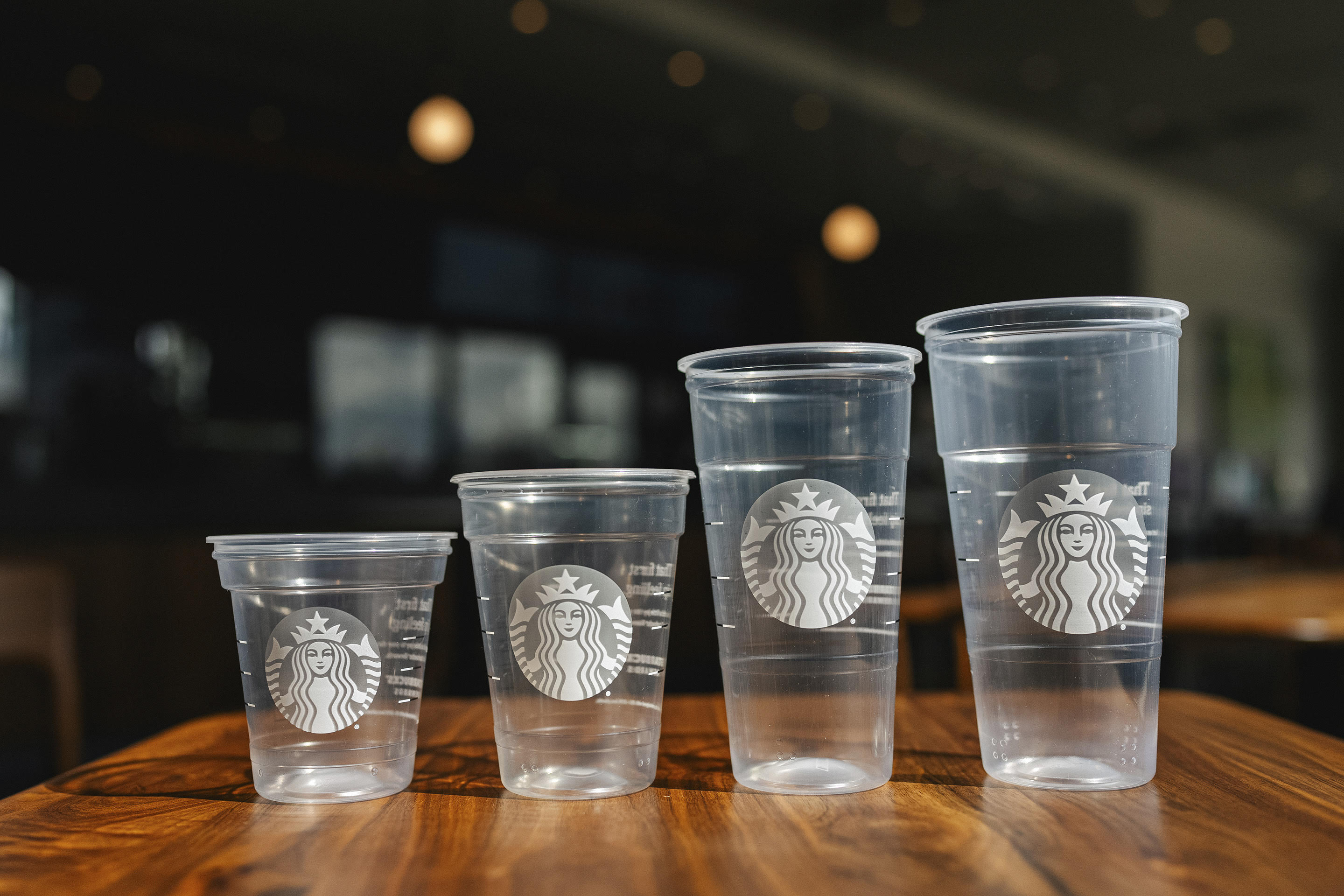
The coffee giant said Thursday it plans to alleviate some of that waste with new disposable cups that contain up to 20 percent less plastic. The cups are set to be rolled out to stores in the US and Canada starting this month. 

Amelia Landers, Starbucks' vice president of product innovation, said the Seattle-based company has spent the last four years developing new containers. Engineers tested thousands of iterations to see how much plastic they could remove while still making the cup feel sturdy. 

"We feel like it's industry-leading," Landers said. "It's the best expression of a cold plastic cup." 

Starbucks says Frappuccinos and other cold drinks now account for 75 percent of its US beverage sales, up from 37 percent in 2013. The company estimates the new cups will keep more than 13.5 million pounds of plastic out of landfills each year. Producing tumblers also requires less water and creates fewer carbon emissions, a leading cause of climate change, it said. 

Starbucks made other changes as part of the redesign. The new cold cups feature raised dots near the bottom, so baristas — including those with impaired vision — can quickly feel with the swipe of a thumb which size cup they're holding. And the 12-ounce cup — that's the "tall" size in Starbucks lingo — is shorter and wider to accommodate the same size lid as larger cups.
sb.jpeg
This photo provided by Starbucks shows a new version of the company's cold cup which is said to be made with up to 20 percent less plastic. The introduction of the cups was announced on Thursday, April 18, 2024. (Starbucks via AP)

Landers said the new cups are part of a sustained sustainability push at Starbucks. The company adopted strawless lids in 2019. Last year, it said it would accept customer-provided cups for drive-thru and mobile orders in the US and Canada. The company plans to roll out a reusable cup program at thousands of stores in Europe, the Middle East, and Africa by next year. Under the program, customers will pay a small deposit when they buy a hot or cold drink in a specially designed cup that can be used up to 30 times. They will get the deposit back when they return the cup to the store. 

Starbucks has also tested US reusable cup programs in California, Arizona, and Colorado. 

"Every market has their own challenges, their own requirements, and customer behavior. Some are more prime for reusables, some are less prime for reusables," Landers said. "There is no one silver bullet to a sustainable cup." 

Longer term, Starbucks has said it wants all of its packaging to be reusable, recyclable, or compostable by 2030. The reduced-plastic cup making its debut is a small step toward that goal: even though the cup is recyclable, it was still designed for one-time use, Landers said. 

The company will continue to explore ways to make single-use cups more sustainable, she said. "I think we will never take our foot off the gas, evaluating new ways and new methods and new technologies to go further," she said. "We're not done." 

Starbucks isn't the only company rethinking plastic packaging. In some markets, McDonald's has introduced McFlurry cups without plastic lids, and salad boxes and cutlery made from renewable fiber. Late last year, Coca-Cola said it had developed a bottle made entirely from plant-based sources. Coke produced a limited run of 900 bottles to show that the technology can be commercially scaled.

Related Tags

Starbucks Landers McDonald’s MBEnvironment
ADVERTISEMENT
.most-popular .layout-ratio{ padding-bottom: 79.13%; } @media (min-width: 768px) and (max-width: 1024px) { .widget-title { font-size: 15px !important; } }

{{ articles_filter_1561_widget.title }}

.most-popular .layout-ratio{ padding-bottom: 79.13%; } @media (min-width: 768px) and (max-width: 1024px) { .widget-title { font-size: 15px !important; } }

{{ articles_filter_1562_widget.title }}

.most-popular .layout-ratio{ padding-bottom: 79.13%; } @media (min-width: 768px) and (max-width: 1024px) { .widget-title { font-size: 15px !important; } }

{{ articles_filter_1563_widget.title }}

{{ articles_filter_1564_widget.title }}

.mb-article-details { position: relative; } .mb-article-details .article-body-preview, .mb-article-details .article-body-summary{ font-size: 17px; line-height: 30px; font-family: "Libre Caslon Text", serif; color: #000; } .mb-article-details .article-body-preview iframe , .mb-article-details .article-body-summary iframe{ width: 100%; margin: auto; } .read-more-background { background: linear-gradient(180deg, color(display-p3 1.000 1.000 1.000 / 0) 13.75%, color(display-p3 1.000 1.000 1.000 / 0.8) 30.79%, color(display-p3 1.000 1.000 1.000) 72.5%); position: absolute; height: 200px; width: 100%; bottom: 0; display: flex; justify-content: center; align-items: center; padding: 0; } .read-more-background a{ color: #000; } .read-more-btn { padding: 17px 45px; font-family: Inter; font-weight: 700; font-size: 18px; line-height: 16px; text-align: center; vertical-align: middle; border: 1px solid black; background-color: white; } .hidden { display: none; }
function initializeAllSwipers() { // Get all hidden inputs with cms_article_id document.querySelectorAll('[id^="cms_article_id_"]').forEach(function (input) { const cmsArticleId = input.value; const articleSelector = '#article-' + cmsArticleId + ' .body_images'; const swiperElement = document.querySelector(articleSelector); if (swiperElement && !swiperElement.classList.contains('swiper-initialized')) { new Swiper(articleSelector, { loop: true, pagination: false, navigation: { nextEl: '#article-' + cmsArticleId + ' .swiper-button-next', prevEl: '#article-' + cmsArticleId + ' .swiper-button-prev', }, }); } }); } setTimeout(initializeAllSwipers, 3000); const intersectionObserver = new IntersectionObserver( (entries) => { entries.forEach((entry) => { if (entry.isIntersecting) { const newUrl = entry.target.getAttribute("data-url"); if (newUrl) { history.pushState(null, null, newUrl); let article = entry.target; // Extract metadata const author = article.querySelector('.author-section').textContent.replace('By', '').trim(); const section = article.querySelector('.section-info ').textContent.replace(' ', ' '); const title = article.querySelector('.article-title h1').textContent; // Parse URL for Chartbeat path format const parsedUrl = new URL(newUrl, window.location.origin); const cleanUrl = parsedUrl.host + parsedUrl.pathname; // Update Chartbeat configuration if (typeof window._sf_async_config !== 'undefined') { window._sf_async_config.path = cleanUrl; window._sf_async_config.sections = section; window._sf_async_config.authors = author; } // Track virtual page view with Chartbeat if (typeof pSUPERFLY !== 'undefined' && typeof pSUPERFLY.virtualPage === 'function') { try { pSUPERFLY.virtualPage({ path: cleanUrl, title: title, sections: section, authors: author }); } catch (error) { console.error('ping error', error); } } // Optional: Update document title if (title && title !== document.title) { document.title = title; } } } }); }, { threshold: 0.1 } ); function showArticleBody(button) { const article = button.closest("article"); const summary = article.querySelector(".article-body-summary"); const body = article.querySelector(".article-body-preview"); const readMoreSection = article.querySelector(".read-more-background"); // Hide summary and read-more section summary.style.display = "none"; readMoreSection.style.display = "none"; // Show the full article body body.classList.remove("hidden"); } document.addEventListener("DOMContentLoaded", () => { let loadCount = 0; // Track how many times articles are loaded const offset = [1, 2, 3, 4, 5, 6, 7, 8, 9, 10]; // Offset values const currentUrl = window.location.pathname.substring(1); let isLoading = false; // Prevent multiple calls if (!currentUrl) { console.log("Current URL is invalid."); return; } const sentinel = document.getElementById("load-more-sentinel"); if (!sentinel) { console.log("Sentinel element not found."); return; } function isSentinelVisible() { const rect = sentinel.getBoundingClientRect(); return ( rect.top < window.innerHeight && rect.bottom >= 0 ); } function onScroll() { if (isLoading) return; if (isSentinelVisible()) { if (loadCount >= offset.length) { console.log("Maximum load attempts reached."); window.removeEventListener("scroll", onScroll); return; } isLoading = true; const currentOffset = offset[loadCount]; window.loadMoreItems().then(() => { let article = document.querySelector('#widget_1690 > div:nth-last-of-type(2) article'); intersectionObserver.observe(article) loadCount++; }).catch(error => { console.error("Error loading more items:", error); }).finally(() => { isLoading = false; }); } } window.addEventListener("scroll", onScroll); });

Sign up by email to receive news.