ADVERTISEMENT

Maynilad's Poblacion WTP wins "Water Project of the Year" in Global Water Awards

Published Apr 23, 2024 08:24 am
042324Maynilad1.jpg
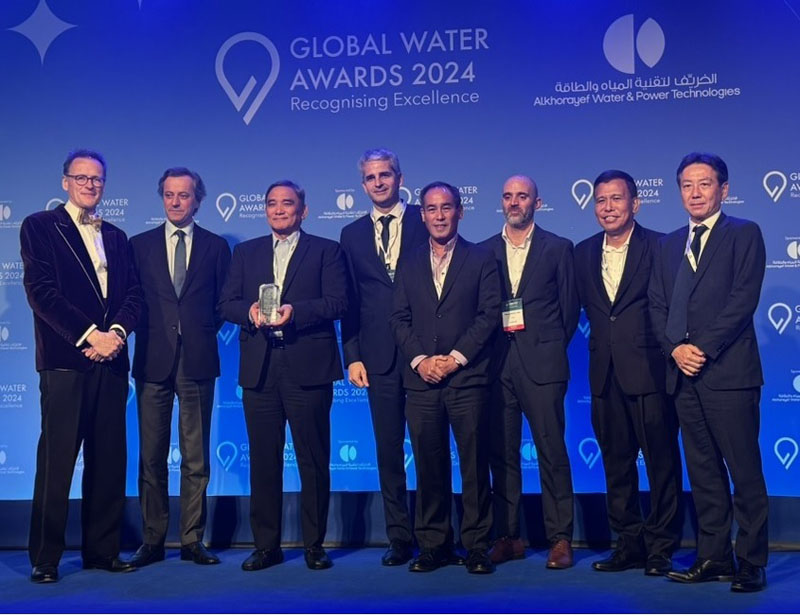
Maynilad officials led by President and CEO Ramoncito S. Fernandez (third from left) receive from Global Water Intelligence publisher Christopher Gasson (leftmost) the “Water Project of the Year” award for the company’s Poblacion Water Treatment Plant (WTP) during the Global Water Awards 2024 held recently in London, England. Maynilad was the sole awardee from the Philippines. The Poblacion WTP was cited for having the greatest innovation in terms of optimizing its physical or environmental footprint.

West Zone concessionaire Maynilad Water Services, Inc. (Maynilad) bagged the “Water Project of the Year” award for its Poblacion Water Treatment Plant (WTP) during the Global Water Awards 2024 held recently in London, England. Maynilad was the sole awardee from the Philippines.

The Poblacion WTP is one of three Maynilad treatment plants that use Laguna Lake as raw water source. Besting other finalists for “Water Project of the Year” from reputable utilities in Australia, Israel and the United States, Maynilad’s Poblacion WTP was chosen for having the greatest innovation in terms of optimizing its physical or environmental footprint.

The Global Water Awards is held annually during the Global Water Summit, a business conference participated in by major water industry players worldwide. The awards—established by the Global Water Intelligence—give recognition to the most important achievements in the international water industry, particularly those initiatives that move the industry forward through improved operating performance, innovative technology adoption and sustainable financial models.

Nominations are shortlisted by a panel of industry experts, and the winners are voted for by the international water community.

“We are honored to have been given this prestigious award for our water treatment plant in Poblacion, Muntinlupa. This recognition underscores our commitment to optimizing the environmental footprint of our operations, ensuring sustainable solutions for the future of water management,” said Maynilad President and CEO Ramoncito S. Fernandez.

The Poblacion WTP is part of Maynilad’s service enhancement program, which aims to enhance water sustainability and climate resiliency. Commissioned in 2023, it can produce 150 million liters per day (MLD) of potable water at full capacity, serving around 1.7 million customers in the southern part of the West concession.

Maynilad tapped the consortium composed of Acciona and DMCI for the design, construction, operations, maintenance and commissioning of the Poblacion WTP. Meanwhile, global firm Arup served as consultant.

Related Tags

Maynilad
ADVERTISEMENT
.most-popular .layout-ratio{ padding-bottom: 79.13%; } @media (min-width: 768px) and (max-width: 1024px) { .widget-title { font-size: 15px !important; } }

{{ articles_filter_1561_widget.title }}

.most-popular .layout-ratio{ padding-bottom: 79.13%; } @media (min-width: 768px) and (max-width: 1024px) { .widget-title { font-size: 15px !important; } }

{{ articles_filter_1562_widget.title }}

.most-popular .layout-ratio{ padding-bottom: 79.13%; } @media (min-width: 768px) and (max-width: 1024px) { .widget-title { font-size: 15px !important; } }

{{ articles_filter_1563_widget.title }}

{{ articles_filter_1564_widget.title }}

.mb-article-details { position: relative; } .mb-article-details .article-body-preview, .mb-article-details .article-body-summary{ font-size: 17px; line-height: 30px; font-family: "Libre Caslon Text", serif; color: #000; } .mb-article-details .article-body-preview iframe , .mb-article-details .article-body-summary iframe{ width: 100%; margin: auto; } .read-more-background { background: linear-gradient(180deg, color(display-p3 1.000 1.000 1.000 / 0) 13.75%, color(display-p3 1.000 1.000 1.000 / 0.8) 30.79%, color(display-p3 1.000 1.000 1.000) 72.5%); position: absolute; height: 200px; width: 100%; bottom: 0; display: flex; justify-content: center; align-items: center; padding: 0; } .read-more-background a{ color: #000; } .read-more-btn { padding: 17px 45px; font-family: Inter; font-weight: 700; font-size: 18px; line-height: 16px; text-align: center; vertical-align: middle; border: 1px solid black; background-color: white; } .hidden { display: none; }
function initializeAllSwipers() { // Get all hidden inputs with cms_article_id document.querySelectorAll('[id^="cms_article_id_"]').forEach(function (input) { const cmsArticleId = input.value; const articleSelector = '#article-' + cmsArticleId + ' .body_images'; const swiperElement = document.querySelector(articleSelector); if (swiperElement && !swiperElement.classList.contains('swiper-initialized')) { new Swiper(articleSelector, { loop: true, pagination: false, navigation: { nextEl: '#article-' + cmsArticleId + ' .swiper-button-next', prevEl: '#article-' + cmsArticleId + ' .swiper-button-prev', }, }); } }); } setTimeout(initializeAllSwipers, 3000); const intersectionObserver = new IntersectionObserver( (entries) => { entries.forEach((entry) => { if (entry.isIntersecting) { const newUrl = entry.target.getAttribute("data-url"); if (newUrl) { history.pushState(null, null, newUrl); let article = entry.target; // Extract metadata const author = article.querySelector('.author-section').textContent.replace('By', '').trim(); const section = article.querySelector('.section-info ').textContent.replace(' ', ' '); const title = article.querySelector('.article-title h1').textContent; // Parse URL for Chartbeat path format const parsedUrl = new URL(newUrl, window.location.origin); const cleanUrl = parsedUrl.host + parsedUrl.pathname; // Update Chartbeat configuration if (typeof window._sf_async_config !== 'undefined') { window._sf_async_config.path = cleanUrl; window._sf_async_config.sections = section; window._sf_async_config.authors = author; } // Track virtual page view with Chartbeat if (typeof pSUPERFLY !== 'undefined' && typeof pSUPERFLY.virtualPage === 'function') { try { pSUPERFLY.virtualPage({ path: cleanUrl, title: title, sections: section, authors: author }); } catch (error) { console.error('ping error', error); } } // Optional: Update document title if (title && title !== document.title) { document.title = title; } } } }); }, { threshold: 0.1 } ); function showArticleBody(button) { const article = button.closest("article"); const summary = article.querySelector(".article-body-summary"); const body = article.querySelector(".article-body-preview"); const readMoreSection = article.querySelector(".read-more-background"); // Hide summary and read-more section summary.style.display = "none"; readMoreSection.style.display = "none"; // Show the full article body body.classList.remove("hidden"); } document.addEventListener("DOMContentLoaded", () => { let loadCount = 0; // Track how many times articles are loaded const offset = [1, 2, 3, 4, 5, 6, 7, 8, 9, 10]; // Offset values const currentUrl = window.location.pathname.substring(1); let isLoading = false; // Prevent multiple calls if (!currentUrl) { console.log("Current URL is invalid."); return; } const sentinel = document.getElementById("load-more-sentinel"); if (!sentinel) { console.log("Sentinel element not found."); return; } function isSentinelVisible() { const rect = sentinel.getBoundingClientRect(); return ( rect.top < window.innerHeight && rect.bottom >= 0 ); } function onScroll() { if (isLoading) return; if (isSentinelVisible()) { if (loadCount >= offset.length) { console.log("Maximum load attempts reached."); window.removeEventListener("scroll", onScroll); return; } isLoading = true; const currentOffset = offset[loadCount]; window.loadMoreItems().then(() => { let article = document.querySelector('#widget_1690 > div:nth-last-of-type(2) article'); intersectionObserver.observe(article) loadCount++; }).catch(error => { console.error("Error loading more items:", error); }).finally(() => { isLoading = false; }); } } window.addEventListener("scroll", onScroll); });

Sign up by email to receive news.