







OPPO unveils groundbreaking 6G white paper
Pioneering a modular, AI-integrated future for mobile connectivity
By MB Technews


At A Glance
- OPPO introduces a 6G system with modular capabilities tailored to specific needs, enhancing network adaptability and efficiency for device and network convergence.
- The white paper emphasizes AI integration into 6G for smarter connectivity, moving beyond data transmission to rapid AI model deployment for device management.
- Central to OPPO's 6G concept is a minimal kernel offering core capabilities like AI, security, and spectrum sharing, facilitating efficient subsystem deployment.
- OPPO plans flexible 6G subsystems optimized for various applications, allowing AI-driven on-demand service customization across industries.
- Since 2019, OPPO leads in 6G research, focusing on AI, zero-power tech, and next-gen communications, driving technology development and international standardization.
OPPO recently released its new 6G white paper, "A Versatile 6G with Minimized Kernel: To Build the Mobile World." Drawing on OPPO's forward-looking research and exploration into 6G, the paper proposes an innovative, versatile 6G system with a minimized kernel that aims to provide a more actionable solution for the next generation of mobile communication systems.
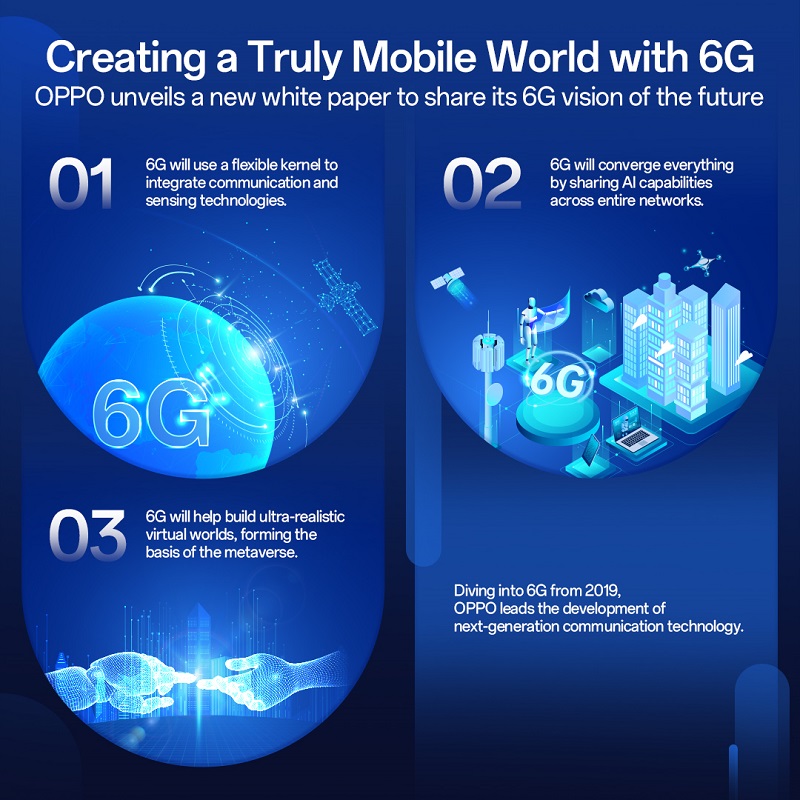
The proposed system "modularizes" 6G capabilities and intelligently "splices" different capability modules according to the specific needs of any given scenario. This will enable 6G networks to be more adaptable and efficient when providing the underlying communications support for the convergence of masses of devices and networks in the future.
Bringing enhanced intelligence to connectivity with 6G
OPPO's vision for 5G and 6G technology is to enable a truly mobile world. Steps towards this mobile future have already been made with 5G, which has evolved the role of communications technology from simple "connectivity" to the Internet of Things with a multitude of different devices. Based on this vision, a key direction for developing 6G technology will be the greater integration of AI technology into communications networks. Such networks will no longer be confined to just transmitting data. Instead, they will be able to transmit and deploy a vast set of AI models rapidly.
Among these models, a large number of AI agents will be trained to become intermediaries to help people manage and control all manner of things. Certain AI agents cannot exist in the physical world, so this form of "management" can only be realized in the virtual world. In these cases, digital twins representing physical objects will be constructed in the virtual world, enabling control of the physical world through these virtual proxies. In this way, 6G will help to advance the Internet of Things from a series of connected devices to a series of converged devices operating as part of intelligent networks.
Based on this vision, the white paper proposes the role of 6G as one that facilitates communication between the virtual world and the real world, realizing the interconnection and convergence of these two worlds to form the basis of the metaverse and the foundations for a truly mobile world.
"Versatile 6G system with minimized kernel" meets the diverse needs of 6G
To realize this vision, OPPO has proposed a new design idea for 6G called "the versatile 6G system with minimized kernel", which consists of a "minimized 6G kernel" that provides shared capabilities such as native AI, spectrum sharing and security, and multiple "6G subsystems". The design comprises a suite of technologies covering disciplines such as integrating AI and 6G, security architecture, spectrum sharing, mobile broadband and D2D protocols, improved low latency and reliability, integrating communication and sensing, zero-power technology, and more. Compared to the "scalable parameter sets + network slices" approach to network resource allocation used in 5G, this new solution allows 6G to be better optimized for vertical applications.
Within this system, the minimized 6G kernel provides the underlying capabilities shared by all subsystems within the network. The AI capabilities integrated through 6G will help the network to efficiently deploy the different capabilities of the 6G subsystems to the corresponding vertical applications. By intelligently realizing on-demand networking and resource allocation, the networks will be able to meet the ever-changing connectivity needs of different applications. At the same time, the new security structure will require establishing a multi-party trust model and endogenous security with intelligent security to protect a wide range of service data. Finally, flexible spectrum management and sharing will use blockchain technology to simplify spectrum allocation and management and improve spectrum utilization efficiency.
To deal with the diverse demands of different applications on the networks, separate optimizations will be made for four different capabilities, including Clouding, Critical IoT, Ubiquitous IoT, and Sensing, with one or more subsystems designed for each capability. These subsystems can be combined and switched on-demand through AI to serve different industries and applications.
For example, the 6G non-terrestrial network subsystem can break constraints imposed by time, cost, or geography by introducing additional satellite communication capabilities into the 6G system. This can support broader network coverage to better serve applications that place higher requirements on coverage over high data rates. Another example is the 6G sensing subsystem, which integrates both communication and sensing technologies. Partial localization capabilities are already possible with 5G, however, with 6G, ubiquitous sensing functionality will be realized by introducing new sensing capabilities. By capturing every detail in the physical world, 6G networks can support the construction of digital twins in the virtual world.
OPPO is leading the next generation of communication technology through its investment in 6G research
Current research into 6G technology is still in its infancy, and the industry as a whole is just beginning its exploration of this future technology. As a leader in the field, OPPO began its initial research into 6G in 2019, beginning with research into new device form factors and new service requirements.
OPPO's key research directions for 6G include integrating AI and wireless communications, zero-power communication technology, user-centric designs, integrating communications and sensing, non-terrestrial networks, and terahertz/wireless optical communications. Through its participation in systems verification, technology research, and standardization, OPPO has already been driving the development of technologies related to its key 6G research interests. In terms of standardization, OPPO is also regularly involved with various standardization organizations around the world, including ITU, 3GPP, CCSA, IMT-2030 Promotion Group, and FuTURE Forum.
In the future, OPPO will continue to work on bringing 5G to more users worldwide while continuing to explore how cutting-edge 6G technology can create a truly mobile world for global users.