






 Philippines
Luzon
Bohol police thank prov'l government for supporting campaign vs drugs
Philippines
Luzon
Bohol police thank prov'l government for supporting campaign vs drugs
Bohol police thank prov'l government for supporting campaign vs drugs


CEBU CITY – The series of successful anti-illegal drug operations where huge amounts of shabu were seized in Bohol were the product of the strong support that the provincial government has given in the campaign against illegal drugs, an official of the Bohol Provincial Police Office (BPPO) said.
Police Lt. Col. Norman Nuez, spokesperson of BPPO, pointed out that Gov. Aris Aumentado has been very supportive in the campaign against illegal drugs.
“The support of the provincial government has been very good. From acquiring equipment for drug testing and supply reduction programs, the governor has given a huge financial support. Financial support is very important because gathering of information is the most expensive. That’s why there have been a lot of arrests recently because the province has invested a lot in information gathering. The more that we invest in gathering information, the more suspects that will be arrested,” Nuez said.
Huge amounts of shabu have been seized in previous weeks in the province. Last February 27, four kilos of shabu worth P27 million were seized from a couple in Tagbilaran City. On the same day, a man was arrested in Panglao where a kilo of shabu worth P7.1 million was seized.
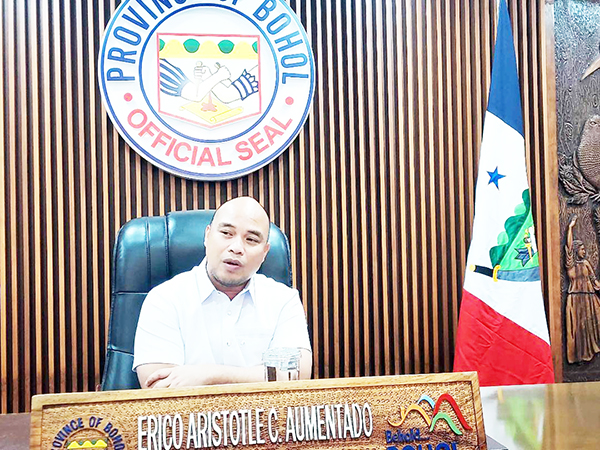
GOV. Aris Aumentado says the provincial government is determined to eradicate illegal drug activities in Bohol. (Calvin Cordova)
“Our law enforcers are very active in arresting these drug personalities because our direction is to really eradicate the illegal drug activities in the province,” Aumentado said.
The governor added that monitoring in ports has been strengthened in ports by deploying more drug-sniffing dogs.
Despite the strict security in ports, illegal drugs may have been still able to enter the province through the coastal barangays.
“They can easily enter because there are pump boats that can easily dock in coastal areas and our problem is to determine if they are carrying illegal drugs,” Aumentado said.
The governor has asked the police and the Philippine Drug Enforcement Agency to also closely monitor coastal areas. “The most effective way really is the buying of information from the community,” said Aumentado.
Nuez said the demand for shabu in the province could reach four to six kilos a month.
He said during “Oplan: Tokhang” in 2016, the BPPO recorded some 39,700 drug personalities in the province.
Nuez said 7,000 drug personalities have completed their drug rehabilitation program and 16,000 are still undergoing rehabilitation.
“There are 10,000 to 15,000 who have to undergo rehab. Since drug addiction is a mental problem, there is craving and that craving will generate demand for illegal drugs,” Nuez said.
Nuez explained that if the 10,000 users will each consume a sachet of shabu, which is about .01 gram, a week, it will create a demand for one kilo of shabu a week.
“According to experts, a drug addict will use shabu two to three times a week. So if the 10,000 users will crave for shabu two to three times a week, it will generate a demand for three kilos of shabu a week to satisfy the cravings,” said Nuez.
With this, Nuez said it is also important to focus on demand reduction strategy. “We have been conducting symposiums in schools, barangays to create awareness on the dangerous effects of shabu,” Nuez said.
Nuez said the support of the provincial government in the campaign against illegal drugs is laudable.
He disclosed that the province has created the Center for Drug Education and Counseling. Nuez said the center spearheads the conduct of drug dependency assessment on the arrested pushers who availed of the plea-bargaining agreement.
The center also supervises the rehabilitation of drug users and training of interventionists. “The rehabilitation of drug users is very important because they are the ones who create demand,” said Nuez.
Despite the numerous confiscations of illegal drugs, the BPPO believes that there is no shabu laboratory in Bohol.
“What we have here are ‘bodegeros’ or those who are tasked to safekeep the illegal drugs that are set to be distributed,” Nuez said.
Nuez agreed that since there are about 36 coastal barangays in the province, prevention of smuggling of shabu into Bohol is extra challenging.