






 Philippines
National
PCW stands at the forefront of advocating women's rights, safety and welfare
Philippines
National
PCW stands at the forefront of advocating women's rights, safety and welfare
PCW stands at the forefront of advocating women's rights, safety and welfare


“The strands of the hair may grow or fall, so as the leaves of a tree. The skies may also come dark or bright, but creations like women—in triumphs and in trials—would never lose their light.”

From the “double burden” of women in both professional and domestic responsibilities, to the reported cases of violence against them, women truly deserve respect, but most importantly, freedom.
In the light of these all, the Philippine Commission on Women (PCW) has reported “remarkable progress” in addressing these issues, and committed that it is continuously advocating for women’s rights, safety, and welfare.
PCW also reminded women, particularly those who were victims, or survivors of violence that they are “strong” and “capable”.
“The violence you have endured is not your fault and it does not define who you are,” PCW said.
Moving forward
To protect women, PCW said certain laws through the Women’s Priority Legislative Agenda (WPLA), were pushed in the 17th and 18th Congress, including the "Safe Spaces Act" (Bawal Bastos Law) that sought to hinder gender-based sexual harassment and child marriage; the Anti-Online Sexual Abuse and Exploitation of Children (OSAEC) Law; and the Act Strengthening the Policies on Anti-Trafficking in Persons.
Moreover, PCW said its efforts have been vital in protecting women by implementing primary prevention programs for many years just as the observance of the 18-Day Campaign to End VAW (Violence Against Women).
“This includes a response system covering multi-disciplinary teams (MDTs) that address the protective, medical, psychosocial, and legal needs of victims,” PCW said.
Also, the Republic Act 9262 or the Anti-Violence Against Women and Their Children Act of 2004 was a triumph for women who were in “violent” relationships.
“Prior to its enactment, victims of intimate partner violence could only resort to the provisions of the Revised Penal Code for physical injuries, concubinage, homicide, or rape,” PCW said.
‘Significant drop’ in VAW cases
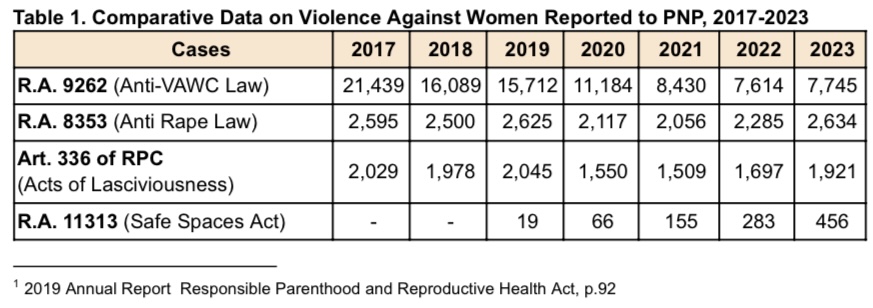
Based on the report of the Philippine National Police (PNP), there was a 50 percent decline in the cases of VAW from 26,462 in 2017 to 13,122 in 2023 with a “slight” six percent increase from 2022 to 2023.
From the 13,122 VAW cases in the country in 2023, 59 percent of it was recorded as a breach of the Anti-VAWC Act.
(PCW)
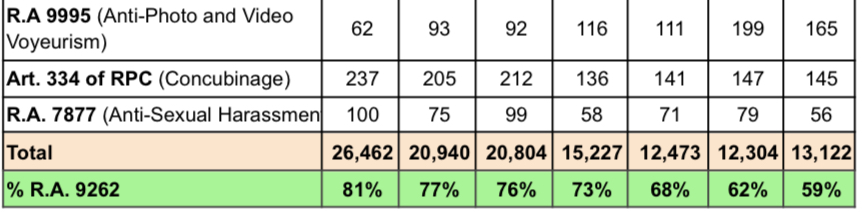
However, PCW said the decrease or increase in reported cases of VAW cases could mean both a positive and negative outcome, as the increase in reporting could mean increasing awareness and help-seeking behavior.
“It could also be attributed to the roll-out of effective advocacy campaigns which empower women to speak out about their experiences However, it could also just mean that more and more women are being victimized,” PCW said.
Also, the data reflect there were less women being abused. PCW said other victims may still not have the courage to seek help due to the fear of judgement or inappropriate treatment from law enforcement agencies.
The road to fully eradicate violence against women may be long and hard, but what these women and the PCW have already traversed is already miles away from the darkness they found themselves in in the past.
PCW also noted a “positive outcome” in terms of gender equality, as there was an growing rate in the number of women who are at the forefront of innovation and economic growth.