







Mayor Francis calls for massive info drive vs pertussis


Amid the increasing number of pertussis cases in the country, most of which are children, San Juan City Mayor and Metro Manila Council (MMC) President Francis Zamora urged on Monday, March 25, the local government units (LGUs) to conduct a massive information campaign regarding the disease.
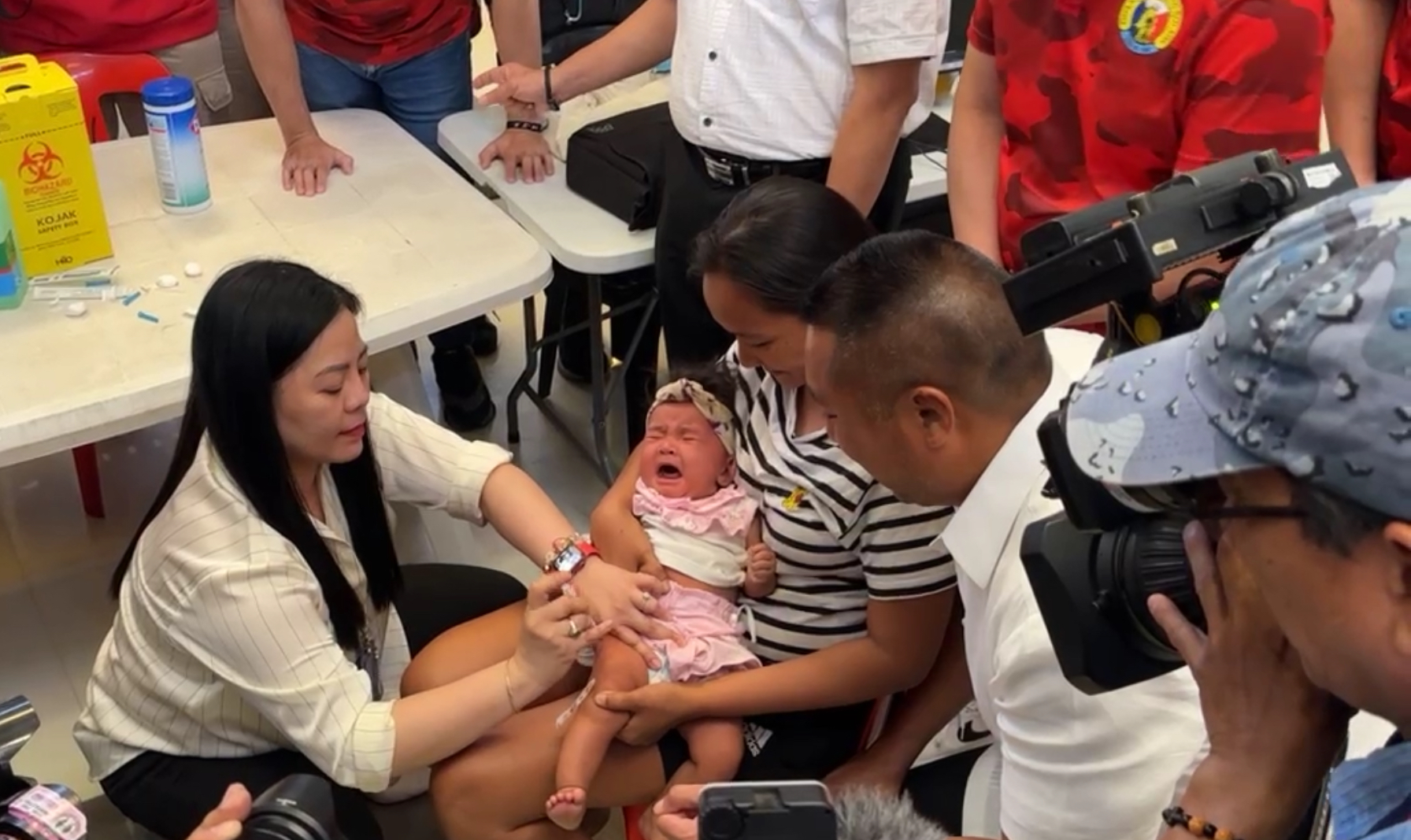
(Photo by Patrick Garcia)
Zamora made the statement during a town hall meeting and infant immunization drive against the disease in the city.
He stressed that aside from the vaccination of children against pertussis, all LGUs must implement information drives to inform the public of the disease.
"What we really need is to inform the public ano ba itong pertussis. Kahit ako po aminado ako na nitong mga nakaraang araw, tsaka ko lang nalaman kung ano ba tong sakit na ito (What we really need is to inform the public what is pertussis. Even I myself admit that I just learned of this sickness in the past days)," Zamora said.
"Mahalaga talaga na magkaroon tayo ng massive information campaign sa lahat ng local government units (It is utterly important for all local government units to have massive information campaigns against pertussis)," he added.
Zamora, together with Department of Health’s Metro Manila Center for Health Development (DOH-MMCHD) Regional Epidemiology and Surveillance Unit (RESU) head Dr. Manuel Mapue II led the town hall meeting and inoculation drive at the atrium of the San Juan City Hall. It aims to educate San Juaneños as well as city and barangay officials on the importance of routine immunization against pertussis, which is provided for free at local health centers and stations.
Mapue discussed about the treatment and prevention of pertussis during the town hall meeting, explaining that most individuals contracting the disease are children aged 1-year-old and below.
"Ito po ay lubos na nakakahawa at nakakamatay. Nakakahawa po siya sa pamamagitan ng droplets, talsik ng laway, at secretion sa ilong (This disease is highly contagious and may cause death. It may spread through saliva droplets and nose secretion)," Mapue said.
According to the official, there were 111 pertussis cases in Metro Manila up until March 16.
"Last year po, dalawa lang ang kaso natin sa buong Metro Manila. Kung susumain ninyo, mahigit 5,000 beses ang itinaas ng kaso. Kung ikukumpara naman sa nakalipas na limang taon, tumaas tayo ng 900 times sa buong Metro Manila. Sa San Juan naman po, 2 lang ang kaso sa inyong lungsod at last year wala po tayong kaso. Yung 2 kaso ng San Juan ay buhay po naman (Last year, there were only two cases in the whole Metro Manila. If you will examine closely, there was a 5,000 times increase in the number of cases. If you will compare this in the past five years, there was a 900 times increase in the whole Metro Manila. Here in San Juan, there are two cases of pertussis while last year there was none. Both cases are alive," he noted.
Following the event, a routine immunization drive for children aged 0-23 months was conducted, administering the 5-in-1 vaccine against diptheria, pertussis, tetanus, Hepatitis B, and Haemophilus influenzae type B (HiB). This effort seeks to reassure parents of the safety and significance of vaccines in safeguarding the well-being of their children.
The Department of Health will also procure booster shots against pertussis and will be distributed to the different cities.
Mapue said one of the agency's suggestions is for people living in one household to wear masks, as well as observe other preventive measures such as the use of wipes and disposing it in the proper disposal areas to prevent the spread of the bacteria.
For his part, Zamora called on the parents to have their children vaccinated against this disease.
Pertussis, also known as the 100-day cough, is a highly contagious, vaccine-preventable bacterial disease caused by the bacterium Bordetella pertussis with initial symptoms usually similar to those of the common cold with a runny nose, fever, and mild cough. However, these are followed by two or three months of severe coughing fits.
Following a fit of coughing, a high-pitched whoop sound or gasp may occur as the person breathes in. The violent coughing may last for 10 or more weeks, hence the phrase "100-day cough."
Patients infected with the disease may cough so hard that it causes vomiting, rib fractures, and fatigue. Children less than one year old may experience little or no cough at all and instead have periods where they cannot breathe.