ADVERTISEMENT

Major Baltimore bridge collapses after ship collision

Published Mar 26, 2024 10:13 am
AFP__20240326__34ME373__v1__Preview__UsTransportAccidentEconomy.jpg
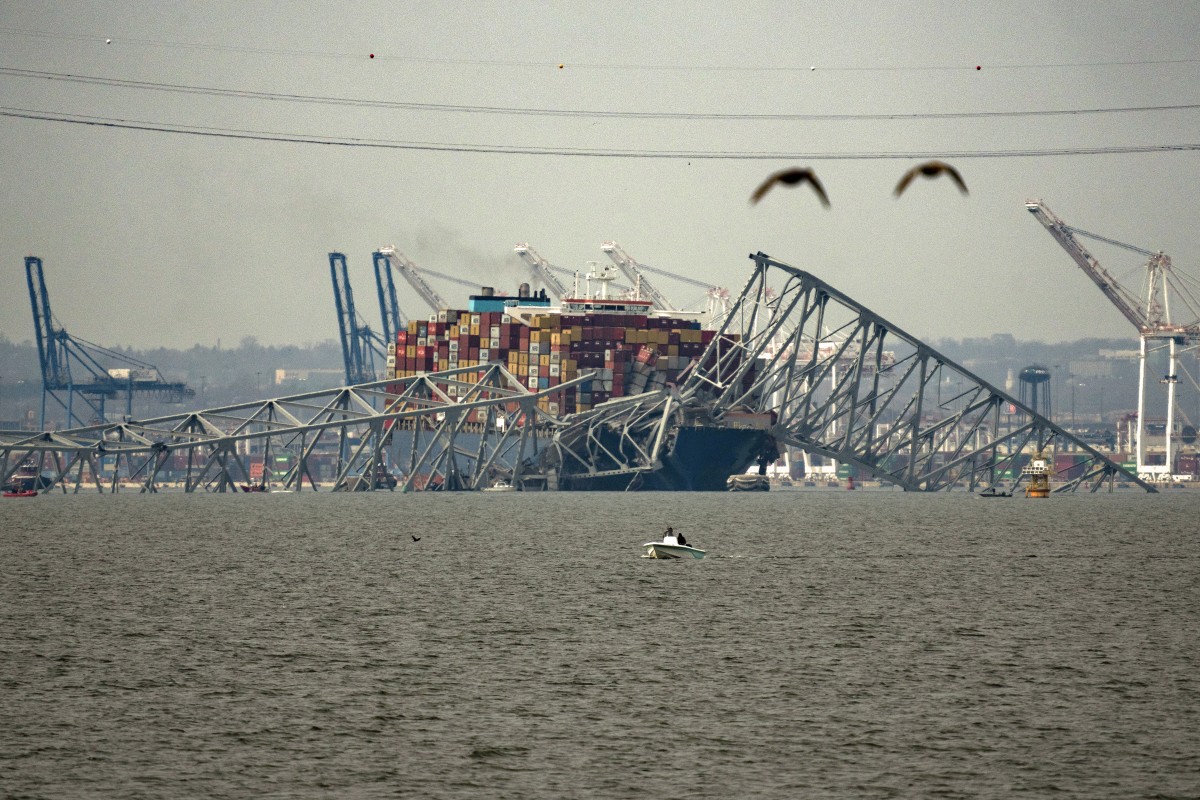
Part of the steel frame of the Francis Scott Key Bridge sits on top of the container ship Dali after the bridge collapsed in Baltimore, Maryland, on March 26, 2024. The bridge collapsed early March 26 after being struck by the Singapore-flagged Dali container ship, sending multiple vehicles and people plunging into the frigid harbor below. There was no immediate confirmation of the cause of the disaster, but Baltimore's Police Commissioner Richard Worley said there was "no indication" of terrorism. (Photo by Kent Nishimura / AFP)

BALTIMORE, United States–A major bridge in the US city of Baltimore almost entirely collapsed Tuesday after being struck by a container ship, sending multiple vehicles and up to 20 people plunging into the harbor below.

Dramatic footage showed a 300-meter vessel hitting a footing of the Francis Scott Key Bridge, sending the steel-built structure crashing into the Patapsco River.

Lights from what appear to be vehicles can be seen on the road surface as the bridge warps and crashes in sections, with the third tranche cantilevering upwards before it, too, tumbles into the water.

Several small explosions can also be seen during the rapid collapse.

"Unfortunately, we understand that there were up to 20 individuals who may be in the Patapsco River right now as well as multiple vehicles," Kevin Cartwright of the Baltimore Fire Department told CNN.

"So we have... a mass-casualty multi agency incident underway.

"We understand that there could have potentially been a vehicle, a tractor trailer or a vehicle as large as a tractor trailer on the bridge at the time that it collapsed."

The footage appeared to show the ship going dark twice in the moments before the collision, with thick black smoke issuing from the ship's funnel, possibly indicating activity from the engine.

A huge emergency response swung into action after the collision, which happened around 1:30 am (0530 GMT), with first response vehicles crowding the shoreline.

Divers were in the water looking for survivors, Cartwright said.

CNN reported that water temperatures were around 48 Fahrenheit (8.8 Celsius), complicating search and rescue efforts and narrowing the window of survivability for anyone in the water.

Photographs from the scene show debris from the bridge resting on the deck of the ship, where containers were stacked several high.

Reports suggested some of the containers were unstable, complicating rescue efforts.


- 'Sound of thunder' -


A man who identified himself as a former Baltimore fire department worker said he could see the bridge from his bedroom window.

"We were awakened by what appeared to be an earthquake and a long, rolling sound of thunder," he told local media.

"I saw some emergency lights in the area and decided to drive up... what was in progress was a multi-jurisdictional response to a disaster."

The 1.6-mile (2.6-kilometer), four-lane bridge spans the Patapsco River southwest of Baltimore.

It opened in 1977 and carries more than 11 million vehicles a year, around 31,000 a day.

It is a major part of the road network around Baltimore, an industrial city on the US East Coast next to the capital Washington.

The Maryland Transportation Authority told drivers to avoid the area, part of the I-695 interstate highway, which it called an "active scene".

Ship monitoring website MarineTraffic showed a Singapore-flagged container ship called the Dali stopped under the bridge early Tuesday.

Logs show the vessel was en route from Baltimore to Colombo in Sri Lanka.

The BBC reported Synergy Marine Group confirming its vessel had been involved.

"Whilst the exact cause of the incident is yet to be determined, the 'Dali' has now mobilised its Qualified Individual Incident response service," it says.

All crew, as well as pilots -- the specialised mariners who navigate vessels around port areas -- have been accounted with no reports of any injuries.

US Secretary of Transportation Pete Buttigieg said on social media that he was in contact with the mayor of Baltimore and the governor of Maryland, and had offered federal help.

"Rescue efforts remain underway and drivers in the Baltimore area should follow local responder guidance on detours and response," he wrote on X, formerly known as Twitter.

Baltimore is one of the busiest cargo ports in the United States, handling billions of dollars of vehicles, containers, forest products and project cargo, according to the city's port authority.

Related Tags

WORLDNEWS
ADVERTISEMENT
.most-popular .layout-ratio{ padding-bottom: 79.13%; } @media (min-width: 768px) and (max-width: 1024px) { .widget-title { font-size: 15px !important; } }

{{ articles_filter_1561_widget.title }}

.most-popular .layout-ratio{ padding-bottom: 79.13%; } @media (min-width: 768px) and (max-width: 1024px) { .widget-title { font-size: 15px !important; } }

{{ articles_filter_1562_widget.title }}

.most-popular .layout-ratio{ padding-bottom: 79.13%; } @media (min-width: 768px) and (max-width: 1024px) { .widget-title { font-size: 15px !important; } }

{{ articles_filter_1563_widget.title }}

{{ articles_filter_1564_widget.title }}

.mb-article-details { position: relative; } .mb-article-details .article-body-preview, .mb-article-details .article-body-summary{ font-size: 17px; line-height: 30px; font-family: "Libre Caslon Text", serif; color: #000; } .mb-article-details .article-body-preview iframe , .mb-article-details .article-body-summary iframe{ width: 100%; margin: auto; } .read-more-background { background: linear-gradient(180deg, color(display-p3 1.000 1.000 1.000 / 0) 13.75%, color(display-p3 1.000 1.000 1.000 / 0.8) 30.79%, color(display-p3 1.000 1.000 1.000) 72.5%); position: absolute; height: 200px; width: 100%; bottom: 0; display: flex; justify-content: center; align-items: center; padding: 0; } .read-more-background a{ color: #000; } .read-more-btn { padding: 17px 45px; font-family: Inter; font-weight: 700; font-size: 18px; line-height: 16px; text-align: center; vertical-align: middle; border: 1px solid black; background-color: white; } .hidden { display: none; }
function initializeAllSwipers() { // Get all hidden inputs with cms_article_id document.querySelectorAll('[id^="cms_article_id_"]').forEach(function (input) { const cmsArticleId = input.value; const articleSelector = '#article-' + cmsArticleId + ' .body_images'; const swiperElement = document.querySelector(articleSelector); if (swiperElement && !swiperElement.classList.contains('swiper-initialized')) { new Swiper(articleSelector, { loop: true, pagination: false, navigation: { nextEl: '#article-' + cmsArticleId + ' .swiper-button-next', prevEl: '#article-' + cmsArticleId + ' .swiper-button-prev', }, }); } }); } setTimeout(initializeAllSwipers, 3000); const intersectionObserver = new IntersectionObserver( (entries) => { entries.forEach((entry) => { if (entry.isIntersecting) { const newUrl = entry.target.getAttribute("data-url"); if (newUrl) { history.pushState(null, null, newUrl); let article = entry.target; // Extract metadata const author = article.querySelector('.author-section').textContent.replace('By', '').trim(); const section = article.querySelector('.section-info ').textContent.replace(' ', ' '); const title = article.querySelector('.article-title h1').textContent; // Parse URL for Chartbeat path format const parsedUrl = new URL(newUrl, window.location.origin); const cleanUrl = parsedUrl.host + parsedUrl.pathname; // Update Chartbeat configuration if (typeof window._sf_async_config !== 'undefined') { window._sf_async_config.path = cleanUrl; window._sf_async_config.sections = section; window._sf_async_config.authors = author; } // Track virtual page view with Chartbeat if (typeof pSUPERFLY !== 'undefined' && typeof pSUPERFLY.virtualPage === 'function') { try { pSUPERFLY.virtualPage({ path: cleanUrl, title: title, sections: section, authors: author }); } catch (error) { console.error('ping error', error); } } // Optional: Update document title if (title && title !== document.title) { document.title = title; } } } }); }, { threshold: 0.1 } ); function showArticleBody(button) { const article = button.closest("article"); const summary = article.querySelector(".article-body-summary"); const body = article.querySelector(".article-body-preview"); const readMoreSection = article.querySelector(".read-more-background"); // Hide summary and read-more section summary.style.display = "none"; readMoreSection.style.display = "none"; // Show the full article body body.classList.remove("hidden"); } document.addEventListener("DOMContentLoaded", () => { let loadCount = 0; // Track how many times articles are loaded const offset = [1, 2, 3, 4, 5, 6, 7, 8, 9, 10]; // Offset values const currentUrl = window.location.pathname.substring(1); let isLoading = false; // Prevent multiple calls if (!currentUrl) { console.log("Current URL is invalid."); return; } const sentinel = document.getElementById("load-more-sentinel"); if (!sentinel) { console.log("Sentinel element not found."); return; } function isSentinelVisible() { const rect = sentinel.getBoundingClientRect(); return ( rect.top < window.innerHeight && rect.bottom >= 0 ); } function onScroll() { if (isLoading) return; if (isSentinelVisible()) { if (loadCount >= offset.length) { console.log("Maximum load attempts reached."); window.removeEventListener("scroll", onScroll); return; } isLoading = true; const currentOffset = offset[loadCount]; window.loadMoreItems().then(() => { let article = document.querySelector('#widget_1690 > div:nth-last-of-type(2) article'); intersectionObserver.observe(article) loadCount++; }).catch(error => { console.error("Error loading more items:", error); }).finally(() => { isLoading = false; }); } } window.addEventListener("scroll", onScroll); });

Sign up by email to receive news.