






 Philippines
National
US stands in support of PH after water cannon attack, tells China to abide by ruling
Philippines
National
US stands in support of PH after water cannon attack, tells China to abide by ruling
US stands in support of PH after water cannon attack, tells China to abide by ruling
By Raymund Antonio and Raymund Antonio


Reiterating its commitment to a defense treaty that will allow the United States to come to the Philippines’ defense in case of an armed attack, Washington on Sunday, March 24, (Manila time) expressed its solidarity with the Philippines after China’s latest water cannon attack against a Philippine vessel during a regular resupply mission in the Ayungin (Second Thomas) Shoal.
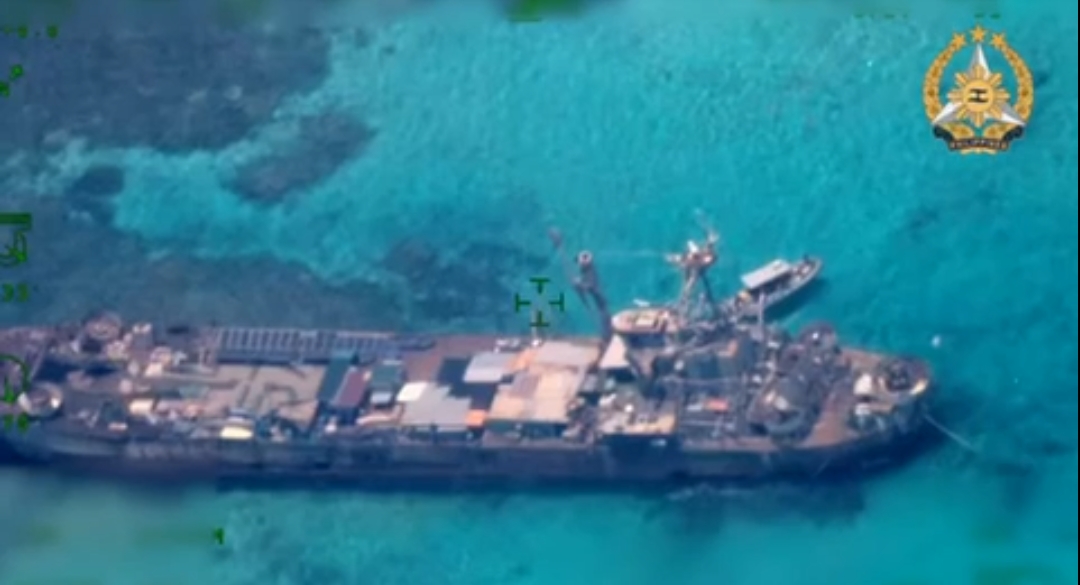
A rigid hull inflatable boat (RHIB) reaches the starboard side of BRP Sierra Madre in Ayungin Shoal to deliver fresh supplies for Filipino troops manning the outpost in the West Philippine Sea on March 23, 2024. (Photo courtesy of the Armed Forces of the Philippines)
In a statement from the US Department of State spokesperson Matthew Miller, Manila’s strongest ally condemned the “dangerous actions” by China against Philippine maritime operations in the contested South China Sea on Saturday, March 23.
“This incident marks only the latest in the PRC’s (People’s Republic of China) repeated obstruction of Philippine vessels’ exercise of high seas freedom of navigation and disruption of supply lines to this longstanding outpost,” he said.
“The PRC’s actions are destabilizing to the region and show clear disregard for international law,” Miller added.
The remarks came after the Armed Forces of the Philippines (AFP) reported that the China Coast Guard (CCG) once more fired water cannons at a Philippine supply vessel in the Ayungin Shoal.
The attack caused “heavy damage” to Unaizah May 4 [UM4], the AFP said, condemning the CCG further for performing a dangerous maneuver by crossing the bow against the Philippine vessel en route to the shoal “for the rotation and resupply mission for the Filipino soldiers stationed in BRP Sierra Madre.”
These “reckless blocking maneuvers,” as the United States described, also injured Filipino service members and rendered the vessel immobile.
“The PRC’s actions prevent normal personnel rotations and deprive Filipino service members at Second Thomas Shoal of necessary provisions,” the statement furthered.
Washington then called on Beijing to follow international maritime laws and reiterated its commitment to the Philippines in regard to the 1951 Mutual Defense Treaty (MDT).
“The United States reaffirms that Article IV of the 1951 U.S.-Philippines Mutual Defense Treaty extends to armed attacks on Philippine armed forces, public vessels, or aircraft – including those of its Coast Guard – anywhere in the South China Sea,” the statement read.
The US State Department asked China to follow the “legally binding decision” of the Arbitral Tribunal’s 2016 ruling, which said that “PRC has no lawful maritime claims to the waters around Second Thomas Shoal and Second Thomas Shoal is a low tide feature clearly within the Philippines exclusive economic zone.”
“As provided under the 1982 Law of the Sea Convention, the 2016 arbitral decision is final and legally binding on the PRC and the Philippines, and the United States calls upon the PRC to abide by the ruling and desist from its dangerous and destabilizing conduct,” it added.
The shoal has been the site of multiple similar incidents in recent months as Philippine vessels were attacked by CCG’s water cannons while on their way to the BRP Sierra Madre, a commissioned Philippine naval vessel permanently stationed in Ayungin Shoal since 1999 “to serve as a constant Philippine government presence in response to China's illegal occupation in 1995 of Panganiban Reef, also known as Mischief Reef.”
The shoal lies about 200 kilometers from Palawan island, but more than 1,000 kilometers from China’s southern Hainan island.
On Saturday, the embassies of France, the United Kingdom, Australia, New Zealand, the European Union, Japan, and the United States in the Philippines expressed its concern on CCG’s actions in the disputed waters.