







NDA to establish dairy stock farms in ancestral domains
By Jel Santos


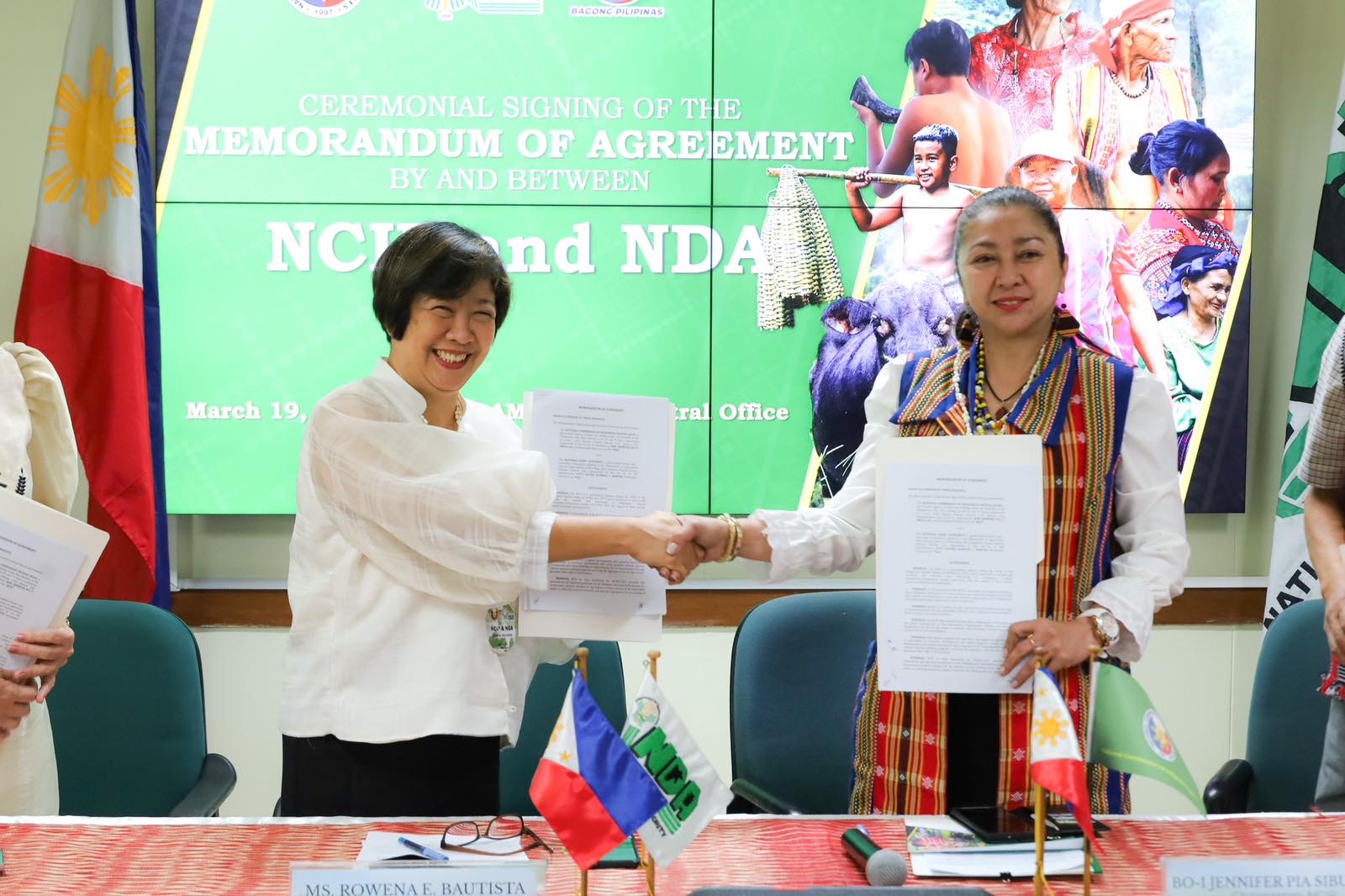
The National Dairy Authority (NDA) will put up dairy stock farms in the Philippines’ ancestral domains in a bid to introduce dairy farming as a source of livelihood to Indigenous Peoples (IPs) in the country.
This, after the NDA has signed a memorandum of agreement (MOA) with the National Commission on Indigenous Peoples (NCIP) though NDA officer-in-charge operations manager Rowena Bautista and NCIP Chairperson Bo-i Jennifer Pia Sibug-Las formally inked the MOA on Tuesday, March 19 in Quezon City.
Under the agreement, dairy stock farms will be managed and operated by the NDA for the production, breeding and post-harvest management of dairy animals such as dairy cattle, dairy carabao and dairy goats.
The five pilot areas where the dairy stock farms will be established are Tanay, Rizal; San Ysiro, Antipolo; Pangasinan; Marilog, Davao; and Mating, Bukidnon.
“Primarily, the dairy stock farms will serve as a multiplier farms to be established within the ancestral land and domains of the IPs,” the MOA stated.
The agreement said IPS will be trained in dairy farm management and supplying animal feeds like corn silage and forage in order to include them in the farm workforce.
“The IPs will be tapped to participate as suppliers of forage materials to the project using the Negotiated Procurement for Community Participation as permitted by the Sagip Saka Law,” the MOA read.
The NDA has vowed that the stock farms will adhere to NCIP standards, respecting sacred ancestral land, environmental norms, and traditional protocols cherished by the ICCs (Indigenous Cultural Communities) or IPs.
The MOA added that culture sensitivity trainings for the implementers of the program from the NDA will be programmed under the Continuing Capability Enhancement Activities.
To prepare the IPs, the NDA said it will conduct orientations and continuous training covering various agricultural techniques such as dairy production, animal health and management, artificial insemination, milk processing, financial literacy, business development, and food safety, among others.
According to Bautista, partnerships between government agencies such as this is potent for the Philippines to achieve food security.
"It is imperative that we combine our resources and expertise for the greater good of our country,” she went on.
The establishments of stocks farms, she said, is another step closer in achieving NDA’s goals of achieving its goal of boosting its milk production to 80 million liters by 2028 to help improve the country’s dairy sector.
“The NDA is driven by a forceful goal: to achieve five percent milk sufficiency, equivalent to 80 million liters of milk, by the year 2028. Ambitious as it is, every contribution plays a significant role in reaching this milestone. Every drop in the bucket - or in this case, the milk can, is important,” the NDA official said.
Per the data of the NDA, cattle production in 2023 reached 17,850 metric tons, accounting for approximately 0.8 percent of total milk consumption of 1.937 million metric tons.
On March 12, Agriculture Secretary Francisco “Kiko” Tiu Laurel Jr. vowed to provide an additional P3 billion in funding to the existing budget of the NDA to boost its operations throughout the Philippines.
Laurel said the agriculture department will invest in essential dairy infrastructure, provide technical assistance to farmers, and attract new investors to make the industry more profitable and dynamic.