






 Business
Philippines weighs up tech review vs relicensing for imported nuclear reactors
Business
Philippines weighs up tech review vs relicensing for imported nuclear reactors
Philippines weighs up tech review vs relicensing for imported nuclear reactors
Repositioning nuclear as a 'sexy choice' for the younger generations


At A Glance
- What is shaping up for the industry will be a stringent and lengthy licensing processes that PhilATOM will be working on – through the entire chain of application, deliberations, review and approvals of a license for the siting, license to construct, license to operate as well as the eventual license for decommissioning that will be lodged by the prospective nuclear power project-sponsors.
- Corollary to the licensing framework for nuclear, there is also a need to build up the human core of the regulatory agency, which needs to be capacitated with at least 200 'nuclearized' experts and administrative people to run PhilATOM.
TORONTO – Emerging regulators in the Philippines are weighing up options whether to undertake relicensing process or to just opt for technology design review of the nuclear reactors that will eventually be imported for deployment in the domestic power industry.
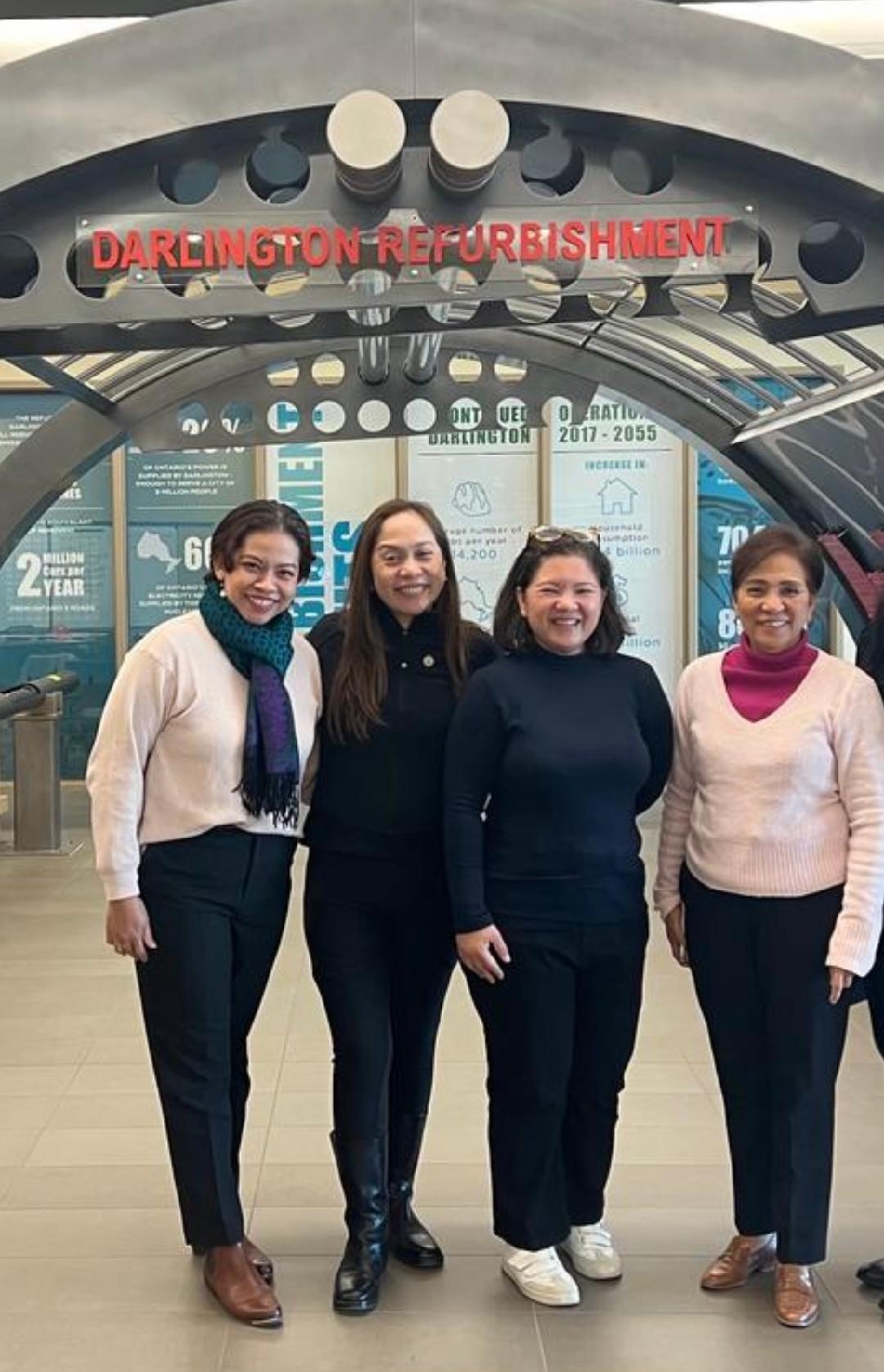
The 'Power Women' who are instrumental in helping shape the country's nuclear future - Dr. Vallerie Samson of PNRI, Energy Undersecretary Sharon Garin, ERC Chairperson Monalisa Dimalanta and DOST Undersecretary Leah Buendia.
In an interview, Dr. Vallerie Ann I. Samson, deputy director of the Philippine Nuclear Research Institute (PNRI), stated that when the proposed Philippine Atomic Energy Regulatory Authority (PhilATOM) will be duly constituted, one of the major items it will need to decide on will be the nature of regulations to be enforced for the nuclear reactors that will be procured from offshore suppliers and will be subsequently utilized for power applications in the country.
As targeted, the PNRI may eventually be integrated into PhilATOM and will take on the paramount role of licensing nuclear technologies to be deployed for power plant developments in the Philippines.
“If there is already a vendor’s license for the nuclear reactor, then perhaps we can just adopt it instead of doing relicensing. But definitely, we will still do technology review – and by resorting to that process, maybe we can cut approval time for licensing by at least 10 months to one year,” she said.
On the propounded adoption of the vendor’s license, she noted that one point of contention will be on nuclear reactor suppliers from some countries that are less transparent when it comes to the feature and development facets of their respective technologies.
Samson qualified “on these concerns, we will cross the bridge when we get there,” although she noted that one fundamental step they are pitching for to address that is to firm up international collaboration on regulations with countries that will be supplying these reactors.
“We will need to have international cooperation with the other regulators – so if developers will be looking to have China-built or European-built, Canadian-built or American-built reactors, then we already need to establish such collaborations early on, that way, we can also familiarize ourselves with their system of regulation. So far, we already have strong collaboration with the US, but we still need to work on this with the other countries,” she expounded.
Long and stringent process of licensing
At this point, she highlighted that what is shaping up for the industry so far will be the stringent and lengthy licensing processes that PhilATOM will be working on – through the entire chain of application, deliberations, review and approvals of a license for the siting, license to construct, license to operate as well as the eventual license for decommissioning that will be lodged by the prospective nuclear power project-sponsors.
On the license for project siting of a nuclear power facility alone, Samson indicated that the timeframe could take 2-4 years or even up to maximum of five years, “because we really need to do this process very comprehensively given the implications on safety as well as security involved in the operations of nuclear power facilities.”
Compared to medical isotopes of which licensing can done in just a matter of one to two months, Samson emphasized that the licensing for nuclear power plants “will definitely take longer because the degree of risks on safety will certainly be more expansive.”
In the case of Canada, the licensing for the site alone could take as much as three years – even for the planned deployment of fourth generation small modular reactors (SMRs) and micro modular reactors (MMRs).
Then from the site licensing, the project developer will need to apply next for license to construct which may take another 2-3 years; then license to operate when the plant is already up for commercial operations which may stretch for another two years; and upon nearing the end of the generating asset’s production life cycle, there is also a need to apply for a license to decommission.
At mid-life cycle of the plant’s operations, a refurbishment of the facilities may be pursued – similar to what Ontario Power Generation has been doing at its Darlington nuclear energy complex.
According to Christopher Grills, senior communications advisor at Ontario Power, the licensing process for the refurbishment of a nuclear power plant is roughly similar to the system of licensing being done in the development of a greenfield nuclear generating asset.
He added that even for the people working at project sites, there is warranted requalification procedure that they will need to go through before they can be re-assigned to refurbishment tasks from one reactor to another.
“The workers at the site will need to be back for requalification before getting assigned to the refurbishment at another reactor; and the re-certification is a guaranteed way of ensuring that the workers will be able to meet specific criteria and standards in the positions or work that they will be assigned to,” Grills conveyed.
Altogether, it was specified that the three-tiered licensing system for nuclear power projects – from the site to construction and operations will take at least 8 to 10 years.
Taking cue from that then, Energy Undersecretary Sharon S. Garin qualified that the nuclear pathway for the Philippines may still traverse a long and winding road – and prospects of deployment may take until mid-2030’s or within 2035, instead of the targeted 2032 timeframe.
Unleashing human potential for nuclear renaissance
Corollary to the licensing framework for nuclear, Samson similarly asserted the need to build up the human core of the regulatory agency, which needs to be capacitated with at least 200 ‘nuclearized’ experts and administrative people to run PhilATOM.
On the warranted ‘training of trainers’, she narrated that what is being contemplated will be to reinforce the atomic regulatory agency with at least five professionals with Doctor of Philosophy (PhD) degrees; and another five with Masters in Nuclear Science Engineering – and it will be them who will be passing on knowledge and expertise to the mid-level officials and organic employees down the line.
“We regularly have international collaborations - so in PNRI, we are internationally linked with the IAEA (International Atomic Energy Agency) which regularly conducts training and workshops to speed up human resources capability in nuclear; and we also have a lot of international collaborations with other universities and other research institutions overseas like ANSTO or the Australian Nuclear Science and Technology Organisation,” Samson shared.
To complement that, she opined that the additional capacity enhancements that could be done upon the institutionalization of PhilATOM will be for its top experts to pursue further studies in offshore universities and research institutions that have already shown topnotch expertise in the nuclear industry.
Then on the broader sphere of capacity development for the next generation of workforce in the nuclear sector, she highlighted that a specific degree on Nuclear Science and Technology will already be offered in the University of the Philippines (UP) starting academic year 2025.
“At UP, we are now preparing the program - a graduate program on Master of Science in Nuclear Science and Technology and it might be online positively in 2025, so we are hard at work preparing the whole curriculum of that Master’s Degree program and it will cover 3 tracks: one is the nuclear regulator track because we need approximately 200 regulators if we have the nuclear power program; then we will have the health track – for nuclear medicine and the medical isotopes; and the other track is of course, nuclear engineering track,” she declared.
A well-calculated follow through to that, she divulged, is the planned Science and Engineering program that we will be concretizing at the Mindanao State University- Iligan Institute of Technology (MSU-IIT) in the next 2-3 years.
“We just inked MOU (memorandum of understanding) with the MSU-IIT because they have very strong program in science and engineering as well. They are interested to replicate the nuclear program that we will be pioneering in UP, and they are really prepared to take on another nuclear science and technology academic program, so we are anticipating that to happen soon also,” she averred.
Asked on how the regulators and the industry as a whole can line up nuclear as a ‘sexy’ professional choice for the younger generation, Samson articulated that since nuclear is a fixture in the constantly evolving and advancing technologies, it thrives as a relatively alluring proposition into the younger generations’ affinity for innovation and technological breakthroughs; as well as on their highly immersive leaning toward abating climate change risks and embracing everything that is environment-friendly.
An acid test to that, she reckoned, was the result of a survey carried out for UP students in which they have bestowed overwhelming acceptance to the proposed introduction of a Master’s Degree program on Nuclear Science and Technology.
“Our young generation of people, as much as they like tiktok and highly attached to social media, they also like new technologies. In fact, when UP launched a survey on the plan to have a Master’s Program on Nuclear Science and Technology –it was oversubscribed. There was really overwhelming response, so that really gives us high hopes for the future on nuclear adoption in the country – and certainly, we will not be lacking talents,” Samson enthused.”