







ERC takes 'regulatory reconnaissance' from Canada's structural changes


At A Glance
- Within the precept of structural shifts adopted by the Canadian regulators, the Ontario Energy Board opted to split the role of its administrative board to the entity that has been focused on adjudicative function – that is in contrast to the amalgamated structure of the ERC now which has been doing work on administrative, quasi-judicial as well as legislative responsibilities all at the same time.
TORONTO – The Energy Regulatory Commission (ERC) is enthusiastically poring over the structural changes implemented by the Ontario Energy Board (OEB), primarily on regulation frames that are also viable for enforcement in the Philippine power sector.
Following a meeting with Ontario Energy Board Chief Commissioner Lynne Anderson and Chief Operating Officer Harneet Panesar, ERC Chairperson Monalisa C. Dimalanta shared that there have been major lessons she gained from discussion with her Canadian peers – and these are matters worth considering for the structural changes that may applied for the ERC based on amendments to be rendered in the Electric Power Industry Reform Act.
“The first key point was that: they needed to make some fundamental structural changes in 2010 to 2013, because the industry and the market has changed, so they saw the need to also revisit their structure. So now, their structure is a ‘better fit’ to the evolving market structure that they have,” the ERC chief conveyed.
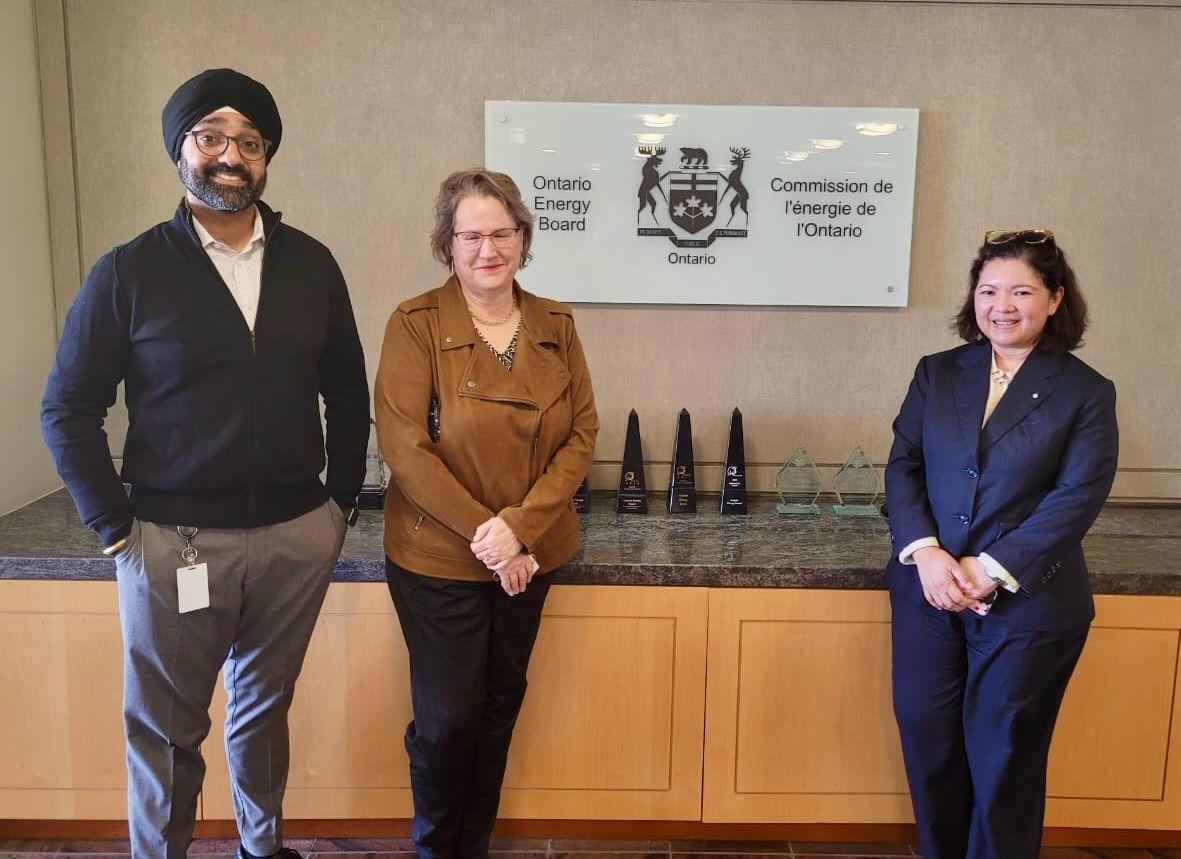
ERC Chairperson Monalisa Dimalanta in a meeting with Ontario Energy Board Chief Commissioner Lynne Anderson and COO Harneet Panesar.
Within the precept of those structural shifts, Dimalanta explained that the Ontario energy regulator opted to split the role of its administrative board to the entity that has been focused on adjudicative function – that is in contrast to the amalgamated structure of the ERC now which has been doing work on administrative, quasi-judicial as well as legislative responsibilities all at the same time.
“For the Ontario Energy Board, they are now more structured as a corporate – more aligned towards a corporate structure, such that their Board actually oversees the three legs: administrative leg, operations leg and adjudicative leg, but there is demarcation of function,” she noted.
The ERC chief further narrated that “for the adjudicative leg, in particular, that is not the full Commission – the adjudicative is just set of Commissioners and their respective staff – and they are the ones that handle the rate-filings and other related matters. So that portion of the organization is not involved on the administrative side. The beauty of that is: their time is not divided between the administrative and adjudicative side of operations.”
On the fiscal independence tenet, Dimalanta recounted that “similar to us, they can charge fees, so they earn their fees but they don’t remit their fees to the Treasury. So their fees actually sustain their operations.”
When asked if the same regulatory regime could be applicable to the ERC, Dimalanta opined that “my takeaway there is: we have been looking at fiscal autonomy for some time…but that fiscal autonomy in our structure has pros and cons, so we will need to strike a balance in our own regulatory framework.”
She expounded “pro is that: it is an advantage that you can allocate your earnings according to the needs of the agency. However, one con of that is: it might perpetuate a thinking on the part of the regulator that they need to impose higher fees to sustain operation, we don’t want that either, so I think – in our structure, what we would have is: a hybrid type.”
Dimalanta said one feasible compromise is “we can have the authority to retain a portion of our collections, so we can allocate budget into certain priorities that the agency has. But at the same time, we must be able to remit the remaining portion to the Treasury as dividends to the national government.”
In Canada’s case, she emphasized that a budget reinforcement from their collected fees had been strategically funneled for ‘consumer protection’ – which is a good practice that the Philippines may also be able to seriously ponder on.
Beyond that, Dimalanta highlighted that they could also break free from funding restraints on the ERC’s digitalization efforts – fundamentally so since there is a need for continuous upgrade on the Commission’s information technology (IT) system so they can expedite processes not just on approvals of regulatory filings, but more so, in the overall service improvements that they will extend to consumers and other relevant stakeholders.
“One major need for us really is: fund that will support our digitalization efforts and allow a periodic upgrading of our systems; because right now, the way it happens with all government agencies is that: if we have IT programs – even for purchase of laptops, we need DICT (Department of Information and Communications Technology) approval,” she stated.
For some time the hurdle on that set-up, she indicated was that “any deviation from the plan that we submit to DICT, including an increase in the price for example of the laptop unit – you have to re-do the application.”
The ERC chief added “it goes the same with our subscription with global institutions like Bloomberg, we need DICT approval because those are considered ICT (information and communications technology) services – and those subscriptions are quoted in US dollars, so we also need to change them if there is any movement in the Philippine peso equivalent. So we have been stuck for some time on that, although eventually, we already found a way around it,” she stressed.
Dimalanta qualified those constraints can be addressed if the ERC can have institutionalized fiscal autonomy via the EPIRA amendments being pushed – and the balancing act to be pursued will be remittance of a prescribed portion of the ERC collections to the national coffers with all the warranted oversight and scrutiny also of the Commission on Audit.
“I think what’s helpful in the discussion with our counterparts in Canada is: knowing what others have done --not necessarily to copy them and just adopt their structure because it may not be a fit for us and that may derail us, but to get ideas of various options available. I guess my biggest takeaway is: an affirmation that we’re not alone in this – it is really happening everywhere in the world; and what’s good is that: we can learn from each other and we can see what works,” she stressed.