






 Philippines
National
What happened when Marcos met all four of the Czech Republic's top officials
Philippines
National
What happened when Marcos met all four of the Czech Republic's top officials
What happened when Marcos met all four of the Czech Republic's top officials


At A Glance
- The meetings, which all took place here in Prague on Thursday, March 15, are aimed at strengthening the bilateral cooperation and multilateral partnerships between the Philippines and the Czech Republic. He was accompanied by Senate President Juan Miguel Zubiri and Speaker Ferdinand Martin Romualdez in his meetings with the four officials.
PRAGUE, Czech Republic — President Marcos took advantage of his three-day State Visit to the Czech Republic and met all four of the Central European country's top officials, including President Petr Pavel and Prime Minister Petr Fiala.
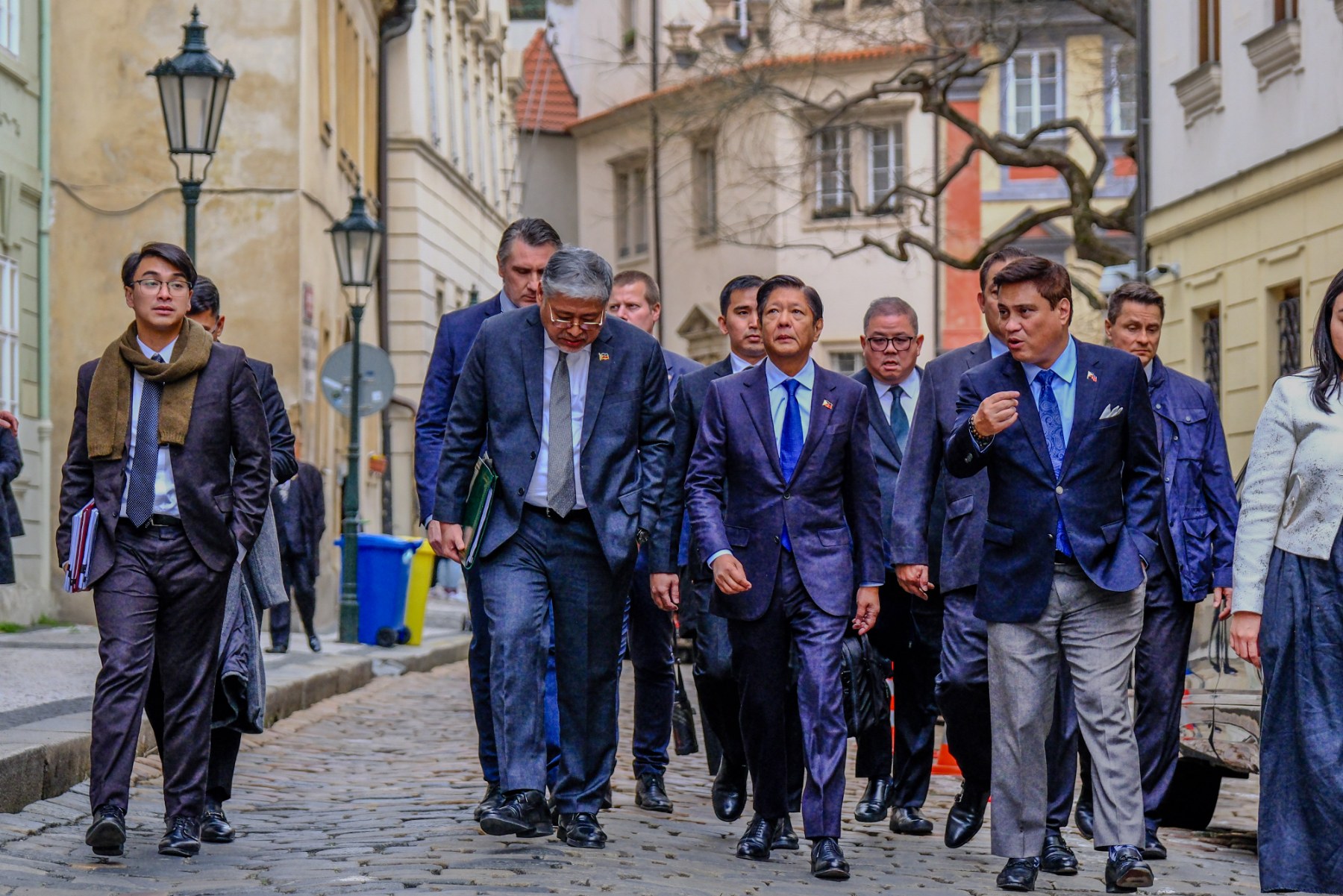
The meetings, which all took place here in Prague on Thursday, March 15, are aimed at strengthening the bilateral cooperation and multilateral partnerships between the Philippines and the Czech Republic. He was accompanied by Senate President Juan Miguel Zubiri and Speaker Ferdinand Martin Romualdez in his meetings with the four officials.
Arrival honors were accorded to President Marcos and First Lady Liza Araneta-Marcos at the Prague Castle where he was warmly welcomed by Czech Republic President Petr Pavel and First Lady Eva Pavlová.
Marcos and Pavel discussed a range of topics, including measures on how the Philippines and the Czech Republic can strengthen the bilateral ties, cooperation, and multilateral partnerships between the two countries.
They also witnessed the signing of the Joint Communique to establish a labor consultation mechanism between the Department of Migrant Workers (DMW) and the Czech Ministry of Labor and Social Affairs.
In addition, both leaders discussed the position of the Philippine government in the South China Sea issues, and the continued efforts to explore various opportunities in terms of trade and investments, agriculture, green economy, renewable energy, space, aerospace, education, tourism, and defense, among others.
Shortly, President Marcos had a working lunch with Czech Senate President Miloš Vystrčil at the Czech Senate where he highlighted the importance of the bicameral system in the Philippines.
The President noted with appreciation the recent positive exchanges between the Philippines and Czech Republic parliaments and encouraged the Senate President to help promote trade, investment, and economic cooperation between the two countries.
They likewise discussed the 50th anniversary of the Philippines-Czech Republic bilateral relations and ways to strengthen cooperation on labor, agriculture, food security, and climate change. Both leaders also exchanged views on regional and international issues.
President Marcos also expressed that the Philippines’ priority is the safe and orderly migration of Filipinos into the Czech Republic, guided by both nations’ labor regulations, and the protection of their rights and well-being.
President Marcos then met with the Czech Speaker of the Chamber of Deputies Markéta Pekarová Adamová where he expressed pride in the industry and skills of the Filipino workers and emphasized that the Philippines has the biggest assets in terms of its young workforce.
He welcomed the more enhanced people-to-people relationship with the Central European country, as well as its decision to allow more Filipino workers to join its labor market. Starting in May this year, the Czech Republic is allowing 10,300 Filipinos to enter the country yearly.
“[The] increase in the quota gives us an opportunity in the Philippines to have another avenue for our overseas workers who have traditionally have become rather a very large part of our economy and very large part of the contributions that they make to our economy,” Marcos said during the meeting.
“And it’s not only in terms of the remittances that they send back, the money they send back to their families. It is the good performance that they have shown in their host countries. That has been a great advantage to the Philippines, the assimilation of our people to Czech society has become an important and fruitful one,” he added.
Before concluding his visit, President Marcos sat a bilateral meeting with Czech Prime Minister Petr Fiala where they both agreed to further strengthen the bilateral relationship between the two countries.
This is the third meeting between the two leaders since the 2022 Commemorative Summit of the Association of Southeast Asian Nations (ASEAN) – European Union (EU) in Belgium and the Czech Prime Minister’s official visit to the Philippines in April last year.
During their meeting, President Marcos conveyed the Philippines’ commitment to work with like-minded countries like the Czech Republic in upholding a rules-based international order. He also sought more engagements with Czech defense establishments to enhance cooperation on security, defense-industrial, and cybersecurity.
Both leaders also discussed the huge potential of increasing cooperation on trade and investment, agriculture, labor, and climate change.
In terms of people-to-people ties, President Marcos said the Philippines is keen on strengthening this relationship through tourism and university-to-university linkages. He invited the Czech people to visit the Philippines and experience its beautiful tourist destinations and excellent Filipino hospitality.
“Hopefully, we will see more of your citizens coming to the Philippines. And I can see that this is an area that will continue to increase for us," he said.
“We take pride in the Filipino hospitality, and we take pride in our beautiful country," he added, noting that the Philippines considers its tourism sector an important part in reviving the economy after the pandemic.
The Czech Republic is second home to 7,026 Filipinos working in the processing industry, automotive, repairs and appliances, manufacturing, IT communications, real estate, health/wellness, and household service work.
Diplomatic relations between the Philippines and the Czech Republic were officially established on Oct. 5, 1973.
Before flying back to Manila, the President will speak at the Philippine-Czech Republic Business Forum in Prague on Friday and conduct a bilateral meeting with a local firm. He will also meet with the Filipino community in Prague to cap his state visit to the Czech capital.