






 Business
Investors weigh-in on siting, regulation as major challenges to Philippine nuclear power projects
Business
Investors weigh-in on siting, regulation as major challenges to Philippine nuclear power projects
Investors weigh-in on siting, regulation as major challenges to Philippine nuclear power projects


At A Glance
- Nuclear project siting must prudently factor in resilience of these areas from the tremors of nature's fury such as earthquakes and tsunamis; and there is also a need to incorporate hydrological dynamics – including unwavering adherence for water resources to always remain untainted with radioactive contaminants.
- In the case of Canada's power sector, the sites of their nuclear generating facilities in Ontario and New Brunswick typically straddle domains inhabited by indigenous peoples, nevertheless, they have successfully hurdled social acceptance and were able to co-exist harmoniously with their host communities, hence, that is one best practice that the Philippines has been taking serious notes on.
TORONTO – Investors who are seriously looking at infusing heavy capital for nuclear power projects in the Philippines are decisively assessing concerns on siting as well as certainty of regulatory frameworks being the challenges that could make or break a deal in the resurgence of this high-powered technology in the country’s energy mix.
Felino M. Bernardo, chief operating officer (COO) and head of Energy Transition Projects of Aboitiz Power Corporation who has been part of the delegation to the Philippine Nuclear Energy Mission to Canada, indicated that the two major items they must seriously scrutinize will be the selection of site; as well as racing certainty and predictability of regulations – primarily those that are linked to safety as well as tariff-setting on warranted revenue stream from the planned facilities.
He qualified “the integrity of the site is one of the important elements we are studying, because in most countries that we have visited, their projects are State-sponsored and because of that, it is also their government that has been selecting the site. But in the case of the Philippines, our industry is private sector-driven, so there is that major question: who will now choose the site?”
Bernardo conveyed that based on initial discussions with relevant government agencies, the site selection might be a ‘collaborative undertaking’ that the private investors must judiciously work on with the government, especially with the Department of Energy (DOE) as the lead agency pushing for nuclear renaissance, then with the entity which will eventually be designated as the regulator.
“What we are discussing is: both government and private investors must work together on looking at prospective sites. The government has its own criteria, then the private sector must also be given its call – because it’s the private sector that has deeper understanding of the sites that can be integrated easier into the grid,” the Aboitiz Power executive noted.
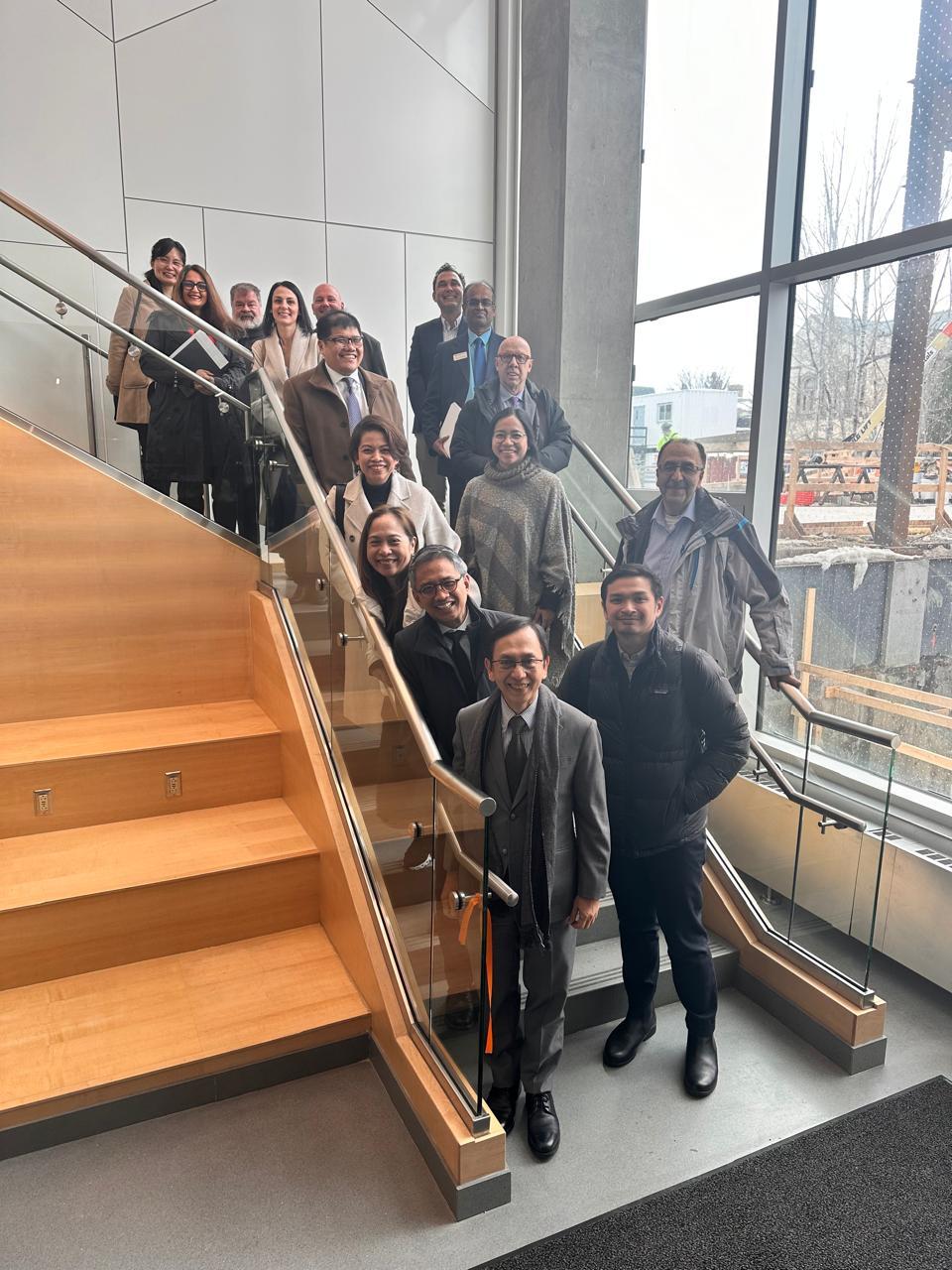
The last leg of the Philippine Nuclear Energy Mission in Saskatoon
Froilan J. Savet, first vice president and head of networks of power utility giant Manila Electric Company (Meralco), specified that when it comes to project siting, it is likewise paramount to ruminate about technologies that nuclear power will eventually be replacing in the entire chain of the Philippine power system.
In his view, project siting must prudently factor in resilience of these areas from the tremors of nature’s fury such as earthquakes and tsunamis; and there is also a need to incorporate hydrological dynamics – including unwavering adherence for water resources to always remain untainted with radioactive contaminants.
Savet expounded that if there is plan to align nuclear as replacement to coal-fired power facilities that are up for retirement in the coming years and decades, then “the existing site of these coal plants or other generating facilities can be studied by the government as prospective sites also for future nuclear power facilities.”
He said “there are capacities that are being eyed to be replaced with other technologies in the grid, so assuming the current sites of the facilities will pass geological and other safety assessments by government regulators, then these can be aligned as prospective site for nuclear power projects – and these could offer economies of scale because they already have sub-transmission and transmission assets that will ensure grid connection.”
The Meralco executive added “the DOE can study these sites – and they can just examine if these will pass their criteria like the resilience of these areas to seismic activities, their overall geological terrain as well as their proximity to population centers and even the stringent requirements for lading if needed.”
In the case of Meralco, it is setting its sights on targeted rollout of micro modular reactors (MMRs), a fourth-generation nuclear energy technology that can underpin the energy-intensive operations of data centers.
Sebastian R. Lacson, chief executive officer of Prime Metro BMD Corporation of the Razon group, emphasized that the long-running experience of Canada in nuclear power generation sends a profound message that “nuclear technology is a safe option that the Philippines can explore for its future energy mix.”
Yet similar to what the other prospective Filipino investors have already been sounding off, he echoed that the policies and regulatory toolboxes for the industry must be well thought out – and the planning must be comprehensive, not just from the facility’s siting, but even on the design of the technology to be deployed, onward to construction then to operations as well as on eventual waste management and disposal strategies up to decommissioning of the installed reactors.
In the case of Canada’s power sector, the sites of their nuclear generating facilities in Ontario and New Brunswick typically straddle domains inhabited by indigenous peoples, nevertheless, they have successfully hurdled social acceptance and were able to co-exist harmoniously with their host communities, hence, that is one best practice that the Philippines has been taking serious notes on.
Navigating nuclear’s regulatory tightrope
Beyond siting, regulation is the other Gordian knot in nuclear power development that has been worrying prospective investors; especially if the stability of policies and regulatory frameworks would be wobbled or tinkered upon at every change of government leaderships.
Then on the precept of safety, investors must similarly gain utmost confidence that the designated regulators can really exercise their assigned tasks efficiently and effectively – because failure on the critical component of safety regulations could trigger profound peril, not just on the economic sphere but more so with lost lives.
“Regulation is really a major concern in most, if not all countries - especially on safety regulation. There’s high degree of uncertainty, so regulation must be effective, well-calculated and must be judiciously enforced. And we must have a strong policy – that there is assurance that the policy will not change, because if your policies keep on changing, you project will incur delays then your capex will swell, that’s why there are concerns of cost overruns due to project delays,” Bernardo stressed.
He further asserted that on the commercial standpoint of project development, the calculation for return on investment must also be judiciously tackled within the industry’s regulatory regime – and that is crucial because of the high capex (capital expenditure) requirements of nuclear power facilities as well as the added cost on redundancies for safety operations.
Bernardo highlighted “nuclear is an expensive way to generate cheap electricity. The capex is high; and the private sector alone may not be able to do it, so the government has to help us – one way of doing that is spread the duration of the PPAs (power purchase agreements), the existing PPAs of 15 to 20 years for other technologies may not be enough in the case of nuclear generation, so that has to be addressed by regulators. Nuclear will eventually thrive as a cheap option, but that will happen within the long stretch of the plant’s operation spanning several decades.”