

ADVERTISEMENT

'Great alternative energy source': UP scientists find evidence of 'gas hydrates' in Manila Trench

Published Mar 13, 2024 10:23 am

Geologists from the University of the Philippines Diliman (UPD) have discovered evidence of gas hydrates in the Manila Trench.
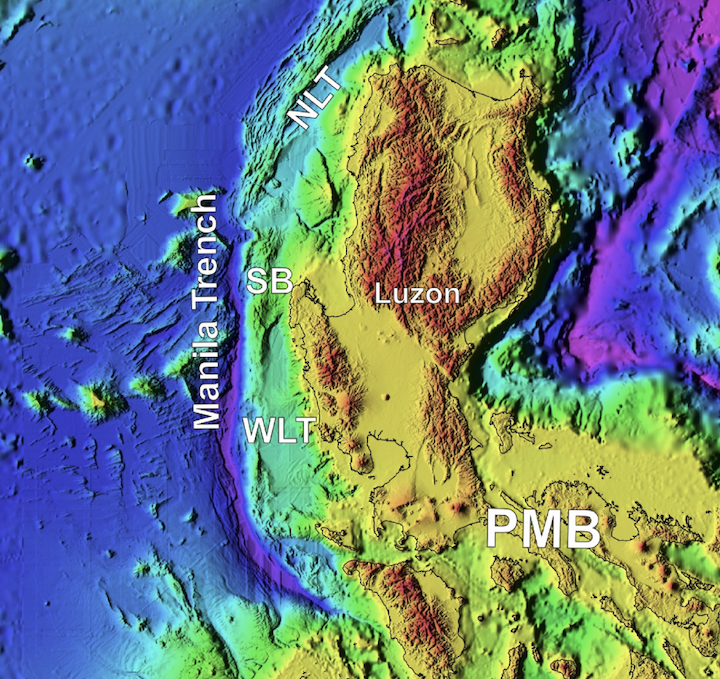
UPGeologistsDiscoverEvidenceofGasHydratesinMa-image2.png
Bathymetric map of Luzon, including the Manila Trench, the North Luzon Trough (NLT), West Luzon Trough (WLT), Stewart Bank (SB), and Philippine Mobile Belt (PMB). (Photo credit: Maglalang et. al. 2023)

This gas, an ice-like substance, serves as a promising alternative energy source.

"Much like carbonated drinks are water infused with carbon dioxide, gas hydrates are ice mostly infused with methane, a natural gas used as fuel," UPD College of Science said in a statement.

"Gas hydrates are ice-like substances that usually only form beneath the seafloor, where the pressure is high and the temperature is just below the water’s freezing point of 0°C," it added.

Elisha Jane Maglalang, Dr. Leo Armada, Madeleine Santos, Karla May Sayen, and Dr. Carla Dimalanta of the UP Diliman-College of Science’s National Institute of Geological Sciences (UPD-CS NIGS) found the possibility that gas hydrates may be "abundant" in the Manila Trench, west of Luzon.

“The western Philippines has vast potential for this unconventional energy resource,” the geologists said.

The researchers observed that a total area of approximately 15,400 square kilometers in the Manila Trench, equivalent to about the size of Palawan, could contain gas hydrates.

UPGeologistsDiscoverEvidenceofGasHydratesinMa-image1.png
A section of the seafloor as mapped using sound waves. (Photo credit: Maglalang et. al. 2023)

They estimate these substances might be located around 200 to 500 meters below the seafloor.

The said discovery is the "first" to investigate the substance in the Philippine trenches.

However, despite the positive and promising effect of the gas hydrates in the energy source discussion, the discovery can also be a geologic and environmental threat.

"Because gas hydrates are unstable solids, they will dissociate and melt when the conditions in which they form change, usually during earthquakes," UPD-CS said.

This is attributed to the fact that the Manila Trench is an active margin, causing numerous earthquakes in Western Luzon.

Consequently, when gas hydrates melt, it can agitate the seafloor, potentially triggering submarine landslides and tsunamis.

Aside from unwanted natural phenomena, methane can affect the environment when released into the atmosphere.

“Methane is a potent greenhouse gas that contributes to global warming, and just one cubic-meter block of gas hydrate contains as many as 160 cubic meter blocks of methane in its gas form. This is equivalent to 14 percent of an average Filipino’s methane emission in 2021,” UPD-CS said.

“Therefore, it is essential to determine the distribution and stability conditions of gas hydrates offshore of the Philippines,” the researchers noted.

How it was discovered

Despite the depth exceeding 5000 meters (m) in the Manila Trench, this discovery might seem nearly impossible to uncover.

However, to locate the substances without drilling through the seafloor, researchers leverage and rely on sound waves. Similar to how a pond reflects sunlight, gas-bearing substances like gas hydrates reflect these waves.

“These seismic reflections, called bottom-simulating reflectors (BSRs), indicate where gas hydrates might be present,” UPD-CS said.

“By analyzing existing seismic data in the Manila Trench, the UP geologists were able to map out BSRs and, consequently, deduce possible locations of gas hydrates in the region,” it added.

Furthermore, scientists underscored that “BSRs are tell-tale signs of gas hydrates, they are not definitive.”

“Future drilling of offshore targets will be instrumental in confirming methane hydrate occurrence,” the researchers said.

“These investigations offer a vital opportunity to develop our indigenous energy wealth,” they added.

Moreover, to further explore the potential for sustainable energy discovery, researchers are conducting additional investigations in other offshore areas in the Philippines to expand their geophysical dataset.

”These efforts will contribute not only to the advancement of scientific knowledge but also to the development of the expertise of Filipino geoscientists in marine geophysics,” the researchers emphasized.

Related Tags

University of the Philippines Diliman (UPD) College of Social Work and Community Development (CSWCD)
ADVERTISEMENT
.most-popular .layout-ratio{ padding-bottom: 79.13%; } @media (min-width: 768px) and (max-width: 1024px) { .widget-title { font-size: 15px !important; } }

{{ articles_filter_1561_widget.title }}

.most-popular .layout-ratio{ padding-bottom: 79.13%; } @media (min-width: 768px) and (max-width: 1024px) { .widget-title { font-size: 15px !important; } }

{{ articles_filter_1562_widget.title }}

.most-popular .layout-ratio{ padding-bottom: 79.13%; } @media (min-width: 768px) and (max-width: 1024px) { .widget-title { font-size: 15px !important; } }

{{ articles_filter_1563_widget.title }}

{{ articles_filter_1564_widget.title }}

.mb-article-details { position: relative; } .mb-article-details .article-body-preview, .mb-article-details .article-body-summary{ font-size: 17px; line-height: 30px; font-family: "Libre Caslon Text", serif; color: #000; } .mb-article-details .article-body-preview iframe , .mb-article-details .article-body-summary iframe{ width: 100%; margin: auto; } .read-more-background { background: linear-gradient(180deg, color(display-p3 1.000 1.000 1.000 / 0) 13.75%, color(display-p3 1.000 1.000 1.000 / 0.8) 30.79%, color(display-p3 1.000 1.000 1.000) 72.5%); position: absolute; height: 200px; width: 100%; bottom: 0; display: flex; justify-content: center; align-items: center; padding: 0; } .read-more-background a{ color: #000; } .read-more-btn { padding: 17px 45px; font-family: Inter; font-weight: 700; font-size: 18px; line-height: 16px; text-align: center; vertical-align: middle; border: 1px solid black; background-color: white; } .hidden { display: none; }
function initializeAllSwipers() { // Get all hidden inputs with cms_article_id document.querySelectorAll('[id^="cms_article_id_"]').forEach(function (input) { const cmsArticleId = input.value; const articleSelector = '#article-' + cmsArticleId + ' .body_images'; const swiperElement = document.querySelector(articleSelector); if (swiperElement && !swiperElement.classList.contains('swiper-initialized')) { new Swiper(articleSelector, { loop: true, pagination: false, navigation: { nextEl: '#article-' + cmsArticleId + ' .swiper-button-next', prevEl: '#article-' + cmsArticleId + ' .swiper-button-prev', }, }); } }); } setTimeout(initializeAllSwipers, 3000); const intersectionObserver = new IntersectionObserver( (entries) => { entries.forEach((entry) => { if (entry.isIntersecting) { const newUrl = entry.target.getAttribute("data-url"); if (newUrl) { history.pushState(null, null, newUrl); let article = entry.target; // Extract metadata const author = article.querySelector('.author-section').textContent.replace('By', '').trim(); const section = article.querySelector('.section-info ').textContent.replace(' ', ' '); const title = article.querySelector('.article-title h1').textContent; // Parse URL for Chartbeat path format const parsedUrl = new URL(newUrl, window.location.origin); const cleanUrl = parsedUrl.host + parsedUrl.pathname; // Update Chartbeat configuration if (typeof window._sf_async_config !== 'undefined') { window._sf_async_config.path = cleanUrl; window._sf_async_config.sections = section; window._sf_async_config.authors = author; } // Track virtual page view with Chartbeat if (typeof pSUPERFLY !== 'undefined' && typeof pSUPERFLY.virtualPage === 'function') { try { pSUPERFLY.virtualPage({ path: cleanUrl, title: title, sections: section, authors: author }); } catch (error) { console.error('ping error', error); } } // Optional: Update document title if (title && title !== document.title) { document.title = title; } } } }); }, { threshold: 0.1 } ); function showArticleBody(button) { const article = button.closest("article"); const summary = article.querySelector(".article-body-summary"); const body = article.querySelector(".article-body-preview"); const readMoreSection = article.querySelector(".read-more-background"); // Hide summary and read-more section summary.style.display = "none"; readMoreSection.style.display = "none"; // Show the full article body body.classList.remove("hidden"); } document.addEventListener("DOMContentLoaded", () => { let loadCount = 0; // Track how many times articles are loaded const offset = [1, 2, 3, 4, 5, 6, 7, 8, 9, 10]; // Offset values const currentUrl = window.location.pathname.substring(1); let isLoading = false; // Prevent multiple calls if (!currentUrl) { console.log("Current URL is invalid."); return; } const sentinel = document.getElementById("load-more-sentinel"); if (!sentinel) { console.log("Sentinel element not found."); return; } function isSentinelVisible() { const rect = sentinel.getBoundingClientRect(); return ( rect.top < window.innerHeight && rect.bottom >= 0 ); } function onScroll() { if (isLoading) return; if (isSentinelVisible()) { if (loadCount >= offset.length) { console.log("Maximum load attempts reached."); window.removeEventListener("scroll", onScroll); return; } isLoading = true; const currentOffset = offset[loadCount]; window.loadMoreItems().then(() => { let article = document.querySelector('#widget_1690 > div:nth-last-of-type(2) article'); intersectionObserver.observe(article) loadCount++; }).catch(error => { console.error("Error loading more items:", error); }).finally(() => { isLoading = false; }); } } window.addEventListener("scroll", onScroll); });

Sign up by email to receive news.