






 Philippines
National
Revolutionizing healthcare: How AI can improve patient outcomes
Philippines
National
Revolutionizing healthcare: How AI can improve patient outcomes
Revolutionizing healthcare: How AI can improve patient outcomes


A medical professional discussed the potential of artificial intelligence (AI) in revolutionizing medicine at the Department of Science and Technology-National Research Council of the Philippines (DOST-NRCP) Annual Scientific Conference (ASC) on Tuesday, March 12.
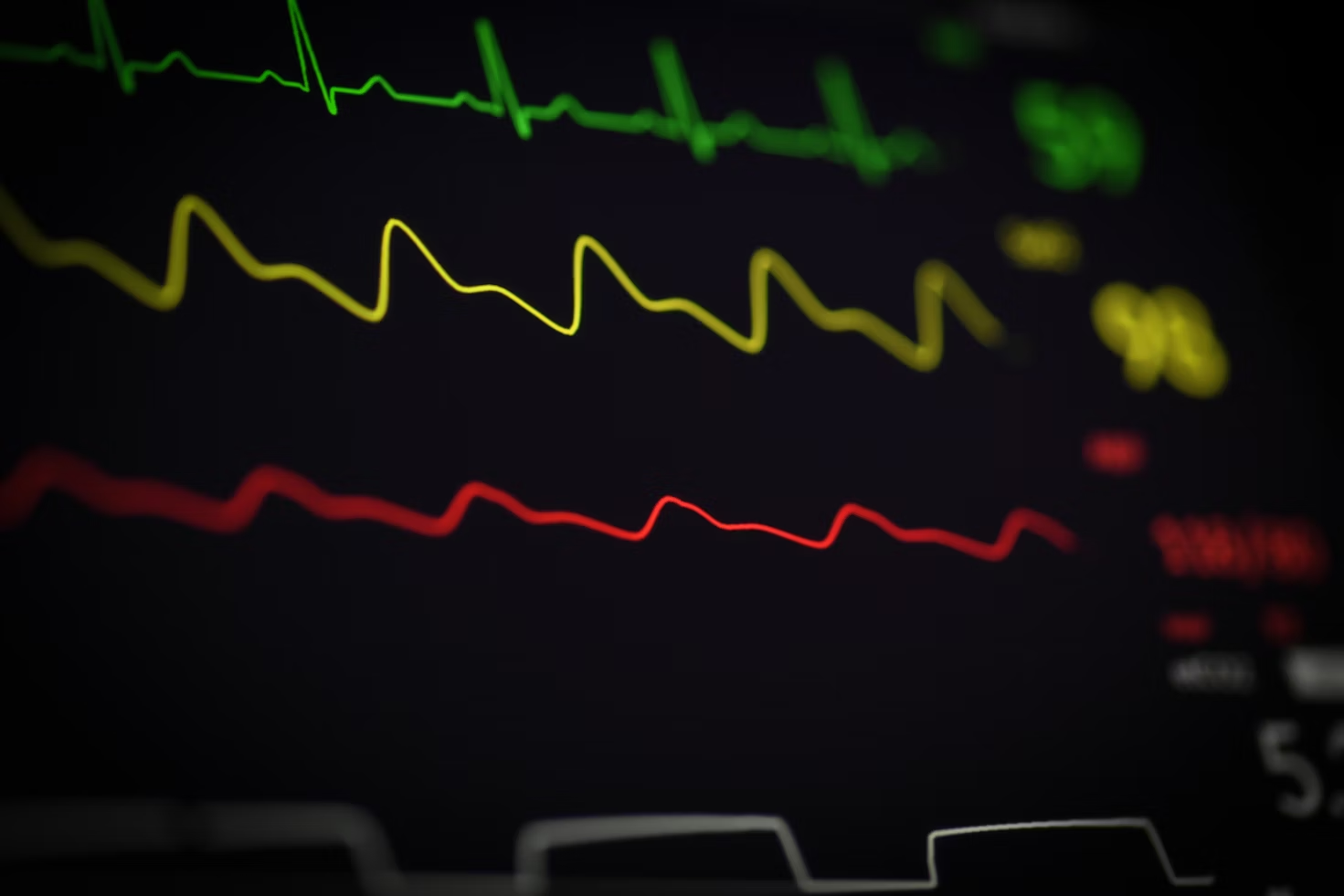
Dr. Reynaldo L. Garcia from the NRCP Division III Medical Science shared an example of electrocardiograms (ECGs), the familiar heart rhythm tracer used by cardiologists in other countries.
He explained how AI can analyze vast amounts of ECG data, including patient outcomes to identify patterns that human doctors might miss.
“In other countries, there are thousands of patients and then there's data that whatever happened to those patients some of them survived, some of them actually died,” he said.
It was discovered that the cardiologist there was unable to see the patient's condition using the ECG, as its function is designed to detect abnormal rhythms and display the trace.
However, "AI was able to see something that a cardiologist would not see," Garcia said. "It could predict, with the benefit of hindsight that a patient would have a heart attack months later," he added.
This example, he said, showcased the power of AI in medicine.
"It can totally analyze massive datasets to find patterns that are invisible to experts because we have to admit, cardiologists are good, but there's something that AI can see that the doctors cannot see," Garcia explained.
He also pointed out that in many of the projects now, as it relates to AI and medicine, researchers are trying to prove that "AI is not only as good as the data you feed it."
Garcia emphasized that with vast amounts of clinical data and ECG readings, the AI can be used to predict a patient's prognosis, even when the ECGs seem normal to human eyes.
In the country, the expert is looking forward to the potential of AI in hospitals, despite concerns about the quality of the data available for use.
“We better take stock of those data and let AI do the job," Garcia said.
He added that the predictions made by AI will still need to be "validated" before being implemented.
However, Garcia pointed out that AI has a very clear application in the field of medical sciences.