

ADVERTISEMENT

Paris Olympics medals to contain 'piece of Eiffel Tower'

Published Feb 9, 2024 02:01 am

At A Glance

  • The medals awarded at this year's Paris Olympics and Paralympics will feature a hexagon-shaped piece of iron taken from the original Eiffel Tower in their center, organizers said as they unveiled the design on Thursday, Feb. 8.
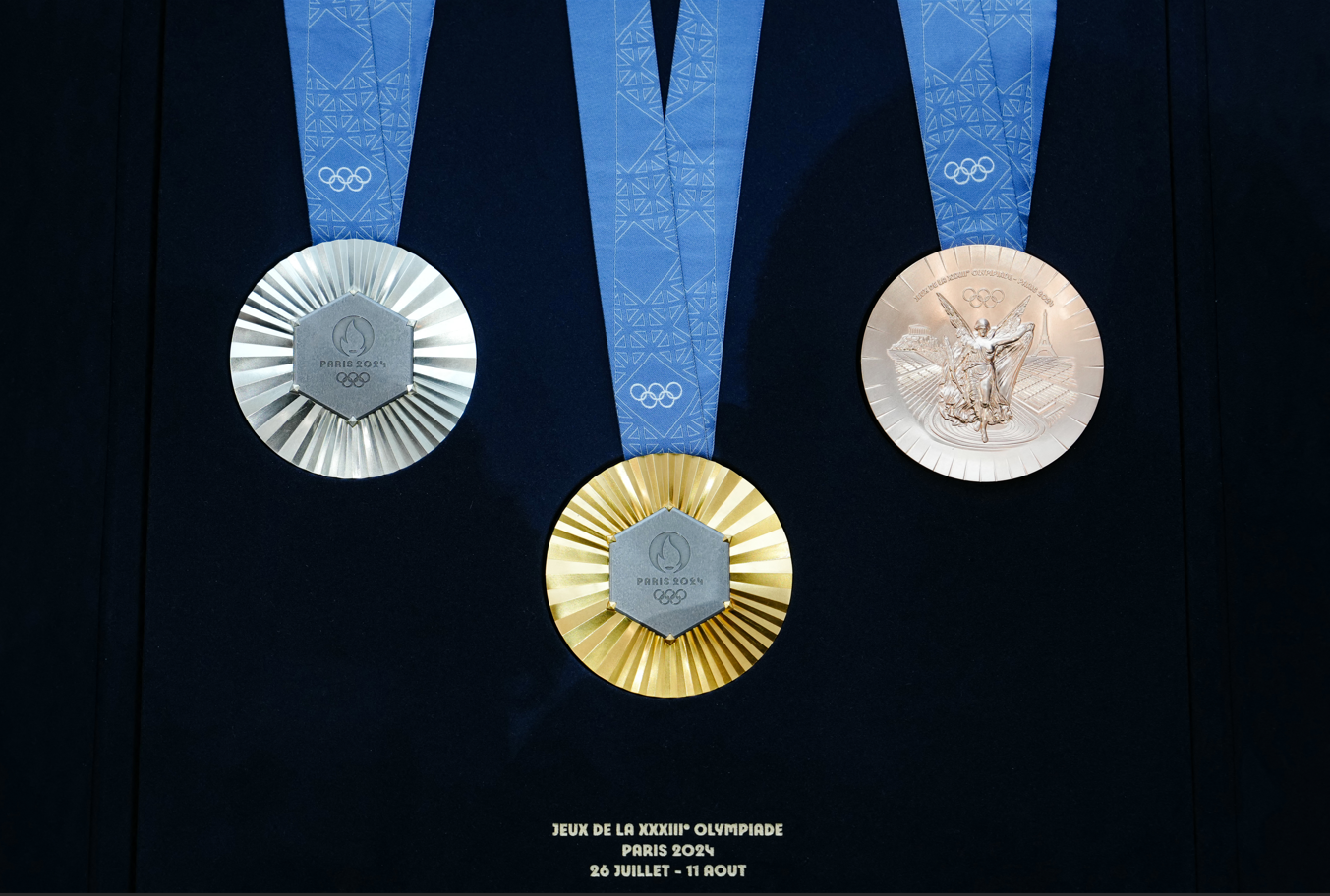
PARIS (AFP) -- The medals awarded at this year's Paris Olympics and Paralympics will feature a hexagon-shaped piece of iron taken from the original Eiffel Tower in their center, organizers said as they unveiled the design on Thursday, Feb. 8.

olympic medals.png
This photograph taken in Paris on Thursday, Feb. 8, shows the Olympic medals during the unveiling of the Olympic and Paralympic medals for the Paris 2024 Olympic Games. On the medals' head side, the engraved figures of the goddess of victory Athena, Nike, the Panathenaic stadium and the Acropolis are imposed by the International Olympic Committee (IOC) but Paris 2024 has obtained exceptional authorization to add the design of the Eiffel Tower, and use 18 grams of Eiffel Tower metal on each medal, extracted from pieces of the tower.

All 5,084 gold, silver and bronze medals for the Paris Games will feature the six-edged metal medallion which will be set like a gemstone in the design by elite French jewelry house Chaumet.

"We wanted to offer to all medal winners at the Paris Olympics and Paralympics a piece of the Eiffel Tower from 1889," said the head of the local organizing committee, Tony Estanguet, at a televised ceremony.

They will be "a combination of the most precious metals from the medals -- gold, silver and bronze -- with the most precious metal in our country, from this treasure that is the Eiffel Tower," he explained.

The design by Chaumet, whose creations have adorned aristocrats and the affluent since 1780, also features a circular arrangement of ridges intended to catch the light and evoke the sun's rays.

The iron hexagon -- a shape which echoes the contours of mainland France -- is held in place by six spurs on each corner which are intended to resemble the rivets used on the Eiffel Tower.

The metal was taken from a Paris warehouse used to stock offcuts by the operating company which maintains the 330-metre (1,083-foot) landmark, known affectionately as the "Old Lady" in France.

"We found out that over the years during the maintenance of the Eiffel Tower that they were obliged to remove some of the original structure," Thierry Reboul, the director of branding and ceremonies, explained during an advance preview of the medals for AFP and other media.

"We used these pieces. There were more than enough of them."

Medal design is a key part of each Games' aesthetic, along with the logo, mascots and opening ceremony.

Since 2004, the back of all medals show the Greek goddess Nike flying into the historic Panathinaikos stadium in Athens, site of the original Olympic Games of antiquity.

Paris organizers squeezed a concession from the International Olympic Committee, enabling them to slightly alter the design to add an Eiffel Tower to the scene.

All the metal used in the Paris medals, which weigh around half a kilogram, has been recycled.

The last Olympics in Tokyo saw Japanese organizers also incorporate recycled metal, with each medal molded from alloys extracted from used consumer electronics such as mobile phones and laptops.


'Like a precious stone'


Though designed by Chaumet, the medals will be manufactured by the French national mint, which has strongly denied a recent report that it has struggled to find a non-toxic agent with which to coat each one.

The puddle iron used in the construction of the Eiffel Tower in particular needs protection from air and humidity to prevent it from oxidizing.

"We've not had any issue with this," Joachim Roncin, head of design for the Paris Games, told reporters.

Chaumet, which counted tower designer Gustav Eiffel as a client as well as Napoleon's family, is one of more than 70 leading luxury brands owned by French conglomerate LVMH, a major Paris Olympics sponsor.

"It's not a medal that we are presenting today. It's a work of art that sums up the spirit of the Olympics and Paralympics," Antoine Arnault, LVMH executive and son of founder Bernard Arnault, said at the ceremony Thursday.

Headquartered in the exclusive Place Vendome in Paris, Chaumet's work more usually involves handling one-off orders from royalty and billionaires for diamond-studded high jewelry for marriages and high-society parties.

"We knew that everyone was going to be looking at this event in 2024 and we knew we couldn't afford to trip up," the head of Chaumet's jewelry atelier, Benoit Verhulle, said.

"We decided to treat the piece of Eiffel Tower like a precious stone. We set it using our expertise as a jewelry house," he said.

Other LVMH brands including Berluti, Dior and Louis Vuitton are also set to feature at the Paris Olympics under the company's sponsorship deal.

The Eiffel Tower is set to have a central role during the Games which will run from July 26-August 11 and the Paralympics from August 28-September 8.

The opening ceremony will see national teams sail down the river Seine and disembark opposite the landmark, while there is speculation that the Olympic flame will be placed on the tower for the duration of the Games.

Related Tags

Eiffel Tower Paris Olympics
ADVERTISEMENT
.most-popular .layout-ratio{ padding-bottom: 79.13%; } @media (min-width: 768px) and (max-width: 1024px) { .widget-title { font-size: 15px !important; } }

{{ articles_filter_1561_widget.title }}

.most-popular .layout-ratio{ padding-bottom: 79.13%; } @media (min-width: 768px) and (max-width: 1024px) { .widget-title { font-size: 15px !important; } }

{{ articles_filter_1562_widget.title }}

.most-popular .layout-ratio{ padding-bottom: 79.13%; } @media (min-width: 768px) and (max-width: 1024px) { .widget-title { font-size: 15px !important; } }

{{ articles_filter_1563_widget.title }}

{{ articles_filter_1564_widget.title }}

.mb-article-details { position: relative; } .mb-article-details .article-body-preview, .mb-article-details .article-body-summary{ font-size: 17px; line-height: 30px; font-family: "Libre Caslon Text", serif; color: #000; } .mb-article-details .article-body-preview iframe , .mb-article-details .article-body-summary iframe{ width: 100%; margin: auto; } .read-more-background { background: linear-gradient(180deg, color(display-p3 1.000 1.000 1.000 / 0) 13.75%, color(display-p3 1.000 1.000 1.000 / 0.8) 30.79%, color(display-p3 1.000 1.000 1.000) 72.5%); position: absolute; height: 200px; width: 100%; bottom: 0; display: flex; justify-content: center; align-items: center; padding: 0; } .read-more-background a{ color: #000; } .read-more-btn { padding: 17px 45px; font-family: Inter; font-weight: 700; font-size: 18px; line-height: 16px; text-align: center; vertical-align: middle; border: 1px solid black; background-color: white; } .hidden { display: none; }
function initializeAllSwipers() { // Get all hidden inputs with cms_article_id document.querySelectorAll('[id^="cms_article_id_"]').forEach(function (input) { const cmsArticleId = input.value; const articleSelector = '#article-' + cmsArticleId + ' .body_images'; const swiperElement = document.querySelector(articleSelector); if (swiperElement && !swiperElement.classList.contains('swiper-initialized')) { new Swiper(articleSelector, { loop: true, pagination: false, navigation: { nextEl: '#article-' + cmsArticleId + ' .swiper-button-next', prevEl: '#article-' + cmsArticleId + ' .swiper-button-prev', }, }); } }); } setTimeout(initializeAllSwipers, 3000); const intersectionObserver = new IntersectionObserver( (entries) => { entries.forEach((entry) => { if (entry.isIntersecting) { const newUrl = entry.target.getAttribute("data-url"); if (newUrl) { history.pushState(null, null, newUrl); let article = entry.target; // Extract metadata const author = article.querySelector('.author-section').textContent.replace('By', '').trim(); const section = article.querySelector('.section-info ').textContent.replace(' ', ' '); const title = article.querySelector('.article-title h1').textContent; // Parse URL for Chartbeat path format const parsedUrl = new URL(newUrl, window.location.origin); const cleanUrl = parsedUrl.host + parsedUrl.pathname; // Update Chartbeat configuration if (typeof window._sf_async_config !== 'undefined') { window._sf_async_config.path = cleanUrl; window._sf_async_config.sections = section; window._sf_async_config.authors = author; } // Track virtual page view with Chartbeat if (typeof pSUPERFLY !== 'undefined' && typeof pSUPERFLY.virtualPage === 'function') { try { pSUPERFLY.virtualPage({ path: cleanUrl, title: title, sections: section, authors: author }); } catch (error) { console.error('ping error', error); } } // Optional: Update document title if (title && title !== document.title) { document.title = title; } } } }); }, { threshold: 0.1 } ); function showArticleBody(button) { const article = button.closest("article"); const summary = article.querySelector(".article-body-summary"); const body = article.querySelector(".article-body-preview"); const readMoreSection = article.querySelector(".read-more-background"); // Hide summary and read-more section summary.style.display = "none"; readMoreSection.style.display = "none"; // Show the full article body body.classList.remove("hidden"); } document.addEventListener("DOMContentLoaded", () => { let loadCount = 0; // Track how many times articles are loaded const offset = [1, 2, 3, 4, 5, 6, 7, 8, 9, 10]; // Offset values const currentUrl = window.location.pathname.substring(1); let isLoading = false; // Prevent multiple calls if (!currentUrl) { console.log("Current URL is invalid."); return; } const sentinel = document.getElementById("load-more-sentinel"); if (!sentinel) { console.log("Sentinel element not found."); return; } function isSentinelVisible() { const rect = sentinel.getBoundingClientRect(); return ( rect.top < window.innerHeight && rect.bottom >= 0 ); } function onScroll() { if (isLoading) return; if (isSentinelVisible()) { if (loadCount >= offset.length) { console.log("Maximum load attempts reached."); window.removeEventListener("scroll", onScroll); return; } isLoading = true; const currentOffset = offset[loadCount]; window.loadMoreItems().then(() => { let article = document.querySelector('#widget_1690 > div:nth-last-of-type(2) article'); intersectionObserver.observe(article) loadCount++; }).catch(error => { console.error("Error loading more items:", error); }).finally(() => { isLoading = false; }); } } window.addEventListener("scroll", onScroll); });

Sign up by email to receive news.