







Responders race vs time to find landslide survivors


DAVAO CITY – Responders are racing against time on Thursday, Feb. 8, to find more survivors in the massive landslide that hit Barangay Masara, Maco, Davao de Oro on Tuesday night, Feb. 6.
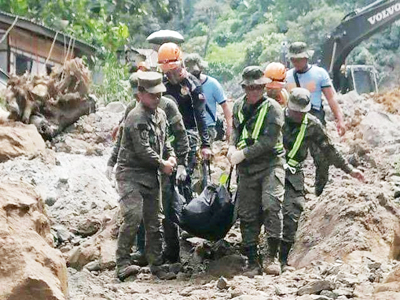
SOLDIERS retrieve a landslide fatality in Barangay Masara, Maco, Davao de Oro. (AFP Eastern Mindanao Command)
A seasoned survivalist still believes that there is still a chance of finding survivors in the area as long as there is a void amid the massive pile of debris and mud.
Dr. Teofredo “Ted” Esguerra, a respected figure in the field of disaster and crisis response and management, said that survival of the landslide victims would depend on a couple of elements.
Esguerra, who is in Davao region with a team from the Energy Development Corp. to assist in disaster response, said that as long as there is a void and oxygen supply, there is still a chance of finding survivors.
If the landslide debris is composed of rocks, there is a chance of having voids or air passages, he added.
However, if it was all mud and water, the chances of survival is slim, Esguerra said.
Esguerra added that if the buses and other structures were able to withstand the landslide, some people who are still inside would still have the chance to survive.
“Although it would also depend on what happened to the bus, was it pushed away and was not covered by a huge amount of debris? Was it able to withstand the volume of mud and rocks? If there are still people inside and the bus is intact, there’s still a chance for as long as there’s oxygen,” he said.
In a press statement on Wednesday, Feb. 7, Apex Mining Company confirmed that there were four 60-seat buses and one 36-person capacity jeep waiting for outgoing employees when the landslide happened.
One of the buses had left for Mawab, Davao de Oro, while the rest were still waiting for the bus during the landslide, the mining firm added.
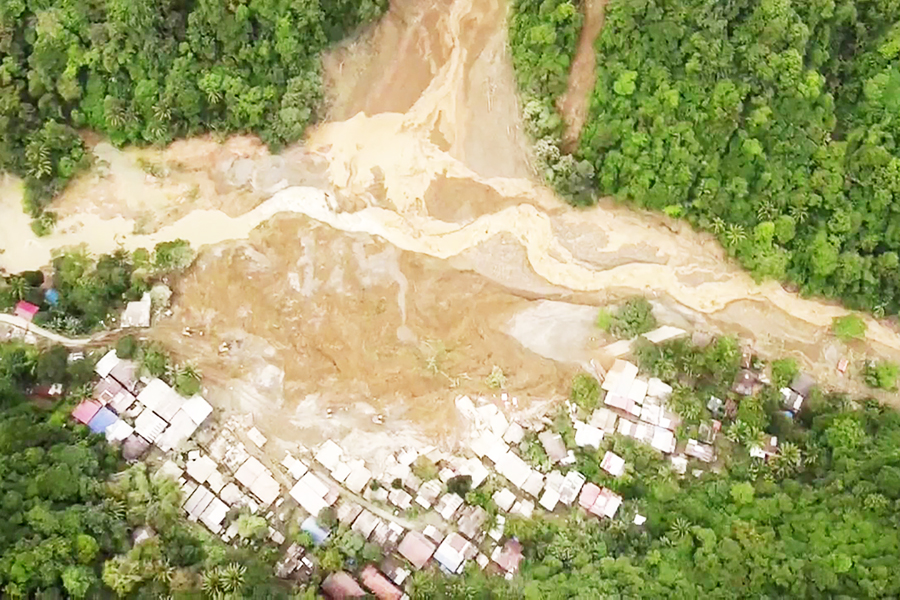
AERIAL footage on February 7 shows the site of the landslide in Maco, Davao de Oro. (AFP)
The death toll went up to 10 as of 2:30 p.m. on Thursday. Thirty-one were injured and taken to the hospital and 49 others are still missing.
The mining firm added that as of 11:30 a.m. on Feb. 7, 62 miners have been accounted for and considered safe. But 45 others are still unaccounted for, it added.
Aside from the mining firm’s buses, several houses were also buried in the landslide.
Maco information officer Jiesyl Mae Tan said that they are still hopeful of finding more survivors as responders resumed search and rescue operations at 8 a.m. on Thursday.
Esguerra said that he is saddened by the incident, adding that casualties would have been avoided since there are already obvious signs of an impending disaster.
He pointed out that the area where the landslide happened has been tagged by the Mines and Geosciences Bureau as high-risk in the geohazard map due to its susceptibility to rain-induced landslides.
Based on the geohazard map of the MGB, almost an entire area of Maco is tagged as susceptible to rain-induced landslides.
The seasoned emergency responder also noted the history of landslides in the area.
“And there are also human activities in the area,” said Esguerra, referring to the large-scale mining activity in a town of 83,000 people.
In the past, dozens of people were killed and reported missing in Maco due to rain-induced landslides.
Based on Department of Environment and Natural Resources (DENR) records, Apex Mining Co. operates a gold mine in Maco under the Mineral Production Sharing Agreement (MPSA).