






 Philippines
National
Marcos pushes for redesigning, not just rebuilding damaged infra, amid Davao floodings
Philippines
National
Marcos pushes for redesigning, not just rebuilding damaged infra, amid Davao floodings
Marcos pushes for redesigning, not just rebuilding damaged infra, amid Davao floodings
By Raymund Antonio and Raymund Antonio


Rather than simply rebuilding roads and bridges destroyed by the massive flooding and landslides in Davao Region, President Marcos is pushing for redesigning these infrastructure to make them safer and more climate-suitable.
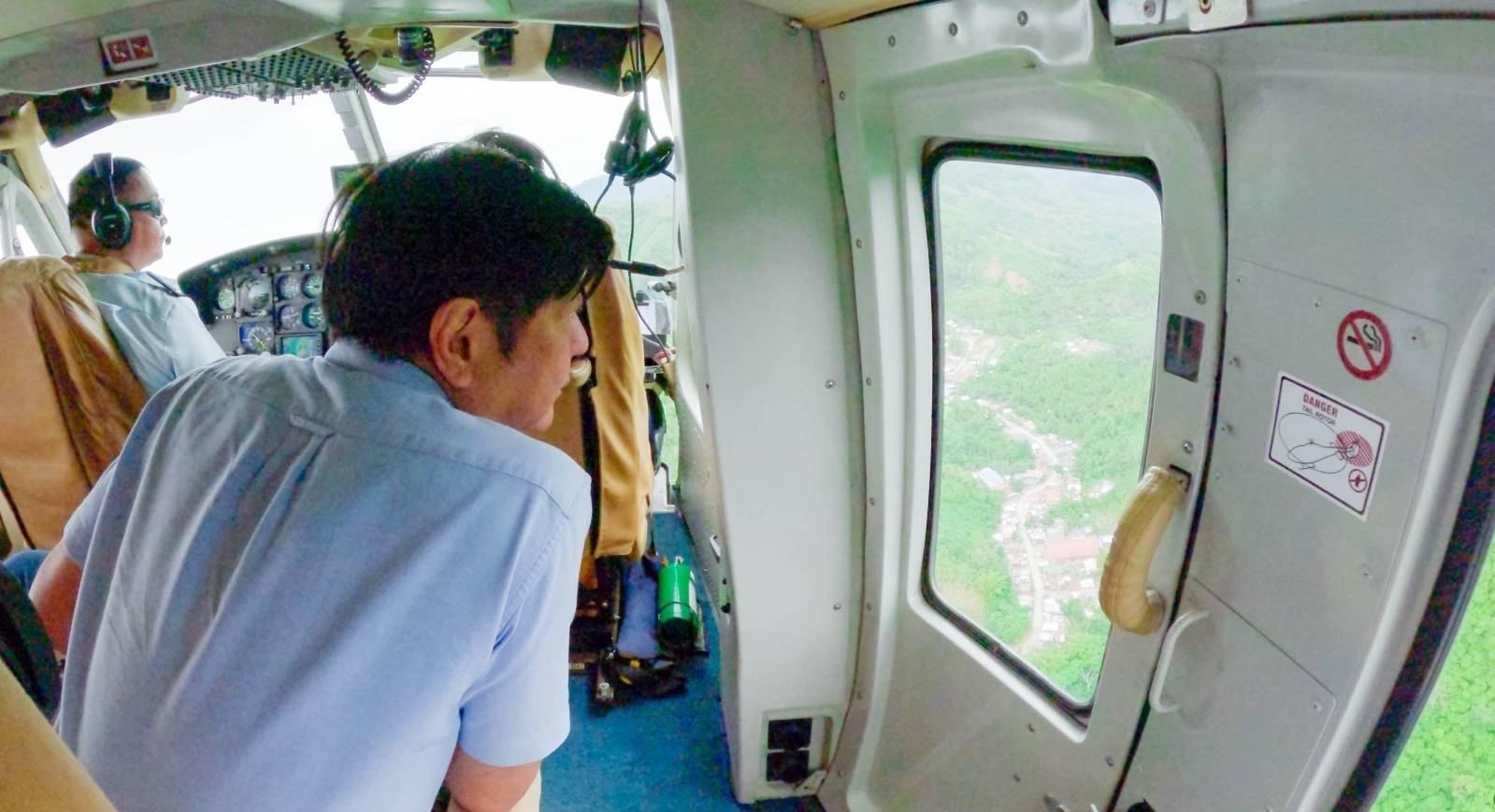 President Ferdinand ‘Bongbong’ Marcos Jr. on Wednesday, Feb. 7, 2024, conducts an aerial inspection of areas hit by the massive flooding and landslides in Davao region. (Photo from the Presidential Communications Office)
The Chief Executive presided over a situation briefing on Wednesday, Feb. 7, and conducted an aerial inspection of the areas hit.
“On the infrastructure side, we will prioritize those roads and thoroughfares that are necessary for us to be able to provide support to those who have become victims,” he said of the government’s immediate response to the catastrophe.
But for the longer term, the President wants to redesign the public infrastructure in consultation with the Department of Environment and Natural Resources (DENR), which can guide the government in building more climate-resistant roads and bridges.
“On the longer term, we really have to start looking at the designs of these bridges and roads to see if they are still compatible with the weather patterns and the effects that the DENR is going to provide us with guidance in terms of how we proceed,” he said.
“Kung ire-rebuild lang natin ang lahat nang masisira, ganun din ang mangyayari (if we will just rebuild all that were destroyed, the same thing will happen)... If we are going to rebuild it, we have to rebuild it in a way that is more, kailangan mas matibay (it needs to be stronger),” he added.
Marcos furthered that doing the rebuilding of Davao Region’s infrastructure in such a way would be “something that I think we can attend to as quickly as possible.”
Department of Science and Technology (DOST) Secretary Renato Solidum Jr. expressed support for the President’s plan of rebuilding.
He said that with Marcos’ “directive to rethink the design of our action plans,” the DOST came up with the “Plan Smart Ready to Rebuild” project, which was developed with the Office of Civil Defense (OCD), the World Bank, and other key government agencies.
“This is an automated planning together with your (local government unit) input, you’ll be able to look at all the multi-hazards that can affect your areas and plan better para maganda po ‘yung ang ating rebuilding after all the emergency interventions have been finished (because our rebuilding will be better after all the emergency interventions have been finished),” the official explained.
“Then, we can actually train your planners together with the national agencies and sit down and plan better for your local government,” he added.
The Provincial Disaster Risk Reduction and Management Office (PDRRMOs) reported that 13 people were dead while nine people were injured in the province because of the floods and landslides triggered by the shear line and trough or extension of a low-pressure area (LPA) in the Davao Region.
Some 14,000 families were also displaced, disaster response authorities added.
Marcos’ situation briefing was also attended by Vice President Sara Duterte, Defense Secretary Gilberto Teodoro Jr., Interior Secretary Benjamin Abalos Jr., Social Welfare Secretary Rex Gatchalian, and other Cabinet members.