

ADVERTISEMENT

House Cha-cha measure gets Marcos economic team's backing 

Published Feb 26, 2024 11:58 am

At A Glance

  • In what could be interpreted as yet another loud endorsement from Malacañang, members of President Marcos' economic team trooped to the House of Representatives Monday, Feb. 26 to express their support for Resolution of Both Houses (RBH) No. 7. 
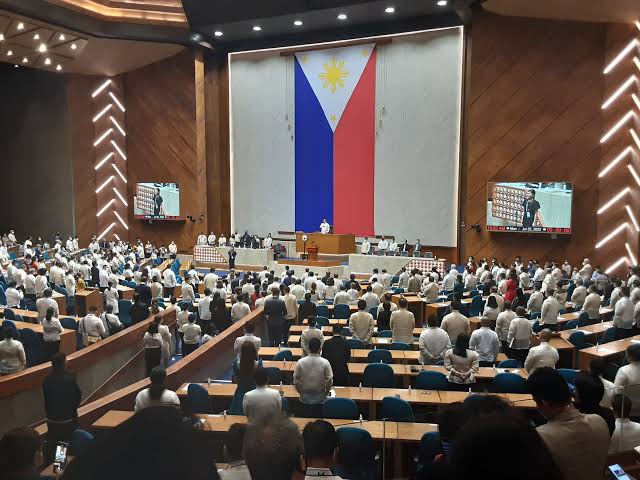
House plenary.jpgThe House plenary (Ellson Quismorio/ MANILA BULLETIN)


In what could be interpreted as yet another loud endorsement from Malacañang, members of President Marcos' economic team trooped to the House of Representatives Monday, Feb. 26 to express their support for Resolution of Both Houses (RBH) No. 7. 

Representatives from National Economic and Development Authority (NEDA), Department of Trade and Industry (DTI), Bangko Sentral ng Pilipinas (BSP), and the Department of Finance (DOF) were invited by the House of Representatives to serve as resource persons on the first day of deliberations on the pro-Charter change (Cha-cha) measure. 

The 300-plus strong House took up RBH No.7--which seeks revisions to the restrictive economic provisions of the 1987 Constitution--as a Committee of the Whole, meaning all of its members participated. 

Monday's discussions took place in plenary. There, NEDA Secretary Arsenio Balisacan said the Philippines needed “massive amounts of investments in both physical and social infrastructure, as well as human capital". 

As such, he said NEDA recognizes the importance of updating the economic provisions in the Constitution so the country could attract more foreign direct investments (FDIs) 

“Compared to our dynamic neighbors, historical data show that the Philippines has obtained a smaller share of FDI inflows that could have generated more economic and social opportunities crucial for inclusive growth and development,” he noted. 

Balisacan cited evidence that suggested a significant connection between the extent of the country's statutory and equity restrictiveness to the country's realized FDI flows. 

"[The Philippines] has missed several chances to attract FDI, technological know-how, and managerial talent that our economy needs to raise its productivity and competitiveness in the global arena. 

“Though we have made significant progress, our neighbors have proceeded at a far more desirable pace. We must catch up, not be held back by uncompetitive markets dominated by a few players, expensive inputs that result in higher prices for end- consumers, and incomplete value chains that prevent us from producing more technologically complex goods and services,” he explained. 

The NEDA chief proposed the lifting of restrictions on critical sectors such as public utilities, education, mass media, and advertising so that we can realize their untapped potential and enable them to contribute to the country’s economic progress. 

“Opening up public utilities to foreign investment will improve the quality and affordability of services, such as energy and water distribution, and offer viable options to address the financing gaps in the infrastructure sector,” he said. 

However, Balisacan urged Congress to address other issues that hinder investments, whether foreign or domestic. “Let me emphasize that we only reap the benefits I mentioned if we also address the other problems involving energy costs, inadequate connectivity infrastructure, slow bureaucratic processes, inconsistent local and national regulations, and highly concerning learning poverty and malnutrition." 


Collective desire 

Speaking for the DTI, Assistant Secretary Agaton Uvero said the proposed economic amendments were "expected to result in more foreign direct investment, international education, globally competitive mass media, international advertising, and modern utilities". 

“Increased investments expand the economy and create jobs. Access to world-class education and research facilities nurtures a culture of innovation, entrepreneurship, and creativity among Filipino students, teachers and researchers,” he said. 

Uvero said the DTI “supports the amendment of the economic provisions of the 1987 Philippine Constitution to enable the country to adapt and respond to current and future socio-economic conditions". 

“This support is driven by a collective desire for economic and social transformation that will accelerate the uplifting of the lives of all Filipinos,” he added. 

For his part, Monetary Board Member Romeo Bernardo said the BSP “supports efforts that will promote inclusive economic growth of the country including, among others, easing restrictive economic provisions in the 1987 Constitution". 

“BSP believes that reducing, if not removing, restrictive provisions will facilitate increase in foreign capital investment and hasten the growth of the economy, which, in turn, can expedite the ability of the nation to realize inclusive economic growth,” he said. 

The Secretary Ralph Recto-led DOF likewise supported the economic amendment proposals laid out in RBH No.7 

In a position paper presented to the plenary, the DOF said it supports the opening up of certain sectors of the economy to foreign ownership, including public utilities, mass media, advertising, education, and mining. 

However, the agency opposed foreign ownership of land.


Related Tags

resolution of both houses Charter change Economic managers
ADVERTISEMENT
.most-popular .layout-ratio{ padding-bottom: 79.13%; } @media (min-width: 768px) and (max-width: 1024px) { .widget-title { font-size: 15px !important; } }

{{ articles_filter_1561_widget.title }}

.most-popular .layout-ratio{ padding-bottom: 79.13%; } @media (min-width: 768px) and (max-width: 1024px) { .widget-title { font-size: 15px !important; } }

{{ articles_filter_1562_widget.title }}

.most-popular .layout-ratio{ padding-bottom: 79.13%; } @media (min-width: 768px) and (max-width: 1024px) { .widget-title { font-size: 15px !important; } }

{{ articles_filter_1563_widget.title }}

{{ articles_filter_1564_widget.title }}

.mb-article-details { position: relative; } .mb-article-details .article-body-preview, .mb-article-details .article-body-summary{ font-size: 17px; line-height: 30px; font-family: "Libre Caslon Text", serif; color: #000; } .mb-article-details .article-body-preview iframe , .mb-article-details .article-body-summary iframe{ width: 100%; margin: auto; } .read-more-background { background: linear-gradient(180deg, color(display-p3 1.000 1.000 1.000 / 0) 13.75%, color(display-p3 1.000 1.000 1.000 / 0.8) 30.79%, color(display-p3 1.000 1.000 1.000) 72.5%); position: absolute; height: 200px; width: 100%; bottom: 0; display: flex; justify-content: center; align-items: center; padding: 0; } .read-more-background a{ color: #000; } .read-more-btn { padding: 17px 45px; font-family: Inter; font-weight: 700; font-size: 18px; line-height: 16px; text-align: center; vertical-align: middle; border: 1px solid black; background-color: white; } .hidden { display: none; }
function initializeAllSwipers() { // Get all hidden inputs with cms_article_id document.querySelectorAll('[id^="cms_article_id_"]').forEach(function (input) { const cmsArticleId = input.value; const articleSelector = '#article-' + cmsArticleId + ' .body_images'; const swiperElement = document.querySelector(articleSelector); if (swiperElement && !swiperElement.classList.contains('swiper-initialized')) { new Swiper(articleSelector, { loop: true, pagination: false, navigation: { nextEl: '#article-' + cmsArticleId + ' .swiper-button-next', prevEl: '#article-' + cmsArticleId + ' .swiper-button-prev', }, }); } }); } setTimeout(initializeAllSwipers, 3000); const intersectionObserver = new IntersectionObserver( (entries) => { entries.forEach((entry) => { if (entry.isIntersecting) { const newUrl = entry.target.getAttribute("data-url"); if (newUrl) { history.pushState(null, null, newUrl); let article = entry.target; // Extract metadata const author = article.querySelector('.author-section').textContent.replace('By', '').trim(); const section = article.querySelector('.section-info ').textContent.replace(' ', ' '); const title = article.querySelector('.article-title h1').textContent; // Parse URL for Chartbeat path format const parsedUrl = new URL(newUrl, window.location.origin); const cleanUrl = parsedUrl.host + parsedUrl.pathname; // Update Chartbeat configuration if (typeof window._sf_async_config !== 'undefined') { window._sf_async_config.path = cleanUrl; window._sf_async_config.sections = section; window._sf_async_config.authors = author; } // Track virtual page view with Chartbeat if (typeof pSUPERFLY !== 'undefined' && typeof pSUPERFLY.virtualPage === 'function') { try { pSUPERFLY.virtualPage({ path: cleanUrl, title: title, sections: section, authors: author }); } catch (error) { console.error('ping error', error); } } // Optional: Update document title if (title && title !== document.title) { document.title = title; } } } }); }, { threshold: 0.1 } ); function showArticleBody(button) { const article = button.closest("article"); const summary = article.querySelector(".article-body-summary"); const body = article.querySelector(".article-body-preview"); const readMoreSection = article.querySelector(".read-more-background"); // Hide summary and read-more section summary.style.display = "none"; readMoreSection.style.display = "none"; // Show the full article body body.classList.remove("hidden"); } document.addEventListener("DOMContentLoaded", () => { let loadCount = 0; // Track how many times articles are loaded const offset = [1, 2, 3, 4, 5, 6, 7, 8, 9, 10]; // Offset values const currentUrl = window.location.pathname.substring(1); let isLoading = false; // Prevent multiple calls if (!currentUrl) { console.log("Current URL is invalid."); return; } const sentinel = document.getElementById("load-more-sentinel"); if (!sentinel) { console.log("Sentinel element not found."); return; } function isSentinelVisible() { const rect = sentinel.getBoundingClientRect(); return ( rect.top < window.innerHeight && rect.bottom >= 0 ); } function onScroll() { if (isLoading) return; if (isSentinelVisible()) { if (loadCount >= offset.length) { console.log("Maximum load attempts reached."); window.removeEventListener("scroll", onScroll); return; } isLoading = true; const currentOffset = offset[loadCount]; window.loadMoreItems().then(() => { let article = document.querySelector('#widget_1690 > div:nth-last-of-type(2) article'); intersectionObserver.observe(article) loadCount++; }).catch(error => { console.error("Error loading more items:", error); }).finally(() => { isLoading = false; }); } } window.addEventListener("scroll", onScroll); });

Sign up by email to receive news.