







House Committee of the Whole to tackle Cha-cha measure Monday


At A Glance
- The House of Representatives will walk the talk on economic Charter change (Cha-cha) on Monday, Feb. 26, when it begins deliberations on Resolution of Both Houses (RBH) No.7.
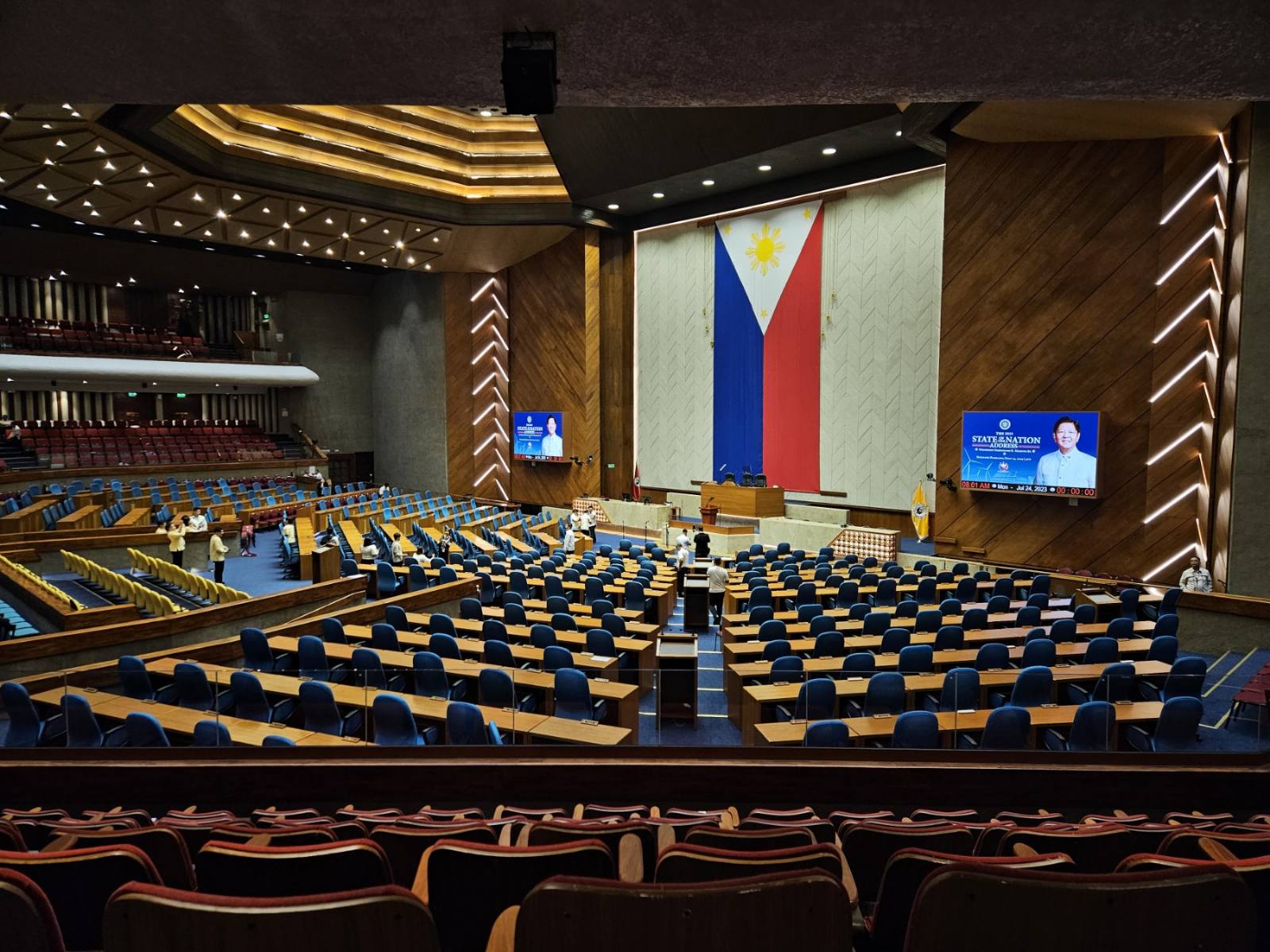 The House plenary hall (Contributed photo)
The House of Representatives will walk the talk on economic Charter change (Cha-cha) on Monday, Feb. 26, when it begins deliberations on Resolution of Both Houses (RBH) No.7.
Senior Deputy Speaker and Pampanga 3rd district Rep. Aurelio Gonzales Jr., one of the authors of RBH No. 7, said the 300-member House will do so as a Committee of the Whole.
This is expected to expedite discussions in the chamber, which historically has been pro-Cha-cha unlike the 24-member Senate.
Gonzales said several resource persons, including noted economists, have been invited to the initial debates that will start at 1 p.m. at the House plenary hall.
“The conversion of the House into a Committee of the Whole, which is like a plenary session, aims to involve every one of our colleagues in discussions with our resource persons. This will facilitate proceedings leading to an eventual approval or rejection of the proposed amendments,” he said.
House Speaker Martin Romualdez sits as chairman of the committee.
The ranking solon said the House will conduct three hearings a week and try to obtain a vote on the proposals before the Holy Week recess of Congress next month. This was also the original timeline set for the Senate by Senate President Juan Miguel "Migz" Zubiri for the Senate’s adoption of RBH No. 6, Gonzales added.
RBH No. 7 is almost an exact reproduction of RBH No. 6, which introduced by Zubiri and Senators Loren Legarda and Juan Edgardo Angara.
RBH No. 6 and RBH No. 7 are both titled, “A Resolution of Both Houses of Congress proposing amendments to certain economic provisions of the 1987 Constitution of the Republic of the Philippines, particularly on Articles Xll, XlV and XVl.”
The proposed House and Senate amendments are on the grant of legislative franchises to and ownership of public utilities in Article Xll, and ownership of basic educational facilities in Article XlV, and advertising firms in Article XVl.
The suggested principal amendments are the insertion of the phrase, “unless otherwise provided by law,” which would empower Congress to lift or relax present economic restrictions in the nation’s basic law, and the addition of the qualifier “basic” in Article XlV.
READ ME AGAIN:
https://mb.com.ph/2024/2/22/these-2-house-officials-lecture-jinggoy-on-cha-cha-voting-provision
RBH No. 7 and RBH No. 6 also restate the provision of the Constitution that Congress may propose amendments “upon a vote of three-fourths of all its members".
However, in their resolution, after the phrase “…a vote of all its members,” Zubiri, Legarda and Angara added the words, “each House voting separately".
Senator Jinggoy Estrada has said the House and the Senate should vote separately and not jointly on amendment proposals, claiming that joint voting is unconstitutional.
Gonzales said they dropped the words “each House voting separately” in RBH No. 7 “because those four words are not in the Constitution".
He said they copied the exact wording of Section 1, Article XVll (Amendments and Revisions) of the Charter, which provides: “Any amendment to, or revision, of the Constitution may be proposed by: 1) The Congress, upon a vote of three-fourths of all its members…”
“We in the House chose to be true to our Constitution by quoting exactly what it says, no more, no less. If they say joint voting is unconstitutional, separate voting is also against the Charter because it is not there. Let the experts interpret this provision,” he said.