

ADVERTISEMENT

Ankle injury forces Alcaraz out in first round of ATP Rio Open

Published Feb 21, 2024 05:21 am

At A Glance

  • World number two Carlos Alcaraz retired from his first-round match on Tuesday, Feb. 20, at the ATP Rio Open after rolling his right ankle on just the second point of the contest against Thiago Monteiro.
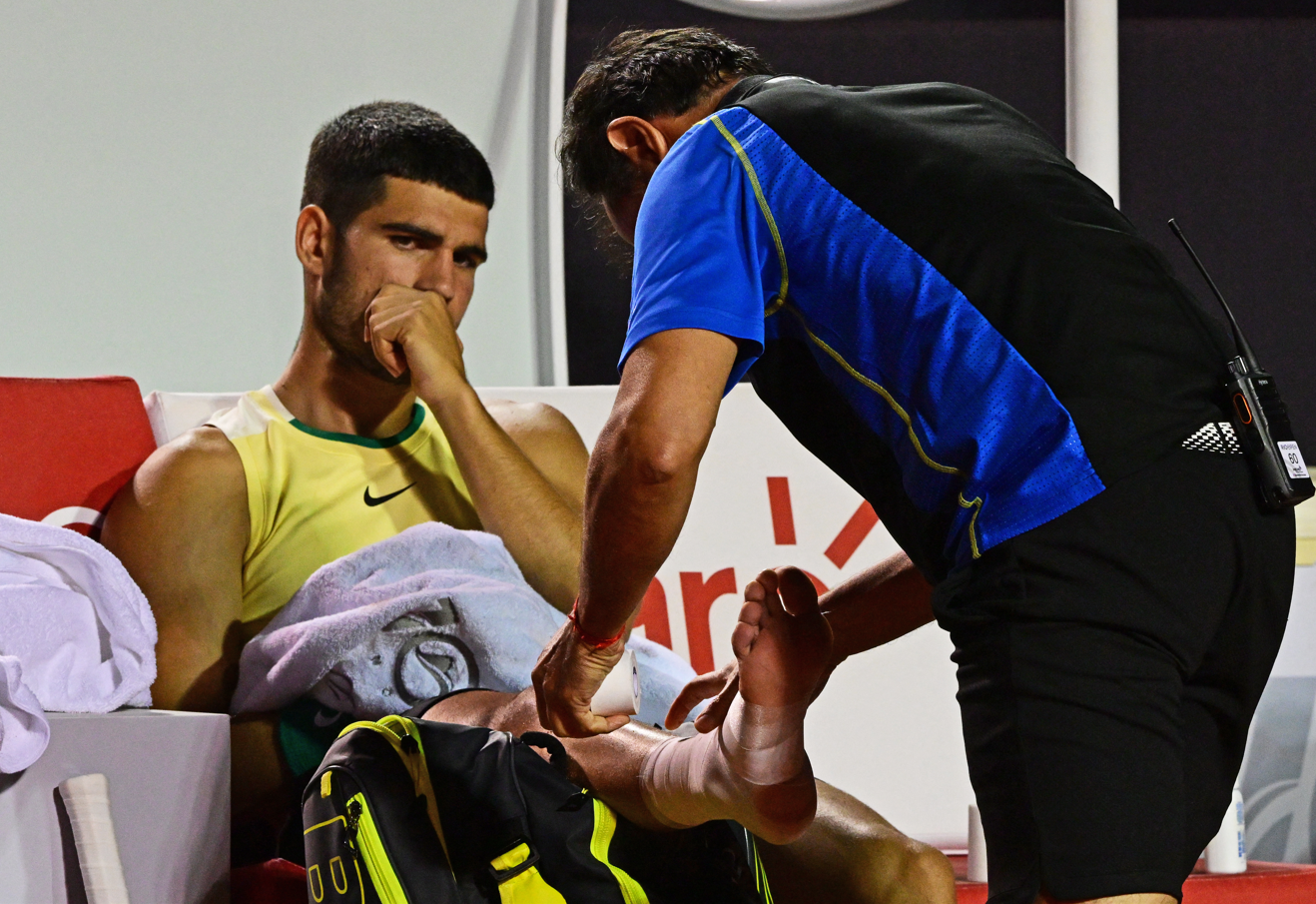
RIO DE JANEIRO (AFP) -- World number two Carlos Alcaraz retired from his first-round match on Tuesday, Feb. 20, at the ATP Rio Open after rolling his right ankle on just the second point of the contest against Thiago Monteiro.

carlos alcarazzzz.png
Spain's Carlos Alcaraz gestures after suffering an injury during the ATP 500 Rio Open tennis match against Brazil's Carlos Monteiro in Rio de Janeiro, Brazil on Tuesday, Feb. 20. (AFP)

The Spanish star took a medical timeout, had the ankle taped and won the first game but after dropping his serve in the second game he called it quits, in another setback to a so-far disappointing 2024 campaign.

Shortly after the match Alcaraz told reporters the decision to withdraw was a "precaution" and that the physiotherapists who treated him had indicated the injury "is not serious."

"I spoke with the physiotherapist on the court and we decided, together, that I would continue to see if it improved. It didn't, so we preferred to be careful and withdraw as a precaution," Alcaraz said, adding that he would have further tests on Wednesday.

The two-time Grand Slam winner's tough start to 2024 included a four-set defeat by Alexander Zverev in the Australian Open quarterfinals.

Last Saturday he fell to 21st-ranked Chilean Nicolas Jarry in the semifinals at Buenos Aires, and hasn't won an ATP title since his stunning Wimbledon triumph over Novak Djokovic last July.

Hopes that he could start turning things around in Rio -- where he lifted the trophy in 2022 and finished runner-up to Britain's Cameron Norrie last year -- were quickly dashed.

He and 117th-ranked Brazilian Monteiro were two points into the match when Alcaraz's right foot stuck in the red clay surface at Jockey Club Brasileiro, where rain had delayed the start of play for three hours.

Four of the day's tennis matches were postponed until Wednesday and the first players to take the court on Tuesday played in misty conditions.


'Those things happen'


That had cleared by the time Alcaraz and Monteiro squared off and Alcaraz said court conditions were not to blame.

"Those things happen, even more so on clay," Alcaraz said.

"It wasn't a problem with the court, I got hurt in a change of direction and that happens on this type of surface," added the Spaniard, who was slow to rise after taking a hard fall, limping to his chair and putting a towel over his face before the trainer arrived.

Alcaraz's coach Juan Carlos Ferrero looked on with concern from the stands as Alcaraz, with a grimace and a slight limp, returned to action and won the opening game.

But after dropping his serve in the second he opted not to continue.

"It's really sad to win in this way, because I know how hard every player works to be ready for a tournament of this magnitude,"  Monteiro said.

"I just wish him a speedy recovery, that it's nothing serious or that it won't affect his season," added the 29-year-old left-hander, who improved to 2-0 against Alcaraz, whom he beat in the round of 16 of the Melbourne-1 in 2021.

The injury comes with Italy's Australian Open champion Jannik Sinner closing in on Alcaraz's world number two ranking.

Alcaraz leads Sinner -- who won the Rotterdam title on Sunday -- by just 535 points and has 1,000 points to defend next month at the prestigious hardcourt tournament in Indian Wells, California.

Related Tags

Carlos Alcaraz ATP
ADVERTISEMENT
.most-popular .layout-ratio{ padding-bottom: 79.13%; } @media (min-width: 768px) and (max-width: 1024px) { .widget-title { font-size: 15px !important; } }

{{ articles_filter_1561_widget.title }}

.most-popular .layout-ratio{ padding-bottom: 79.13%; } @media (min-width: 768px) and (max-width: 1024px) { .widget-title { font-size: 15px !important; } }

{{ articles_filter_1562_widget.title }}

.most-popular .layout-ratio{ padding-bottom: 79.13%; } @media (min-width: 768px) and (max-width: 1024px) { .widget-title { font-size: 15px !important; } }

{{ articles_filter_1563_widget.title }}

{{ articles_filter_1564_widget.title }}

.mb-article-details { position: relative; } .mb-article-details .article-body-preview, .mb-article-details .article-body-summary{ font-size: 17px; line-height: 30px; font-family: "Libre Caslon Text", serif; color: #000; } .mb-article-details .article-body-preview iframe , .mb-article-details .article-body-summary iframe{ width: 100%; margin: auto; } .read-more-background { background: linear-gradient(180deg, color(display-p3 1.000 1.000 1.000 / 0) 13.75%, color(display-p3 1.000 1.000 1.000 / 0.8) 30.79%, color(display-p3 1.000 1.000 1.000) 72.5%); position: absolute; height: 200px; width: 100%; bottom: 0; display: flex; justify-content: center; align-items: center; padding: 0; } .read-more-background a{ color: #000; } .read-more-btn { padding: 17px 45px; font-family: Inter; font-weight: 700; font-size: 18px; line-height: 16px; text-align: center; vertical-align: middle; border: 1px solid black; background-color: white; } .hidden { display: none; }
function initializeAllSwipers() { // Get all hidden inputs with cms_article_id document.querySelectorAll('[id^="cms_article_id_"]').forEach(function (input) { const cmsArticleId = input.value; const articleSelector = '#article-' + cmsArticleId + ' .body_images'; const swiperElement = document.querySelector(articleSelector); if (swiperElement && !swiperElement.classList.contains('swiper-initialized')) { new Swiper(articleSelector, { loop: true, pagination: false, navigation: { nextEl: '#article-' + cmsArticleId + ' .swiper-button-next', prevEl: '#article-' + cmsArticleId + ' .swiper-button-prev', }, }); } }); } setTimeout(initializeAllSwipers, 3000); const intersectionObserver = new IntersectionObserver( (entries) => { entries.forEach((entry) => { if (entry.isIntersecting) { const newUrl = entry.target.getAttribute("data-url"); if (newUrl) { history.pushState(null, null, newUrl); let article = entry.target; // Extract metadata const author = article.querySelector('.author-section').textContent.replace('By', '').trim(); const section = article.querySelector('.section-info ').textContent.replace(' ', ' '); const title = article.querySelector('.article-title h1').textContent; // Parse URL for Chartbeat path format const parsedUrl = new URL(newUrl, window.location.origin); const cleanUrl = parsedUrl.host + parsedUrl.pathname; // Update Chartbeat configuration if (typeof window._sf_async_config !== 'undefined') { window._sf_async_config.path = cleanUrl; window._sf_async_config.sections = section; window._sf_async_config.authors = author; } // Track virtual page view with Chartbeat if (typeof pSUPERFLY !== 'undefined' && typeof pSUPERFLY.virtualPage === 'function') { try { pSUPERFLY.virtualPage({ path: cleanUrl, title: title, sections: section, authors: author }); } catch (error) { console.error('ping error', error); } } // Optional: Update document title if (title && title !== document.title) { document.title = title; } } } }); }, { threshold: 0.1 } ); function showArticleBody(button) { const article = button.closest("article"); const summary = article.querySelector(".article-body-summary"); const body = article.querySelector(".article-body-preview"); const readMoreSection = article.querySelector(".read-more-background"); // Hide summary and read-more section summary.style.display = "none"; readMoreSection.style.display = "none"; // Show the full article body body.classList.remove("hidden"); } document.addEventListener("DOMContentLoaded", () => { let loadCount = 0; // Track how many times articles are loaded const offset = [1, 2, 3, 4, 5, 6, 7, 8, 9, 10]; // Offset values const currentUrl = window.location.pathname.substring(1); let isLoading = false; // Prevent multiple calls if (!currentUrl) { console.log("Current URL is invalid."); return; } const sentinel = document.getElementById("load-more-sentinel"); if (!sentinel) { console.log("Sentinel element not found."); return; } function isSentinelVisible() { const rect = sentinel.getBoundingClientRect(); return ( rect.top < window.innerHeight && rect.bottom >= 0 ); } function onScroll() { if (isLoading) return; if (isSentinelVisible()) { if (loadCount >= offset.length) { console.log("Maximum load attempts reached."); window.removeEventListener("scroll", onScroll); return; } isLoading = true; const currentOffset = offset[loadCount]; window.loadMoreItems().then(() => { let article = document.querySelector('#widget_1690 > div:nth-last-of-type(2) article'); intersectionObserver.observe(article) loadCount++; }).catch(error => { console.error("Error loading more items:", error); }).finally(() => { isLoading = false; }); } } window.addEventListener("scroll", onScroll); });

Sign up by email to receive news.