

ADVERTISEMENT

London Fashion Week: Tolu Coker breaks boundaries with 'Broken English' collection

A refreshing perspective on the value of longevity and heritage in fashion

Published Feb 20, 2024 10:25 am
427910720_720154583438657_3575083724016770675_n.jpg
(Photos by Jason Lloyd Evans)

Tolu Coker’s “Broken English” show at London Fashion Week offers a powerful blend of cultural influence, sustainability, and social commentary. The designer’s British-Nigerian background and her inspiration from street hawkers in Accra, Ghana, create a unique and compelling narrative that is deeply embedded in her collection.

The use of upcycled and recycled materials in Tolu Coker's brand is not only a bold statement in support of sustainability but also a reflection of her personal connection to her roots. By drawing inspiration from the street hawkers and the environment of Accra, she brings attention to the resilience and resourcefulness of these individuals. The influence of her mother’s work in the local market adds an authentic and personal touch to the collection, further emphasizing the cultural and familial elements woven into the designs.

428026957_706145251712528_4050032323103411103_n.jpg
(Photos by Jason Lloyd Evans)

The incorporation of circular shapes, stripes, and floral prints, along with the ochre hue of the sandy roads, effectively captures the essence of the streets of Accra. The use of aged and eco-leather and denim adds texture and depth to the collection, while the red accents symbolize the energy and vitality of roadside trade. This attention to detail in capturing the spirit and vibrancy of the environment shines through in the overall aesthetic of the pieces.

427101247_275232355615088_8815347193886275665_n.jpg
(Photos by Jason Lloyd Evans)

The revival of pleated ankle-length skirts and A-line dresses, reminiscent of conservative kaftans, speaks to a sense of timelessness and tradition, challenging the fashion industry's relentless pursuit of newness. By incorporating pieces from past collections, Tolu Coker confronts the industry’s inclination toward constant novelty, offering a refreshing perspective on the value of longevity and heritage in fashion.
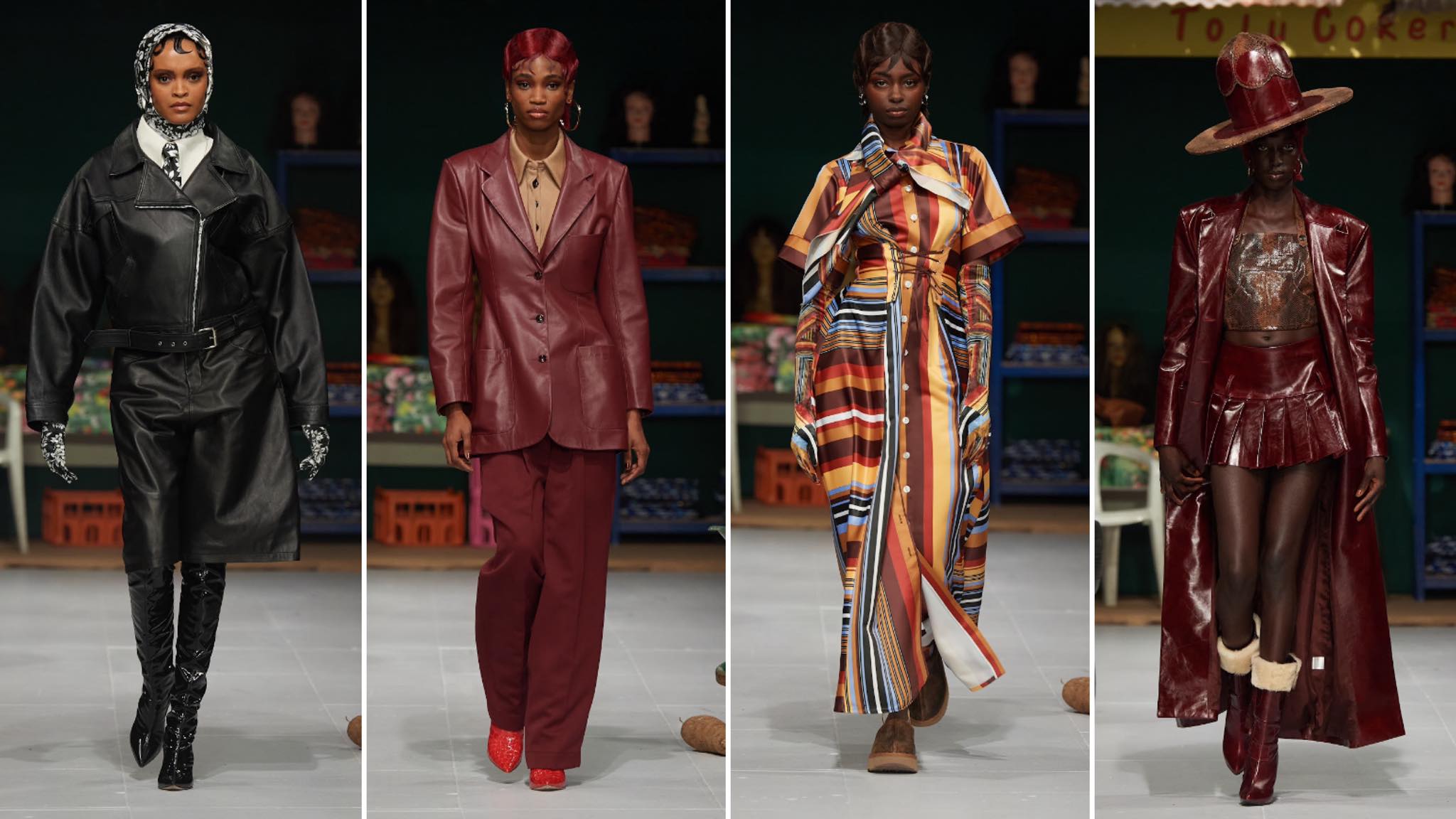
427751575_7541695285840740_6902409503088791995_n.jpg
(Photos by Jason Lloyd Evans)

Overall, Tolu Coker’s “Broken English” show presents a thought-provoking blend of cultural storytelling, sustainability, and fashion innovation. Her ability to seamlessly weave together personal narratives, cultural influences, and sustainable practices demonstrates a forward-thinking approach to design that is both visually captivating and socially resonant.
 

Related Tags

Tolu Coker Fashion and Beauty London Fashion Week
ADVERTISEMENT
.most-popular .layout-ratio{ padding-bottom: 79.13%; } @media (min-width: 768px) and (max-width: 1024px) { .widget-title { font-size: 15px !important; } }

{{ articles_filter_1561_widget.title }}

.most-popular .layout-ratio{ padding-bottom: 79.13%; } @media (min-width: 768px) and (max-width: 1024px) { .widget-title { font-size: 15px !important; } }

{{ articles_filter_1562_widget.title }}

.most-popular .layout-ratio{ padding-bottom: 79.13%; } @media (min-width: 768px) and (max-width: 1024px) { .widget-title { font-size: 15px !important; } }

{{ articles_filter_1563_widget.title }}

{{ articles_filter_1564_widget.title }}

.mb-article-details { position: relative; } .mb-article-details .article-body-preview, .mb-article-details .article-body-summary{ font-size: 17px; line-height: 30px; font-family: "Libre Caslon Text", serif; color: #000; } .mb-article-details .article-body-preview iframe , .mb-article-details .article-body-summary iframe{ width: 100%; margin: auto; } .read-more-background { background: linear-gradient(180deg, color(display-p3 1.000 1.000 1.000 / 0) 13.75%, color(display-p3 1.000 1.000 1.000 / 0.8) 30.79%, color(display-p3 1.000 1.000 1.000) 72.5%); position: absolute; height: 200px; width: 100%; bottom: 0; display: flex; justify-content: center; align-items: center; padding: 0; } .read-more-background a{ color: #000; } .read-more-btn { padding: 17px 45px; font-family: Inter; font-weight: 700; font-size: 18px; line-height: 16px; text-align: center; vertical-align: middle; border: 1px solid black; background-color: white; } .hidden { display: none; }
function initializeAllSwipers() { // Get all hidden inputs with cms_article_id document.querySelectorAll('[id^="cms_article_id_"]').forEach(function (input) { const cmsArticleId = input.value; const articleSelector = '#article-' + cmsArticleId + ' .body_images'; const swiperElement = document.querySelector(articleSelector); if (swiperElement && !swiperElement.classList.contains('swiper-initialized')) { new Swiper(articleSelector, { loop: true, pagination: false, navigation: { nextEl: '#article-' + cmsArticleId + ' .swiper-button-next', prevEl: '#article-' + cmsArticleId + ' .swiper-button-prev', }, }); } }); } setTimeout(initializeAllSwipers, 3000); const intersectionObserver = new IntersectionObserver( (entries) => { entries.forEach((entry) => { if (entry.isIntersecting) { const newUrl = entry.target.getAttribute("data-url"); if (newUrl) { history.pushState(null, null, newUrl); let article = entry.target; // Extract metadata const author = article.querySelector('.author-section').textContent.replace('By', '').trim(); const section = article.querySelector('.section-info ').textContent.replace(' ', ' '); const title = article.querySelector('.article-title h1').textContent; // Parse URL for Chartbeat path format const parsedUrl = new URL(newUrl, window.location.origin); const cleanUrl = parsedUrl.host + parsedUrl.pathname; // Update Chartbeat configuration if (typeof window._sf_async_config !== 'undefined') { window._sf_async_config.path = cleanUrl; window._sf_async_config.sections = section; window._sf_async_config.authors = author; } // Track virtual page view with Chartbeat if (typeof pSUPERFLY !== 'undefined' && typeof pSUPERFLY.virtualPage === 'function') { try { pSUPERFLY.virtualPage({ path: cleanUrl, title: title, sections: section, authors: author }); } catch (error) { console.error('ping error', error); } } // Optional: Update document title if (title && title !== document.title) { document.title = title; } } } }); }, { threshold: 0.1 } ); function showArticleBody(button) { const article = button.closest("article"); const summary = article.querySelector(".article-body-summary"); const body = article.querySelector(".article-body-preview"); const readMoreSection = article.querySelector(".read-more-background"); // Hide summary and read-more section summary.style.display = "none"; readMoreSection.style.display = "none"; // Show the full article body body.classList.remove("hidden"); } document.addEventListener("DOMContentLoaded", () => { let loadCount = 0; // Track how many times articles are loaded const offset = [1, 2, 3, 4, 5, 6, 7, 8, 9, 10]; // Offset values const currentUrl = window.location.pathname.substring(1); let isLoading = false; // Prevent multiple calls if (!currentUrl) { console.log("Current URL is invalid."); return; } const sentinel = document.getElementById("load-more-sentinel"); if (!sentinel) { console.log("Sentinel element not found."); return; } function isSentinelVisible() { const rect = sentinel.getBoundingClientRect(); return ( rect.top < window.innerHeight && rect.bottom >= 0 ); } function onScroll() { if (isLoading) return; if (isSentinelVisible()) { if (loadCount >= offset.length) { console.log("Maximum load attempts reached."); window.removeEventListener("scroll", onScroll); return; } isLoading = true; const currentOffset = offset[loadCount]; window.loadMoreItems().then(() => { let article = document.querySelector('#widget_1690 > div:nth-last-of-type(2) article'); intersectionObserver.observe(article) loadCount++; }).catch(error => { console.error("Error loading more items:", error); }).finally(() => { isLoading = false; }); } } window.addEventListener("scroll", onScroll); });

Sign up by email to receive news.