






 Philippines
Luzon
ARTA: Not all Cagayan de Oro gov't services reflected in Citizen's Charter
Philippines
Luzon
ARTA: Not all Cagayan de Oro gov't services reflected in Citizen's Charter
ARTA: Not all Cagayan de Oro gov't services reflected in Citizen's Charter


CAGAYAN DE ORO CITY – The Anti-Red Tape Authority (ARTA) found out in a recent inspection at city hall that not all external services of city government offices were reflected in their Citizen’s Charters.
Jutchel Nayra, regional chief of ARTA-Northern Mindanao, said on Tuesday, February 20, that all services provided by an agency must be reflected under the law. “The local government unit committed to revisiting their citizen’s charter and improving it,” she added.
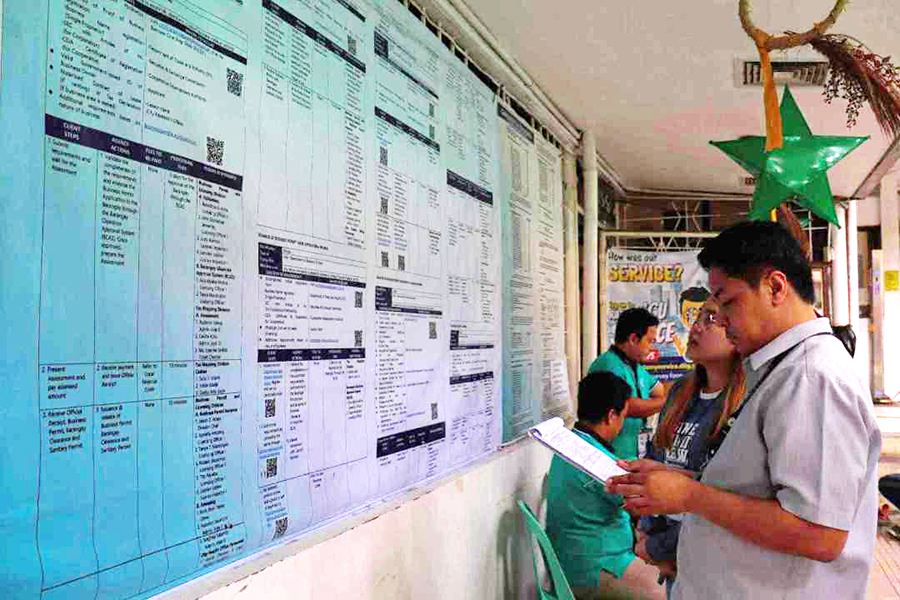
THE Anti-Red Tape Authority-Northern Mindanao visit Cagayan de Oro City Hall on January 16 for an inspection. (Jomar Figuraion, City Information Office)
Section 6 of the Ease of Doing Business and Efficient Government Services Delivery Act of 2018 or Republic Act 11032 states that all government agencies “shall set up their respective most current and updated service standards to be known as the Citizen's Charter,” which should be in the form of information billboards placed at the main entrance of offices or in a noticeable place on their websites.
The Citizen's Charter will guarantee citizens' access to information while holding government agencies accountable and transparent on the services they provide.
It must include a comprehensive and uniform checklist of requirements for each type of application or request, the procedure to obtain a particular service, the person(s) responsible for each step, the maximum time to conclude the process, the document(s) to be presented by the requesting party, the amount of fees, and the procedure for filing complaints.
ARTA-Northern Mindanao was asked to specify these external services but has to ask permission first from their central office in Manila before disclosing them.
However, according to the law, government service involves “applications for any privilege, right, reward, license, clearance, permit or authorization, concession, or for any modification, renewal, or extension of the enumerated applications or requests which are acted upon in the ordinary course of business of the agency or office concerned.”
Nayra said aside from improving the Citizen’s Charter, there is also a need for the city government here to promote Electronic Business One-Stop Shop (eBOSS) to business owners, particularly in the application and renewal process of business permits.
“It will save time and resources on the client’s part, and there will be no long queues in City Hall if clients transact online,” Nayra said. “There are only three steps in the process, and in a matter of minutes, you can already claim your permit.”
eBoss aims to streamline business permitting process online, and it is required under the law.
BenCyrus Ellorin, political spokesperson of Mayor Rolando Uy, assured that the city government will comply with ARTA standards on the Citizen’s Charter.
“In this context, the Ccitizen's Charter should not be limiting but inclusive. Emerging external services will be integrated into the Citizen's Charter,” Ellorin said on Tuesday.
During the inspection, ARTA also checked compliance with other provisions of the law, such as the Public Assistance and Complaints Desk, the 3-7-20 working days prescribed processing time, limitation of signatories to not more than three, no noon break, issuance of official receipts, and incidents of fixing.
ARTA interviewed clients in the business permitting area to know if they are content with services.
The city government is compliant with the Citizen’s Charter, ARTA said, noting no additional fees and no additional requirements, except only those specified in their charter.
It also has a fully-automated eBOSS, being the first local government unit in Mindanao to be awarded by ARTA with a Certificate of Compliance for having such system, the gold standard in the business permitting process.
The agency also noted good practice as the city government conducts weekly assessments to review clients’ feedback to improve their services.
ARTA said “agencies will become lax and non-compliant” without inspections. It urged LGUs and government agencies to follow the law, reminding them that ARTA empowers agencies to become compliant, but it also has enforcement authority.