

ADVERTISEMENT

Why European farmers are up in arms

Published Feb 2, 2024 09:24 am

The European Commission is due on Thursday to begin "strategic" talks with farmers' federations, agri-business firms, NGOs, and experts on ways to assuage the ire on farms in several countries. 

On the agenda are key issues including farming incomes, sustainable agricultural practices, technological innovations, and competitiveness, which will be discussed in advance by the European Union's agriculture ministers at their meeting in Brussels on Tuesday. 

The initiative was not confirmed until late last week, even though Commission President Ursula von der Leyen had promised in September to start discussions, insisting that farming and environmental protection were not mutually exclusive. 

Here is a look at some of the grievances that have sparked discontent in various parts of the 27-nation bloc ahead of this year's European Parliament elections. 

Netherlands

Grumblings in the Dutch farming sector bubbled to the surface in June 2022, when the government unveiled plans to cut nitrogen emissions by reducing the country's herd of four million cows by nearly a third, and possibly shutting some farms. 

Farmers said the move would ruin their livelihoods. 

Nitrogen compounds produced by manure and fertilizer used in farming can contribute to climate change and harm natural habitats. 

The move followed a 2019 Dutch court ruling that the government was not doing enough on nitrogen, and that key house building and road projects that also produced the chemical would be on hold until it did. 

But farmers in the country of 18 million, which is the world's second-largest food exporter after the United States, reacted furiously, dumping manure and rubbish on roads and blocking supermarket warehouses. 

Their protests drew support from populists abroad, including former US President Donald Trump, who claimed the Dutch farmers were fighting "climate tyranny."
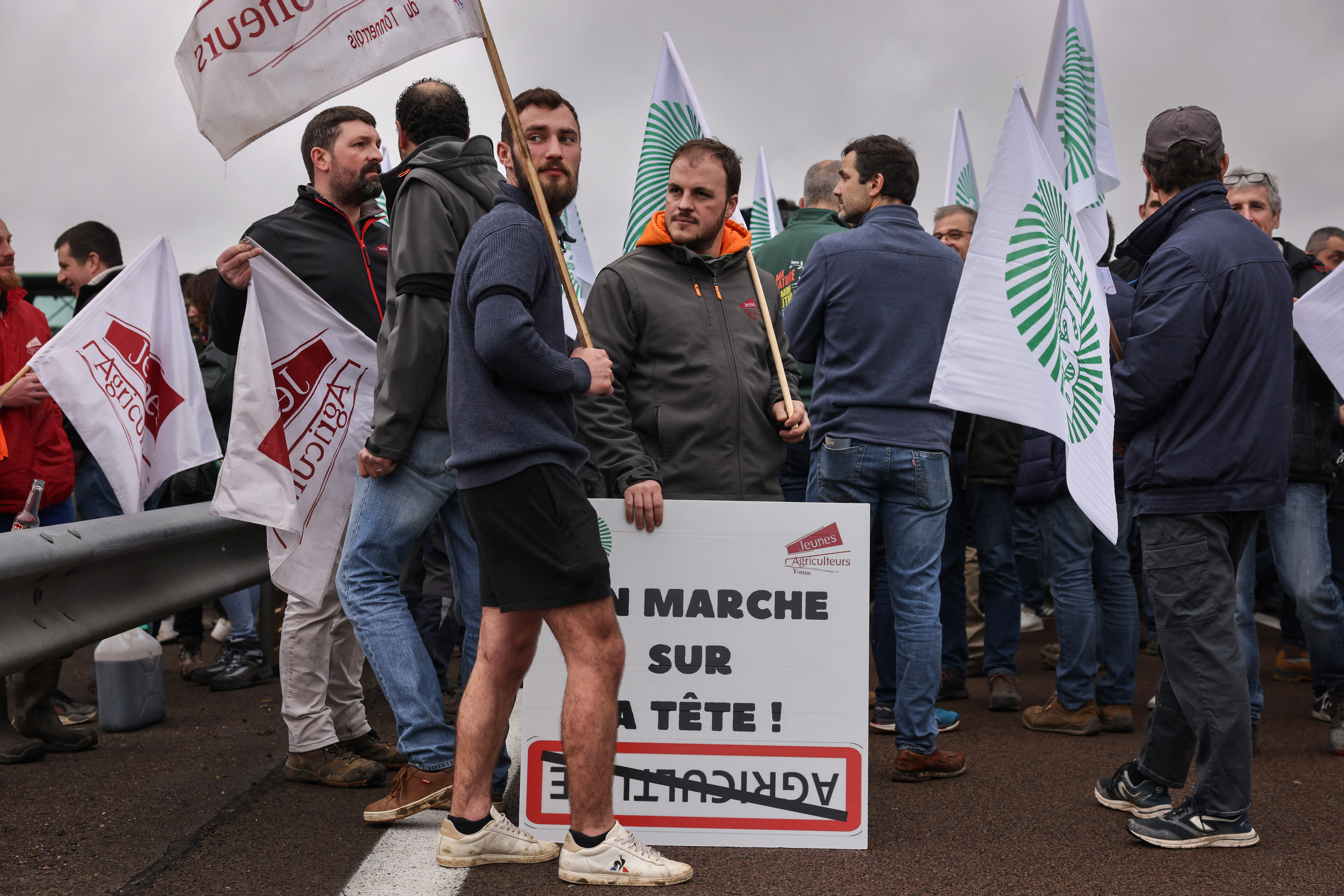
1^.jpg
Farmers block the A6 highway during a demonstration called by the French farmer union FDSEA (Féderation Départementale des syndicats d’exploitants agricoles) in Nitry, central eastern France. (Photos from AFP)

Months of demonstrations triggered a wave of support at the ballot box for the recently founded BBB farmers' party, which made a significant breakthrough in Senate elections in March 2023. 

It was less successful than predicted in the general election in November last year but continues to attract support from a rural community that feels urban elites in The Hague, Amsterdam, and Brussels do not understand its concerns. 

Poland and Romania 

In recent months, there has also been an increase in exasperation in the east of the EU, namely in Poland, Romania, Slovakia, Hungary, and Bulgaria, where food producers have complained of unfair competition from cut-price cereals from Ukraine, which is not part of the bloc. 

After Russia launched its invasion of Ukraine in February 2022 and blocked Ukraine from using the Black Sea to export its goods, the EU suspended customs duties on imports from Ukraine and set up corridors, so Kyiv could transit its grains through the EU to world markets. 

But because of logistical issues, the grain started piling up in EU countries and driving down local prices. 

Tractor-riding farmers in Bulgaria and Romania jammed border crossings with Ukraine and in Poland, the anger triggered the resignation of the agriculture minister in April 2023. 

That did little to calm tempers and in November, Polish farmers, and lorry drivers started blockading roads from Ukraine. 

Farmers only suspended their protest on Jan. 6 after the government agreed to provide subsidies. 

In Romania, the rural sector staged new demonstrations on Jan. 14 over what it said were excessively high levies. 

The customs exemptions granted to Ukrainian exporters expire in June, so the European Commission will need to tell EU farmers fairly soon whether it intends to prolong them or not. 

Germany 

In Germany, farmers have been up in arms since early January over a government plan to roll back tax breaks on fuel for agricultural machinery and other subsidies.
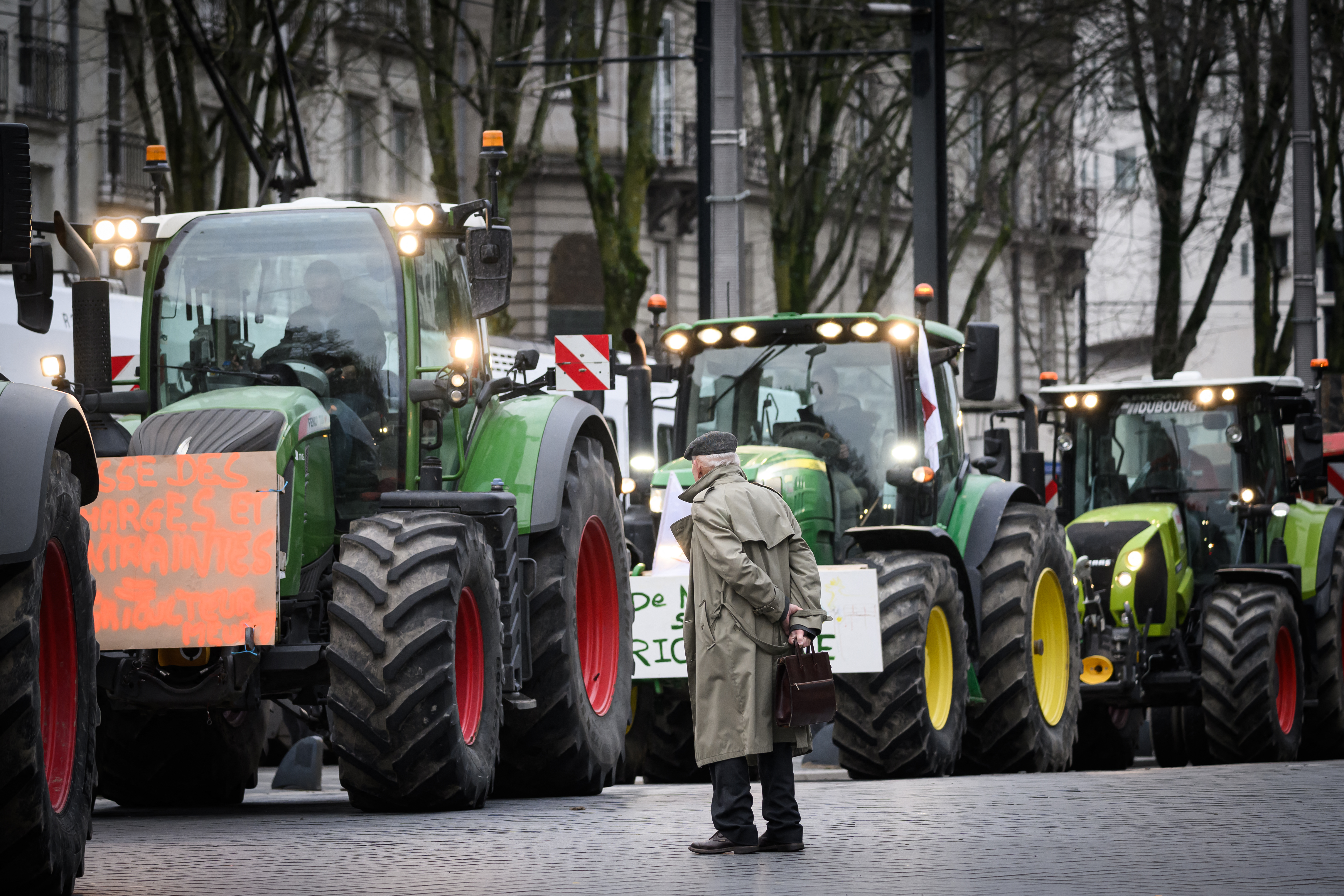
2^.jpg
Farmers demonstrate with hundreds of tractors in downtown Nantes on Jan. 25, 2024, as part of a nationwide day of action called by several farming unions.

On Jan. 8, they launched a week of nationwide rallies, blocking several city centers and major road arteries with hordes of noisy tractors, and have vowed to push on with their demands. 

The coalition government of Chancellor Olaf Scholz has agreed to stagger the cuts between now and January 2026 and reduce red tape. 

But it may feel unable to offer more concessions after a court ruling forced the government to find savings in the 2024 budget. 

France 

Farmers in France are also cross about increases in production costs and environmental regulations. 

In the autumn, they turned signposts upside down to show the world itself was "upside down." 

Since Thursday, they have been blockading motorways in the southwest and rallying at roundabouts. 

The powerful farming union FNSEA is planning other forms of protest, after a meeting with newly installed Prime Minister Gabriel Attal on Monday failed to produce a breakthrough. 

Further afield 

In former EU member Britain, fruit and vegetable farmers planted 49 scarecrows outside parliament on Monday to represent the 49 percent of farmers who say they are on the brink of leaving the industry due to "unfair" treatment by the country's powerful supermarket chains. 

Supermarkets are "bringing British farming to its knees," Guy Singh-Watson, founder of the fruit and veg box delivery firm Riverford Organic, told AFP, adding that government policies failed adequately to support the sector and were rarely enforced. 

And there are predictions the rural unrest could spread to other parts of the EU too. 

"There is talk of protest in Italy and Spain," said Christiane Lambert, head of Europe's leading farmers' union, the Committee of Professional Agricultural Organizations (COPA).

Related Tags

European Commission MBEnvironment Ursula von der Leyen
ADVERTISEMENT
.most-popular .layout-ratio{ padding-bottom: 79.13%; } @media (min-width: 768px) and (max-width: 1024px) { .widget-title { font-size: 15px !important; } }

{{ articles_filter_1561_widget.title }}

.most-popular .layout-ratio{ padding-bottom: 79.13%; } @media (min-width: 768px) and (max-width: 1024px) { .widget-title { font-size: 15px !important; } }

{{ articles_filter_1562_widget.title }}

.most-popular .layout-ratio{ padding-bottom: 79.13%; } @media (min-width: 768px) and (max-width: 1024px) { .widget-title { font-size: 15px !important; } }

{{ articles_filter_1563_widget.title }}

{{ articles_filter_1564_widget.title }}

.mb-article-details { position: relative; } .mb-article-details .article-body-preview, .mb-article-details .article-body-summary{ font-size: 17px; line-height: 30px; font-family: "Libre Caslon Text", serif; color: #000; } .mb-article-details .article-body-preview iframe , .mb-article-details .article-body-summary iframe{ width: 100%; margin: auto; } .read-more-background { background: linear-gradient(180deg, color(display-p3 1.000 1.000 1.000 / 0) 13.75%, color(display-p3 1.000 1.000 1.000 / 0.8) 30.79%, color(display-p3 1.000 1.000 1.000) 72.5%); position: absolute; height: 200px; width: 100%; bottom: 0; display: flex; justify-content: center; align-items: center; padding: 0; } .read-more-background a{ color: #000; } .read-more-btn { padding: 17px 45px; font-family: Inter; font-weight: 700; font-size: 18px; line-height: 16px; text-align: center; vertical-align: middle; border: 1px solid black; background-color: white; } .hidden { display: none; }
function initializeAllSwipers() { // Get all hidden inputs with cms_article_id document.querySelectorAll('[id^="cms_article_id_"]').forEach(function (input) { const cmsArticleId = input.value; const articleSelector = '#article-' + cmsArticleId + ' .body_images'; const swiperElement = document.querySelector(articleSelector); if (swiperElement && !swiperElement.classList.contains('swiper-initialized')) { new Swiper(articleSelector, { loop: true, pagination: false, navigation: { nextEl: '#article-' + cmsArticleId + ' .swiper-button-next', prevEl: '#article-' + cmsArticleId + ' .swiper-button-prev', }, }); } }); } setTimeout(initializeAllSwipers, 3000); const intersectionObserver = new IntersectionObserver( (entries) => { entries.forEach((entry) => { if (entry.isIntersecting) { const newUrl = entry.target.getAttribute("data-url"); if (newUrl) { history.pushState(null, null, newUrl); let article = entry.target; // Extract metadata const author = article.querySelector('.author-section').textContent.replace('By', '').trim(); const section = article.querySelector('.section-info ').textContent.replace(' ', ' '); const title = article.querySelector('.article-title h1').textContent; // Parse URL for Chartbeat path format const parsedUrl = new URL(newUrl, window.location.origin); const cleanUrl = parsedUrl.host + parsedUrl.pathname; // Update Chartbeat configuration if (typeof window._sf_async_config !== 'undefined') { window._sf_async_config.path = cleanUrl; window._sf_async_config.sections = section; window._sf_async_config.authors = author; } // Track virtual page view with Chartbeat if (typeof pSUPERFLY !== 'undefined' && typeof pSUPERFLY.virtualPage === 'function') { try { pSUPERFLY.virtualPage({ path: cleanUrl, title: title, sections: section, authors: author }); } catch (error) { console.error('ping error', error); } } // Optional: Update document title if (title && title !== document.title) { document.title = title; } } } }); }, { threshold: 0.1 } ); function showArticleBody(button) { const article = button.closest("article"); const summary = article.querySelector(".article-body-summary"); const body = article.querySelector(".article-body-preview"); const readMoreSection = article.querySelector(".read-more-background"); // Hide summary and read-more section summary.style.display = "none"; readMoreSection.style.display = "none"; // Show the full article body body.classList.remove("hidden"); } document.addEventListener("DOMContentLoaded", () => { let loadCount = 0; // Track how many times articles are loaded const offset = [1, 2, 3, 4, 5, 6, 7, 8, 9, 10]; // Offset values const currentUrl = window.location.pathname.substring(1); let isLoading = false; // Prevent multiple calls if (!currentUrl) { console.log("Current URL is invalid."); return; } const sentinel = document.getElementById("load-more-sentinel"); if (!sentinel) { console.log("Sentinel element not found."); return; } function isSentinelVisible() { const rect = sentinel.getBoundingClientRect(); return ( rect.top < window.innerHeight && rect.bottom >= 0 ); } function onScroll() { if (isLoading) return; if (isSentinelVisible()) { if (loadCount >= offset.length) { console.log("Maximum load attempts reached."); window.removeEventListener("scroll", onScroll); return; } isLoading = true; const currentOffset = offset[loadCount]; window.loadMoreItems().then(() => { let article = document.querySelector('#widget_1690 > div:nth-last-of-type(2) article'); intersectionObserver.observe(article) loadCount++; }).catch(error => { console.error("Error loading more items:", error); }).finally(() => { isLoading = false; }); } } window.addEventListener("scroll", onScroll); });

Sign up by email to receive news.