

ADVERTISEMENT

Strong El Niño to persist until May; affected provinces down to 41

Published Feb 13, 2024 08:32 am

Several parts of the Philippines will experience “strong El Niño” this February, and would persist until May, as the number of affected provinces is now down to 41 from the previously reported 50, the spokesperson of Task Force El Niño said on Tuesday, Feb. 13.
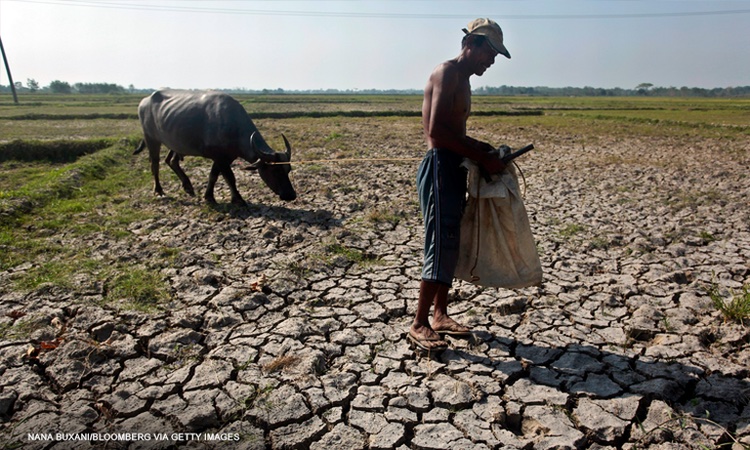
 

El Niño phenomenon.jpg(Photo by Nana Buxani/Bloomberg via Getty Images)


In a Palace press briefing after a sectoral meeting with President Marcos, Presidential Communications Office (PCO) Assistant Secretary and Task Force El Niño spokesperson Joey Villarama cited a Philippine Atmospheric, Geophysical and Astronomical Services Administration (PAGASA) advisory.
 

“PAGASA and its advisory or bulletin number eight said that the effects of El Niño are expected strong El Niño are expected to highly impact parts of the country this month of February,” he said, adding that the phenomenon will persist until May 2024.
 

But there’s also “a bit of good news,” the official shared.
 

“Kung doon sa initial or doon sa last report ng PAGASA, 50 provinces ang affected, ngayon ay na-reduce na lang to 41 (The initial or last report of PAGASA, 50 provinces are affected, it has now been reduced to only 41).”
 

Villarama said that 17 provinces are currently experiencing dry condition, 10 provinces are under a dry spell, and 14 provinces are experiencing drought.
 

Those experiencing drought are Apayao, Benguet, Cagayan, Cavite, Ifugao, Ilocos Norte, Ilocos Sur, Kalinga, La Union, Mountain Province, Nueva Ecija, Nueva Vizcaya, Palawan, and Pangasinan.
 

Despite the reduced number of affected provinces, the official underscored the need for the government to provide assistance to the country’s agricultural sector.
 

He assured that “all the principal agencies” in the task force “have closely coordinated to implement mitigating measures to stayed off the effects of El Niño.”
 

“But, in terms of the work of the Task Force and the government, we are forward looking to mitigate the effects until maybe June to September,” he stressed.
 

“So, hindi porke ma-terminate iyong strong El Niño or maging sudden oscillation neutral na siya ay titigil na po ang trabaho ng Task Force (even if the strong El Niño is terminated or it becomes only a sudden oscillation neutral, it doesn’t mean that the Task Force will stop) to help those severely affected.”
 

Asked about the estimated damage of El Niño on agriculture, Villarama quoted a “reported figure” of P150 million, providing a breakdown of P141.24 million for rice and P10.04 million for corn, for Regions 6 (Western Visayas) and 9 (Zamboanga Peninsula).
 

“So two regions pa lang po ang (only two regions are) severely affected, but as I said, the task force is doing all it can to help the farmers affected by the situation,” he furthered.
 

Currently, with President Marcos’ directive of an intervention-and-mitigation approach across all agencies, the government has been repairing irrigation canals for a more efficient supply of water, providing inputs and implements for irrigation to farmers in Regions 6 and 9, and offering social protection and alternative means of livelihood for those severely affected.
 

Villarama, however, admitted that there are challenges that lie ahead, particularly the “unforeseen effect” of El Niño like a rise in temperature, a decrease in dam water levels, and issues in the irrigation inputs.
 

“So basically, the challenge is for the unforeseen events. But as I said, as the President mentioned in his speech in Davao last week, under Bagong Pilipinas, we try to nip the problem in the bud; not let them catch us off guard,” he added.

Related Tags

Dry spell PAGASA El Niño Joey Villarama
ADVERTISEMENT
.most-popular .layout-ratio{ padding-bottom: 79.13%; } @media (min-width: 768px) and (max-width: 1024px) { .widget-title { font-size: 15px !important; } }

{{ articles_filter_1561_widget.title }}

.most-popular .layout-ratio{ padding-bottom: 79.13%; } @media (min-width: 768px) and (max-width: 1024px) { .widget-title { font-size: 15px !important; } }

{{ articles_filter_1562_widget.title }}

.most-popular .layout-ratio{ padding-bottom: 79.13%; } @media (min-width: 768px) and (max-width: 1024px) { .widget-title { font-size: 15px !important; } }

{{ articles_filter_1563_widget.title }}

{{ articles_filter_1564_widget.title }}

.mb-article-details { position: relative; } .mb-article-details .article-body-preview, .mb-article-details .article-body-summary{ font-size: 17px; line-height: 30px; font-family: "Libre Caslon Text", serif; color: #000; } .mb-article-details .article-body-preview iframe , .mb-article-details .article-body-summary iframe{ width: 100%; margin: auto; } .read-more-background { background: linear-gradient(180deg, color(display-p3 1.000 1.000 1.000 / 0) 13.75%, color(display-p3 1.000 1.000 1.000 / 0.8) 30.79%, color(display-p3 1.000 1.000 1.000) 72.5%); position: absolute; height: 200px; width: 100%; bottom: 0; display: flex; justify-content: center; align-items: center; padding: 0; } .read-more-background a{ color: #000; } .read-more-btn { padding: 17px 45px; font-family: Inter; font-weight: 700; font-size: 18px; line-height: 16px; text-align: center; vertical-align: middle; border: 1px solid black; background-color: white; } .hidden { display: none; }
function initializeAllSwipers() { // Get all hidden inputs with cms_article_id document.querySelectorAll('[id^="cms_article_id_"]').forEach(function (input) { const cmsArticleId = input.value; const articleSelector = '#article-' + cmsArticleId + ' .body_images'; const swiperElement = document.querySelector(articleSelector); if (swiperElement && !swiperElement.classList.contains('swiper-initialized')) { new Swiper(articleSelector, { loop: true, pagination: false, navigation: { nextEl: '#article-' + cmsArticleId + ' .swiper-button-next', prevEl: '#article-' + cmsArticleId + ' .swiper-button-prev', }, }); } }); } setTimeout(initializeAllSwipers, 3000); const intersectionObserver = new IntersectionObserver( (entries) => { entries.forEach((entry) => { if (entry.isIntersecting) { const newUrl = entry.target.getAttribute("data-url"); if (newUrl) { history.pushState(null, null, newUrl); let article = entry.target; // Extract metadata const author = article.querySelector('.author-section').textContent.replace('By', '').trim(); const section = article.querySelector('.section-info ').textContent.replace(' ', ' '); const title = article.querySelector('.article-title h1').textContent; // Parse URL for Chartbeat path format const parsedUrl = new URL(newUrl, window.location.origin); const cleanUrl = parsedUrl.host + parsedUrl.pathname; // Update Chartbeat configuration if (typeof window._sf_async_config !== 'undefined') { window._sf_async_config.path = cleanUrl; window._sf_async_config.sections = section; window._sf_async_config.authors = author; } // Track virtual page view with Chartbeat if (typeof pSUPERFLY !== 'undefined' && typeof pSUPERFLY.virtualPage === 'function') { try { pSUPERFLY.virtualPage({ path: cleanUrl, title: title, sections: section, authors: author }); } catch (error) { console.error('ping error', error); } } // Optional: Update document title if (title && title !== document.title) { document.title = title; } } } }); }, { threshold: 0.1 } ); function showArticleBody(button) { const article = button.closest("article"); const summary = article.querySelector(".article-body-summary"); const body = article.querySelector(".article-body-preview"); const readMoreSection = article.querySelector(".read-more-background"); // Hide summary and read-more section summary.style.display = "none"; readMoreSection.style.display = "none"; // Show the full article body body.classList.remove("hidden"); } document.addEventListener("DOMContentLoaded", () => { let loadCount = 0; // Track how many times articles are loaded const offset = [1, 2, 3, 4, 5, 6, 7, 8, 9, 10]; // Offset values const currentUrl = window.location.pathname.substring(1); let isLoading = false; // Prevent multiple calls if (!currentUrl) { console.log("Current URL is invalid."); return; } const sentinel = document.getElementById("load-more-sentinel"); if (!sentinel) { console.log("Sentinel element not found."); return; } function isSentinelVisible() { const rect = sentinel.getBoundingClientRect(); return ( rect.top < window.innerHeight && rect.bottom >= 0 ); } function onScroll() { if (isLoading) return; if (isSentinelVisible()) { if (loadCount >= offset.length) { console.log("Maximum load attempts reached."); window.removeEventListener("scroll", onScroll); return; } isLoading = true; const currentOffset = offset[loadCount]; window.loadMoreItems().then(() => { let article = document.querySelector('#widget_1690 > div:nth-last-of-type(2) article'); intersectionObserver.observe(article) loadCount++; }).catch(error => { console.error("Error loading more items:", error); }).finally(() => { isLoading = false; }); } } window.addEventListener("scroll", onScroll); });

Sign up by email to receive news.