






 Philippines
Luzon
Mining firm, local execs may be liable for allowing structures in no-build zones
Philippines
Luzon
Mining firm, local execs may be liable for allowing structures in no-build zones
Mining firm, local execs may be liable for allowing structures in no-build zones


DAVAO CITY – As casualties mount in the landslide in Barangay Masara, Maco, Davao de Oro, an environmental group believes that local government officials and Apex Mining Co. may be held liable for allowing the construction of structures in identified no-build zones that led to the loss of lives.
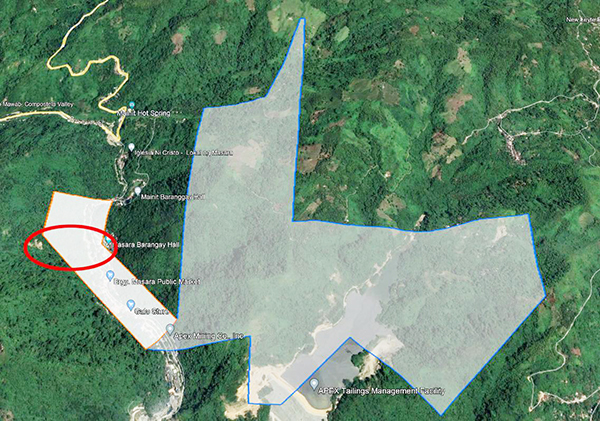
MAP shows the mining tenement of Apex Mining Co. with approximate location of the landslide site.
Interfacing Development Interventions for Sustainability (IDIS) Executive Director Mark Peñalver pointed out that local government officials from the governor down to the barangay should explain why there are structures in geohazard zones.
“If it’s a no-build zone and then they just allowed the people to build structures in the area they may be held liable. That’s it is very important to ensure proper implementation of existing polices,” Peñalver said.
He added that the provincial government should revisit its Provincial Development and Physical Framework Plan if the recommendations of Mines and Geosciences Bureau have been considered.
The massive landslide on February 6 that left 68 people dead and 51 missing as of 12 noon on Tuesday, February 13, is not the first in the first-class town of 83,000 people.
About 55 houses were buried in the nine-hectare landslide site which has a height of up to 50 meters.
The Maco Municipal Social Welfare and Development Office reported that approximately 1,600 families are staying in evacuation centers following a forced evacuation amid the massive landslide.
In 2007, at least 10 people were killed in a landslide in Masara due to heavy rains. A year later, 24 miners and residents were also killed in a landslide in the area.
The February 6 landslide was the worst natural disaster to have hit the province in a decade, according to the Provincial Disaster Risk Reduction and Management Office.
In an online press briefing over the weekend, MGB-Davao Region Geosciences Division chief Beverly Brebante confirmed that Masara is one of the barangays in the province that has been tagged as no build zones since 2008.
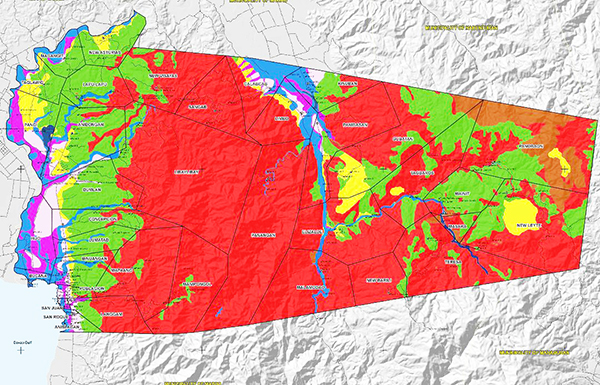
FLOOD susceptibility map of Maco, Davao de Oro. Red means high landslide susceptibility. (Map courtesy of MGB-Davao)
The implementation of a no-build zone policy should be a collaborative effort of national government agencies and local government units, she added.
While the MGB official emphasized that the landslide in Masara was caused by natural factors, she bared that they are still investigating the incident to find out if anyone should be held liable.
Brebante said that the landslide site is outside of the active mining area of Apex Mining Co.
She said that once an area is declared as a no-build zone, it is regardless of any structure such as residential and industrial structures.
However, she defended the presence of mining operations inside the identified red zones or geohazard areas, saying these are accompanied by mitigating measures.
Brebante said that there are some barangay sites that are within the red zones but these are subject to regular monitoring.
Should there be any indication of instabilities, Brebante said that red zones can progress to very critical zones. “Thus, we recommend more appropriate actions. So what we always recommend on red zones is constant monitoring of the stakeholders.”
Masara, with a population of over 1,000 people, is one of the host communities of Apex Mining Co. that holds two Mineral Production Sharing Agreements (MPSA) based on MGB records.
Davao de Oro Gov. Dorothy Gonzaga said that residents left the area following the landslide in 2008 but she refused to comment why they were allowed to resettle in the area.
Gonzaga said she has been reminding mayors and concerned agencies since she assumed office in 2022 to regularly monitor high-risk areas due to a series of earthquakes.
She added that it is the priority of her administration to find relocation sites for communities in high-risk areas.
“In fact, we have already identified relocation sites for New Bataan and Nabunturan. But we are still facing difficulties in finding a relocation site for Maco because the MGB has no definite recommendation yet as to where these communities will be relocated.”
Mining tenement area
MGB-Davao records said Davao de Oro hosts seven of 15 MPSA permits in the region. The rest are in neighboring Davao Oriental.
Under the MPSA, a mining firm is granted up to 5,000 hectares for 25 years and may be allowed to extend for another 25 years.
MGB data added that Davao de Oro, formerly known as Compostela Valley province, boasts a rich mineral reserve of gold and silver amounting to P9.4 billion as of 2022.
One of the large-scale mine operators in Davao de Oro is Apex Mining Co. that holds two MPSA permits to mine gold and silver in a combined total area of 2,237 hectares.
MPSA 225-2005-XI is on commercial operation and covers 679.02 hectares and set to expire in 2030. MPSA 234-2007-XI, which is still under exploration period stage as of 2022, covers 1,558.52 hectares and set to expire in 2032.
The mining tenement sprawls across Barangays Masara, Teresa, Mainit, Tagbaros, New Barili, New Leyte, and Elizalde in Maco and Golden Valley in Mabini town, Davao de Oro.
An Apex Mining Co. company profile posted on the website of MGB-Davao said the firm has a total of 3,213 employees.
Based on map coordinates from a document posted on the firm's website, the landslide site appears to sit within the MPSA 2007-234-XI.
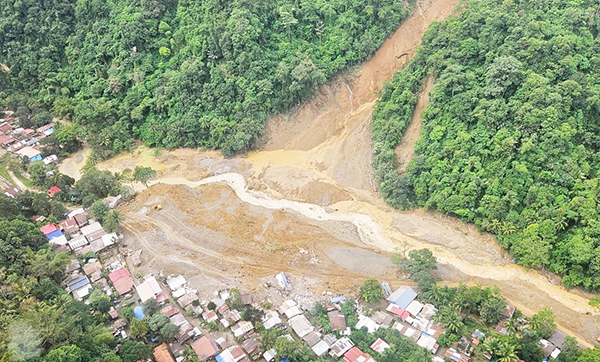
AERIAL photo of the landslide site in Barangay Masara, Maco, Davao de Oro. (OCD-Davao)
A search on Google Map on the location of Barangay Masara will lead to the center of the village and reveals the location of the barangay hall and the blue buses as the distinct landmarks.
The barangay hall appears to be just outside of the MPSA coverage area but the open space where the six blue buses are located is within the tenement.
Aside from the houses, Apex Mining Co. also confirmed that there were four 60-seat buses and one 36-person capacity jeep waiting for outgoing employees when the landslide happened.
One of the buses had left for Mawab, Davao de Oro, while the rest were still waiting for the bus during the landslide, the mining firm added.
Following the landslide, photos and videos made rounds in social media showing the blue buses parked in an open space in Masara waiting for passengers apparently taken or posted before the deadly landslide.
The barangay’s public market and the elementary school are also within the mining tenement.
Apex Mining Co. community relations manager Engr. Ferdinand Dobli said that the landslide site is outside of its active mine site.
In a media briefing in Maco on February 12, Dobli admitted that some of its areas in Masara are within the identified geohazard areas.
But he emphasized that they have mitigating measures in place. He admitted that the bus terminal for their workers is located at the heart of Masara and that it also serves as a staging area for their cargo.
In a statement issued on February 12, MGB-Davao confirmed that the mining firm's bus terminal was among the affected areas in the landslide.
"It can be recalled that a landslide incident occurred in the same area last September 6 to 7, 2008 due to heavy rainfall and deteriorating geophysical conditions," it said.
Teresa Pacis, Apex Mining Co. assistant vice president for corporate affairs and communication, said on February 8 that the landslide site in Masara is within their mining tenement.