






 Philippines
Metro Manila
Innovative, inclusive investments in education key to PISA 2022 performance - Mayor Abby
Philippines
Metro Manila
Innovative, inclusive investments in education key to PISA 2022 performance - Mayor Abby
Innovative, inclusive investments in education key to PISA 2022 performance - Mayor Abby


Makati City Mayor Abby Binay on Monday, Feb. 12, noted that Benigno Ninoy Aquino High School's (BNAHS) exceptional performance in the 2022 Program for International Student Assessment (PISA) is the fruit of the city's introduction and integration of innovative and inclusive learning programs and interventions to its learners before and during the Covid-19 pandemic.
(Photo from Makati LGU)
According to the city government, PISA assesses the knowledge and skills of 15-year-old students (Grade 9) in mathematics, reading, and science that explores how well students can solve complex problems, think critically, and communicate effectively. This also gives insights into how well education systems are preparing students for real-life challenges and future success.
BNAHS was the only public school in the National Capital Region (NCR) to pass Level 2 and is the only Makati public school selected to participate in the international test,
“Considering that there had been no face-to-face classes for over two years when the test was conducted, this achievement speaks volumes of the success of Makati’s innovative and inclusive programs for our public school students,” Binay said.
She explained that prior to the pandemic, Makati had invested P31 million for the full implementation of Project MILES (Mathematics Intensive Learning Enhancement for Students) for Grades 1 to 10 during School Year 2019-2020, following its successful pilot launch in 2018.
Under Project MILES, students received intervention to enhance their numeracy skills through Saturday classes and 100 percent access to free learning materials locally developed by the Department of Education Makati (DepEd Makati) with full funding from the city government.
No fees were charged to students since the city paid for the honoraria of over 700 teachers who handled both onsite and online sessions, the subscription of Math software Koobits popular in Singapore, and the learning materials of students.
"Unlike some private sector-led learning interventions like MTAP which require a fee from participants, Project MILES promoted inclusivity as it was free for everyone who needed or wanted to hone their skills in Mathematics. It also helped familiarize students with e-learning, making it easier for them to adapt to online classes when the pandemic struck," Binay said.
Mobile Learning Hubs
During the height of the Covid-19 pandemic, the city government launched a series of programs aimed at ensuring the quality of education its learners will receive despite the issuance of public health and safety protocols such as the suspension of face-to-face classes to mitigate the spread of the virus.
One of which is the Dyipni Makati initiative where 27 jeepneys were converted into mobile learning hubs. These jeepneys are equipped with laptops, internet connection, books and other learning materials to be used by the city's youth who are having difficulties in their online learning classes due to lack of equipment and internet.
Binay noted that since Makati is small, the city government cannot build libraries in each barangay, hence, their decision to create the mobile learning hub project to make it more mobile and accessible to the community.
In June of last year, the city government procured two Mobile Learning Hubs and announced her administration's plan to purchase additional vehicles for the expansion of the initiative. The two new Mobile Learning Hubs are equipped with books, TVs, tablets, tutorial lessons, and other learning equipment which are considered an upgrade from the Dyipni Makati vehicles.
The city government and DepEd Makati also jointly focused on developing, digitizing and printing local learning materials that were made available to the students for their online classes and asynchronous learning sessions.
Aside from providing USB OTGs containing learning modules to students, the city also equipped teachers with laptops and internet load to facilitate online classes.
“I believe the innovative measures implemented by the city government to address the challenges of the pandemic had given our students a competitive edge,” Binay said.
“This achievement is a clear validation of the sound investments that Makati has made in modernizing the public school system," she added.
Smart Makati
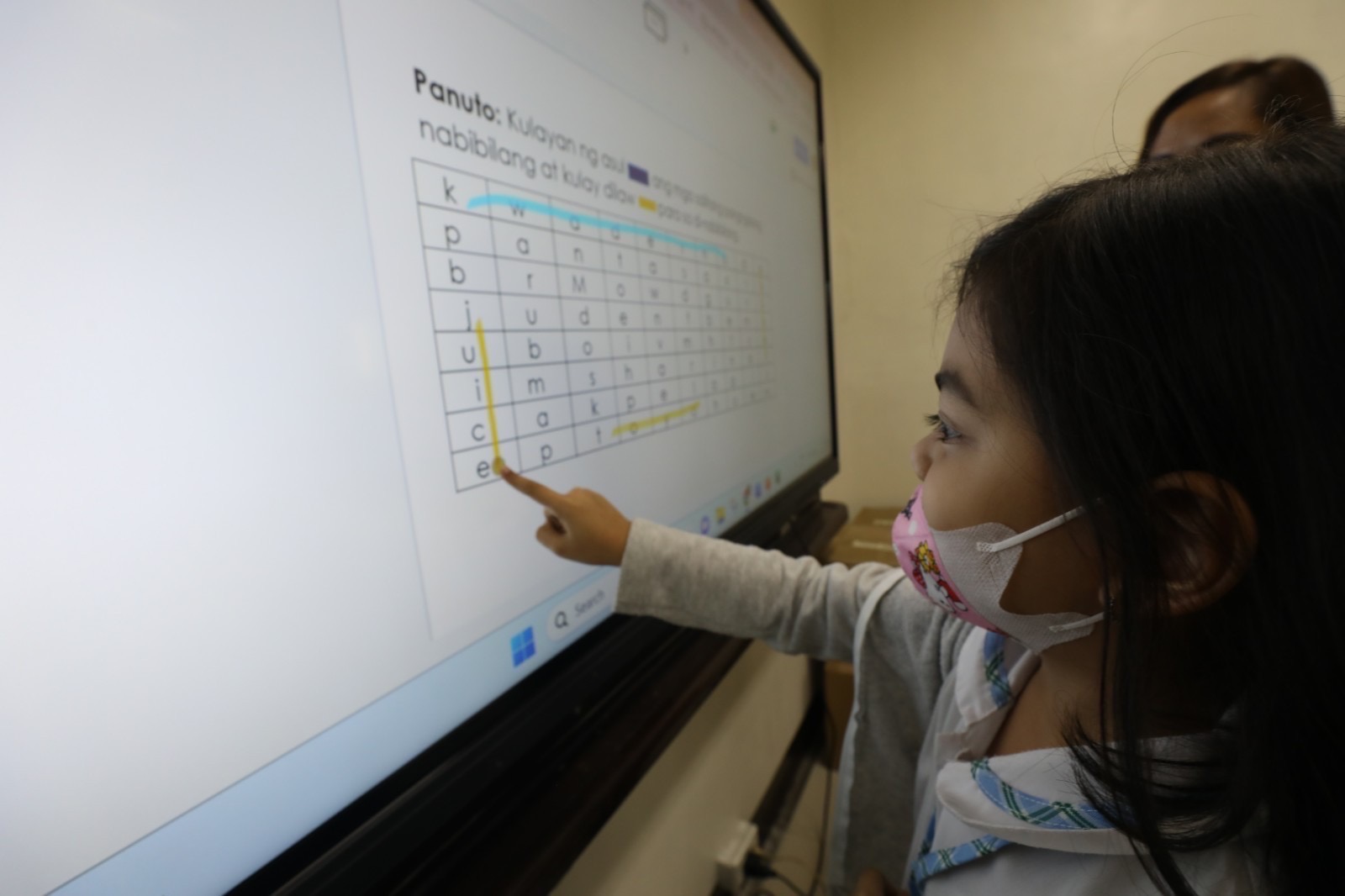
On Jan. 26, the three-term mayor announced the conversion of 400 traditional classrooms into smart classrooms by installing interactive whiteboards, notebook tablets, and unlimited internet access by this year.
A total of 200 Hybrid Interactive Boards (HIBs) equivalent to 50 percent of its target have already been installed in the city public schools as of January with 119 HIBs installed in elementary schools and 81 in secondary schools.
"Each HIB unit is equipped with Android 11.0 intelligent operating system and built with 5G wireless internet access with WiFi hotspot, and a three-way USB interface support. It also has a 4-core 64-bit CPU, a 4K touchscreen whiteboard with multi-gesture writing features, wireless co-screening with multiple screening, and remote snapshot. Its 8-array microphones have a 10-meter pickup distance for convenient video conferencing," Binay explained.
Learners will also have access to notebook tablets connected to the school's Learning Management System (LMS), aside from an HIB unit featuring remote classroom capabilities.
The internet access will also be unlimited for all students and teachers during classes inside the smart classrooms. Charging stations will be installed in the schools to ensure continuous use of the students' digital devices during learning activities.
Students will have each have a notebook tablets on the desk, allowing them to directly submit answers for exercises, worksheets, or exams provided by their teachers.
Meanwhile, learning analytics tools integrated into the LMS will help reduce the administrative workload for teachers in assessing and evaluating the students' performance.
In February last year, Makati topped the regional Test of Functional Academic Skills (TOFAS) administered by the DepEd.
Makati public schools have also consistently ranked high in the annual National Achievement Test (NAT).
This year, the city has allocated P3.25 billion of its general fund for the education sub-sector covering city-funded programs and projects of DepEd Makati, the operations of the University of Makati, and initiatives implemented by the city Education Department and Museum and Cultural Affairs Office.
Another P1.89-billion under Special Education Fund covers the free school uniforms and supplies provided from preschool to senior high school and students’ competency enhancement programs.