

ADVERTISEMENT

Tested in rallying, refined for daily driving

The Mitsubishi Triton and the Ralliart AXCR

Published Feb 1, 2024 10:40 pm

020224MitsubishiTritonAXCR4.jpg

The all-new Mitsubishi Triton's recent launch has generated so much excitement with the new truck sure to heat up the local pickup segment. The handsome new pickup gets a whole slew of changes, not the least of which is the name change from the old Strada badge. 

There’s a new improved engine, a re-engineered ladder frame, and a significant increase in size. Mitsubishi claims that the truck bed can now fit a European standard pallet, which itself is 1.2m in length and 0.8m wide. The new styling is also a lot more appealing and blends together a good balance of composed aggression.

A new rally contender
020224MitsubishiTritonAXCR2.jpg

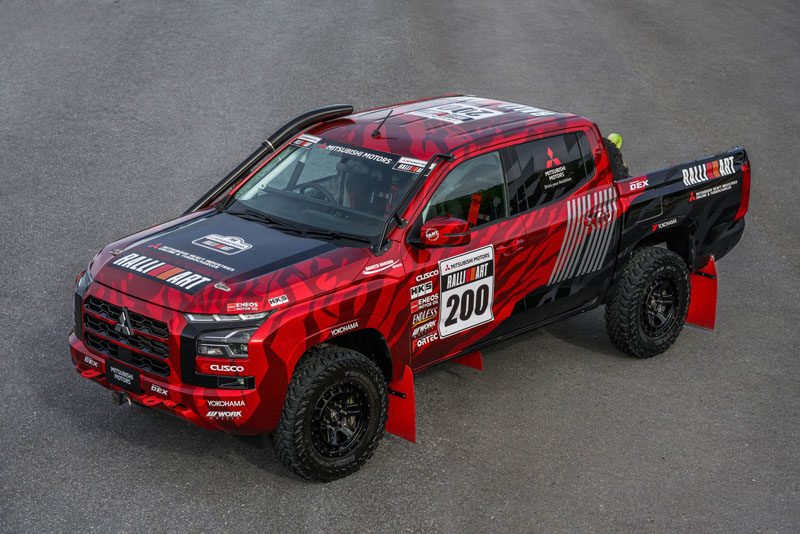
It’s nice to see new life injected into Mitsubishi in the past years, and with this new sixth-generation Triton, the reawakening of the Ralliart motorsports arm continues to move forward. Mitsubishi Ralliart Triton trucks have been competing with great success in the Asia Cross Country Rally (AXCR) placing first in 2022, with the sixth-generation trucks taking third place in 2023. All three sixth-gen Triton entries finished, giving Mitsubishi the Team Award. 

This motorsport connection provides an intriguing window into how technology that is tested in race conditions can enhance the design and engineering of consumer versions. The Triton AXCR race truck has proven more than competitive and has provided Mitsubishi with a platform to test and refine technologies under extreme conditions. Technologies which can be used to inform the development of the passenger version, marrying racing proven engineering with everyday usability.

The Triton AXCR falls under the Federation Internationale de l'Automobile (FIA) regulations for T1 (modified cross-country vehicles) and is designed for cross-country rally racing's harsh and unpredictable terrains. At its heart lies the new 4N16 2.4-liter MIVEC turbo diesel engine tuned for better performance. According to Mitsubishi’s official AXCR spec sheet, this power unit provides the same 204-Ps as that in the regular Athlete 4WD version with the two-stage turbo. As the AXCR truck is a motorsports vehicle, it is equipped with a six-speed manual transmission as opposed to the more comfort-oriented automatic transmission. What remains through is the proven Super Select 4WD-II system, but with the addition of race-focused CUSCO front and rear limited-slip differentials.

Racing upgrades
020224MitsubishiTritonAXCR1.jpg

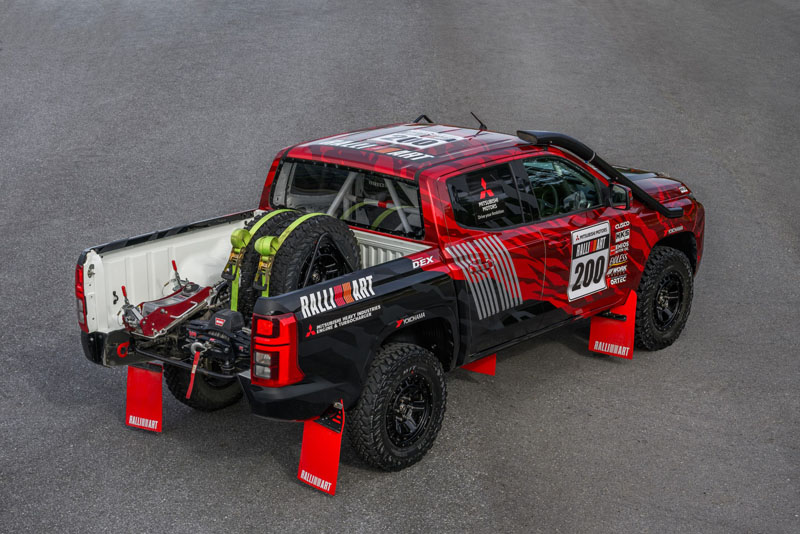
One of the key areas where the race truck influences the road-going Triton is in its handling and suspension systems. The suspension setup on the race truck is unchanged — it still gets the independent coil-sprung front with the leaf-spring rears — except that the dampers have been swapped out to CUSCO adjustable units. The race truck features a suspension setup tailored for high-speed stability and control on uneven terrains. And while the passenger version doesn't need to navigate similar terrain at race speeds, the lessons learned from the race truck's suspension development have been applied to enhance the standard vehicle's ride quality and handling, making it more adaptable to varying road conditions.

The truck's lightweight construction, achieved through the use of materials like carbon fiber for the truck bed, hood, and door panels, has also informed the design philosophy of the passenger version. Of course, the standard truck doesn’t get any factory carbon fiber goodies, but where weight savings and rigidity are concerned, the standard truck makes the most of its steel to provide the best amount of safety and agility.

One for racing, one for utility

020224MitsubishiTritonAXCR3.jpg

The standard Triton comes with all sorts of Advanced Driver Assistance Systems such as adaptive cruise control, forward collision mitigation, and blind spot warning, to name a few. The AXCR truck meanwhile has little need for those. Instead, it gets beefy cabin strengthening in the form of a full roll-cage, Bride bucket seats and five-point harnesses. The Triton's interior, while not as sparse as that of its race counterpart, draws upon ergonomic lessons gleaned in rally racing. Comfort, control layout and ease of use are all influenced from a performance perspective, but balanced out for more comfort and convenience for daily use.

It's worth noting that while the Triton AXCR and the standard version share a common lineage, they are designed for very different purposes. The race truck is a specialized machine, honed for the singular purpose of competitive rallying. In contrast, the passenger version was designed to be a more versatile vehicle, meeting the needs of daily drivers, families, and professionals who require a reliable and practical utility vehicle.

The development of the all-new Triton, in the context of its racing counterparts, illustrates how motorsport can be more than just a testing ground for performance and endurance. It can also be an incubator for innovation, where technologies are made to enhance the practicality, safety, and performance of everyday vehicles.

Related Tags

Mitsubishi
ADVERTISEMENT
.most-popular .layout-ratio{ padding-bottom: 79.13%; } @media (min-width: 768px) and (max-width: 1024px) { .widget-title { font-size: 15px !important; } }

{{ articles_filter_1561_widget.title }}

.most-popular .layout-ratio{ padding-bottom: 79.13%; } @media (min-width: 768px) and (max-width: 1024px) { .widget-title { font-size: 15px !important; } }

{{ articles_filter_1562_widget.title }}

.most-popular .layout-ratio{ padding-bottom: 79.13%; } @media (min-width: 768px) and (max-width: 1024px) { .widget-title { font-size: 15px !important; } }

{{ articles_filter_1563_widget.title }}

{{ articles_filter_1564_widget.title }}

.mb-article-details { position: relative; } .mb-article-details .article-body-preview, .mb-article-details .article-body-summary{ font-size: 17px; line-height: 30px; font-family: "Libre Caslon Text", serif; color: #000; } .mb-article-details .article-body-preview iframe , .mb-article-details .article-body-summary iframe{ width: 100%; margin: auto; } .read-more-background { background: linear-gradient(180deg, color(display-p3 1.000 1.000 1.000 / 0) 13.75%, color(display-p3 1.000 1.000 1.000 / 0.8) 30.79%, color(display-p3 1.000 1.000 1.000) 72.5%); position: absolute; height: 200px; width: 100%; bottom: 0; display: flex; justify-content: center; align-items: center; padding: 0; } .read-more-background a{ color: #000; } .read-more-btn { padding: 17px 45px; font-family: Inter; font-weight: 700; font-size: 18px; line-height: 16px; text-align: center; vertical-align: middle; border: 1px solid black; background-color: white; } .hidden { display: none; }
function initializeAllSwipers() { // Get all hidden inputs with cms_article_id document.querySelectorAll('[id^="cms_article_id_"]').forEach(function (input) { const cmsArticleId = input.value; const articleSelector = '#article-' + cmsArticleId + ' .body_images'; const swiperElement = document.querySelector(articleSelector); if (swiperElement && !swiperElement.classList.contains('swiper-initialized')) { new Swiper(articleSelector, { loop: true, pagination: false, navigation: { nextEl: '#article-' + cmsArticleId + ' .swiper-button-next', prevEl: '#article-' + cmsArticleId + ' .swiper-button-prev', }, }); } }); } setTimeout(initializeAllSwipers, 3000); const intersectionObserver = new IntersectionObserver( (entries) => { entries.forEach((entry) => { if (entry.isIntersecting) { const newUrl = entry.target.getAttribute("data-url"); if (newUrl) { history.pushState(null, null, newUrl); let article = entry.target; // Extract metadata const author = article.querySelector('.author-section').textContent.replace('By', '').trim(); const section = article.querySelector('.section-info ').textContent.replace(' ', ' '); const title = article.querySelector('.article-title h1').textContent; // Parse URL for Chartbeat path format const parsedUrl = new URL(newUrl, window.location.origin); const cleanUrl = parsedUrl.host + parsedUrl.pathname; // Update Chartbeat configuration if (typeof window._sf_async_config !== 'undefined') { window._sf_async_config.path = cleanUrl; window._sf_async_config.sections = section; window._sf_async_config.authors = author; } // Track virtual page view with Chartbeat if (typeof pSUPERFLY !== 'undefined' && typeof pSUPERFLY.virtualPage === 'function') { try { pSUPERFLY.virtualPage({ path: cleanUrl, title: title, sections: section, authors: author }); } catch (error) { console.error('ping error', error); } } // Optional: Update document title if (title && title !== document.title) { document.title = title; } } } }); }, { threshold: 0.1 } ); function showArticleBody(button) { const article = button.closest("article"); const summary = article.querySelector(".article-body-summary"); const body = article.querySelector(".article-body-preview"); const readMoreSection = article.querySelector(".read-more-background"); // Hide summary and read-more section summary.style.display = "none"; readMoreSection.style.display = "none"; // Show the full article body body.classList.remove("hidden"); } document.addEventListener("DOMContentLoaded", () => { let loadCount = 0; // Track how many times articles are loaded const offset = [1, 2, 3, 4, 5, 6, 7, 8, 9, 10]; // Offset values const currentUrl = window.location.pathname.substring(1); let isLoading = false; // Prevent multiple calls if (!currentUrl) { console.log("Current URL is invalid."); return; } const sentinel = document.getElementById("load-more-sentinel"); if (!sentinel) { console.log("Sentinel element not found."); return; } function isSentinelVisible() { const rect = sentinel.getBoundingClientRect(); return ( rect.top < window.innerHeight && rect.bottom >= 0 ); } function onScroll() { if (isLoading) return; if (isSentinelVisible()) { if (loadCount >= offset.length) { console.log("Maximum load attempts reached."); window.removeEventListener("scroll", onScroll); return; } isLoading = true; const currentOffset = offset[loadCount]; window.loadMoreItems().then(() => { let article = document.querySelector('#widget_1690 > div:nth-last-of-type(2) article'); intersectionObserver.observe(article) loadCount++; }).catch(error => { console.error("Error loading more items:", error); }).finally(() => { isLoading = false; }); } } window.addEventListener("scroll", onScroll); });

Sign up by email to receive news.