

ADVERTISEMENT

Taiwan demands that China end its military activity in nearby waters

Published Dec 11, 2024 02:00 pm

TAIPEI, Taiwan (AP) — Taiwan demanded Wednesday that China end its ongoing military activity in nearby waters, which it said is unilaterally undermining peace and stability and disrupting international shipping and trade.
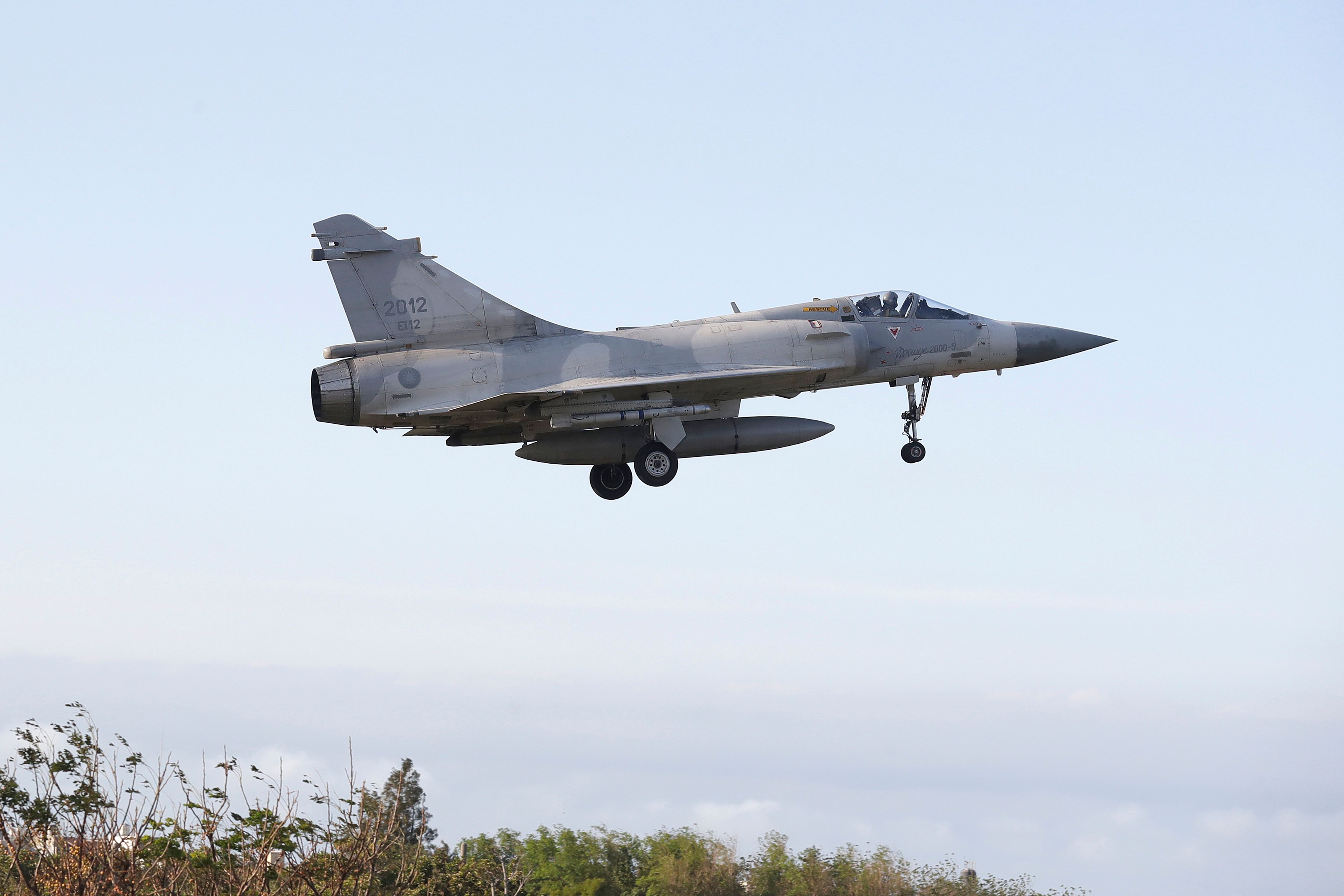
AP24345300173130.jpg

A Taiwan's fighter jet lands at an airbase in Hsinchu, northern Taiwan, Tuesday, Dec. 10, 2024, as Taiwan's Defense Ministry said it detected Chinese naval ships and military planes engaged in training. (AP Photo/Chiang Ying-ying)


Taiwan's Foreign Ministry said in a statement on its website that it was responding in part to the activities of a “large number” of Chinese ships in the first-island chain, the Pacific archipelago off the Asian continental mainland that includes Japan, Taiwan and part of the Philippines.

“The Ministry of Foreign Affairs solemnly demands that the Beijing authorities immediately stop military intimidation and all irrational activities that endanger regional peace and stability,” the statement said.

Taiwan’s military has detected Chinese ships since Monday, both off Taiwan and farther out along the first-island chain, Defense Ministry officials said this week. They described the formations as two walls designed to demonstrate that the waters belong to China. Taiwanese media, citing an unnamed national security official, have said that 90 ships — 60 from the navy and 30 from the coast guard — are involved overall.

An analyst said the participation of the coast guard, which also took part in drills in May and October, is new this year and part of a blockade scenario in which the coast guard would block Taiwan’s ports while the navy would form an outer barrier out at sea.

“They were practicing to seal off Taiwan,” Kuo Yujen, an Asia-Pacific security expert at the National Sun Yat-Sen University in Taiwan, said in an interview with The Associated Press.

Taiwan's military had been expecting drills following stops by its president, Lai Ching-te, in Hawaii and the U.S. territory of Guam during an overseas trip last week. China claims self-governing Taiwan as its territory and opposes any official contact with America and other foreign governments.

China restricted airspace off its southeast coast from Monday to Wednesday, an indication that it was planning to hold drills over those three days, but the country’s People’s Liberation Army has not confirmed whether it is doing so.

The low-key approach may be intended as a warning to both Lai and U.S. President-elect Donald Trump, Kuo said.

Lai, who took office in May, angered China by visiting Hawaii and Guam, but unlike other new leaders, he has so far refrained from going to the U.S. mainland, Kuo said. The analyst added that if China held a high-profile exercise around Taiwan, it wouldn't have a card to play if Lai visits the continental U.S. next year.

“China must reserve strategic maneuvering room for itself,” he said.

Kuo also believes the military activity is “a very important strategic communication” to Trump. “They intentionally let Trump know that this is the red line,” he said. "If the new U.S. administration allows President Lai to transit (the mainland U.S.), then China will react even more strongly. By then, it would be a large-scale military drill.”

The Chinese military held major exercises around Taiwan following both Lai’s inauguration in May and his national day speech in October. It also held a major drill after Nancy Pelosi, then the speaker of the U.S. House of Representatives, visited Taiwan in 2022.

A Chinese spokesperson didn't comment directly on any ongoing exercises but said in a statement posted online Wednesday that the government would not let provocations by Taiwan in collusion with external forces go unchecked.

"We will take necessary measures to resolutely defend national sovereignty and territorial integrity, maintain peace and stability in the Taiwan Strait and safeguard the fundamental interests of compatriots on both sides of the Taiwan Strait,” said Zhu Fenglian, a spokesperson for the government's Taiwan Affairs Office.

The Taiwan Strait is a 160-kilometer (100-mile) wide body of water between China and the island of Taiwan.

Related Tags

WORLDNEWS
ADVERTISEMENT
.most-popular .layout-ratio{ padding-bottom: 79.13%; } @media (min-width: 768px) and (max-width: 1024px) { .widget-title { font-size: 15px !important; } }

{{ articles_filter_1561_widget.title }}

.most-popular .layout-ratio{ padding-bottom: 79.13%; } @media (min-width: 768px) and (max-width: 1024px) { .widget-title { font-size: 15px !important; } }

{{ articles_filter_1562_widget.title }}

.most-popular .layout-ratio{ padding-bottom: 79.13%; } @media (min-width: 768px) and (max-width: 1024px) { .widget-title { font-size: 15px !important; } }

{{ articles_filter_1563_widget.title }}

{{ articles_filter_1564_widget.title }}

.mb-article-details { position: relative; } .mb-article-details .article-body-preview, .mb-article-details .article-body-summary{ font-size: 17px; line-height: 30px; font-family: "Libre Caslon Text", serif; color: #000; } .mb-article-details .article-body-preview iframe , .mb-article-details .article-body-summary iframe{ width: 100%; margin: auto; } .read-more-background { background: linear-gradient(180deg, color(display-p3 1.000 1.000 1.000 / 0) 13.75%, color(display-p3 1.000 1.000 1.000 / 0.8) 30.79%, color(display-p3 1.000 1.000 1.000) 72.5%); position: absolute; height: 200px; width: 100%; bottom: 0; display: flex; justify-content: center; align-items: center; padding: 0; } .read-more-background a{ color: #000; } .read-more-btn { padding: 17px 45px; font-family: Inter; font-weight: 700; font-size: 18px; line-height: 16px; text-align: center; vertical-align: middle; border: 1px solid black; background-color: white; } .hidden { display: none; }
function initializeAllSwipers() { // Get all hidden inputs with cms_article_id document.querySelectorAll('[id^="cms_article_id_"]').forEach(function (input) { const cmsArticleId = input.value; const articleSelector = '#article-' + cmsArticleId + ' .body_images'; const swiperElement = document.querySelector(articleSelector); if (swiperElement && !swiperElement.classList.contains('swiper-initialized')) { new Swiper(articleSelector, { loop: true, pagination: false, navigation: { nextEl: '#article-' + cmsArticleId + ' .swiper-button-next', prevEl: '#article-' + cmsArticleId + ' .swiper-button-prev', }, }); } }); } setTimeout(initializeAllSwipers, 3000); const intersectionObserver = new IntersectionObserver( (entries) => { entries.forEach((entry) => { if (entry.isIntersecting) { const newUrl = entry.target.getAttribute("data-url"); if (newUrl) { history.pushState(null, null, newUrl); let article = entry.target; // Extract metadata const author = article.querySelector('.author-section').textContent.replace('By', '').trim(); const section = article.querySelector('.section-info ').textContent.replace(' ', ' '); const title = article.querySelector('.article-title h1').textContent; // Parse URL for Chartbeat path format const parsedUrl = new URL(newUrl, window.location.origin); const cleanUrl = parsedUrl.host + parsedUrl.pathname; // Update Chartbeat configuration if (typeof window._sf_async_config !== 'undefined') { window._sf_async_config.path = cleanUrl; window._sf_async_config.sections = section; window._sf_async_config.authors = author; } // Track virtual page view with Chartbeat if (typeof pSUPERFLY !== 'undefined' && typeof pSUPERFLY.virtualPage === 'function') { try { pSUPERFLY.virtualPage({ path: cleanUrl, title: title, sections: section, authors: author }); } catch (error) { console.error('ping error', error); } } // Optional: Update document title if (title && title !== document.title) { document.title = title; } } } }); }, { threshold: 0.1 } ); function showArticleBody(button) { const article = button.closest("article"); const summary = article.querySelector(".article-body-summary"); const body = article.querySelector(".article-body-preview"); const readMoreSection = article.querySelector(".read-more-background"); // Hide summary and read-more section summary.style.display = "none"; readMoreSection.style.display = "none"; // Show the full article body body.classList.remove("hidden"); } document.addEventListener("DOMContentLoaded", () => { let loadCount = 0; // Track how many times articles are loaded const offset = [1, 2, 3, 4, 5, 6, 7, 8, 9, 10]; // Offset values const currentUrl = window.location.pathname.substring(1); let isLoading = false; // Prevent multiple calls if (!currentUrl) { console.log("Current URL is invalid."); return; } const sentinel = document.getElementById("load-more-sentinel"); if (!sentinel) { console.log("Sentinel element not found."); return; } function isSentinelVisible() { const rect = sentinel.getBoundingClientRect(); return ( rect.top < window.innerHeight && rect.bottom >= 0 ); } function onScroll() { if (isLoading) return; if (isSentinelVisible()) { if (loadCount >= offset.length) { console.log("Maximum load attempts reached."); window.removeEventListener("scroll", onScroll); return; } isLoading = true; const currentOffset = offset[loadCount]; window.loadMoreItems().then(() => { let article = document.querySelector('#widget_1690 > div:nth-last-of-type(2) article'); intersectionObserver.observe(article) loadCount++; }).catch(error => { console.error("Error loading more items:", error); }).finally(() => { isLoading = false; }); } } window.addEventListener("scroll", onScroll); });

Sign up by email to receive news.