ADVERTISEMENT

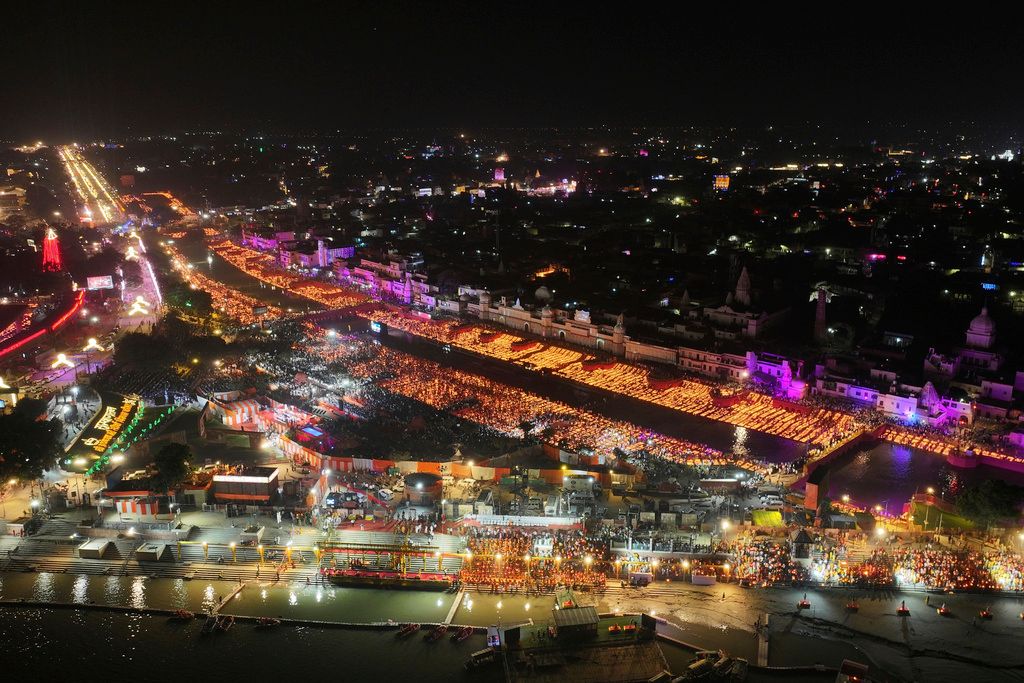
Indians celebrate Diwali by lighting a record number of clay lamps

Published Oct 31, 2024 12:49 pm
AP24304572410554.jpg
A record 2.51 million earthen oil lamps are lit along the Saryu river during Deepotsav celebrations on the eve of Diwali, creating a new Guinness World Record, in Ayodhya, India, Wednesday, Oct. 30, 2024. (AP Photo/Rajesh Kumar Singh)

LUCKNOW, India (AP) — Millions of Indians began celebrating the annual Hindu festival of lights, Diwali, by symbolically lighting a record 2.51 million clay oil lamps at dusk on Wednesday on the banks of the river Saryu in a northern Indian city they believe to be the birthplace of the deity Lord Ram.

Diwali is the most important festival of the year in India, particularly for the Hindu majority. It is celebrated by socializing and exchanging gifts with loved ones. Many light candles and oil lamps made from clay. Fireworks are set off. In the evening, a special prayer is dedicated to the Hindu goddess Lakshmi, who is believed to bring luck and prosperity.

A Guinness World Records team presented a certificate to Uttar Pradesh state Chief Minister Yogi Adityanath acknowledging the unprecedented number of oil lamps, exceeding last year's 2.2 million. Drone cameras closely monitored the event.

The celebrations took place within the northern city of Ayodhya, where Prime Minister Narendra Modi nine months ago opened a controversial Hindu temple built on the ruins of a historic mosque following a Supreme Court decision, seen as a political win for the populist leader. The establishment of the temple dedicated to Lord Ram fulfilled a long-standing demand by millions of Hindus.

On Wednesday, thousands of volunteers lit lamps, called “diyas,” along riverbanks, lanes, fronts and roofs of homes.

“More than 30,000 volunteers, primarily college students, worked meticulously to maintain the systematic pattern of burning lamps for the prescribed time,” said Dr. Pratibha Goyal, vice chancellor of Dr. Ram Manohar Lohia Avadh University, who coordinated the massive effort.

The lamps lit along 55 riverfront steps of the river Saryu created a captivating display along 1.5 kilometers (one mile). As the lamps remained lit for over five minutes, government spokesperson Shishir Singh said Ayodhya achieved its seventh consecutive world record for the largest display.

Singh said that around 91,000 liters (about 24,000 gallons) of mustard oil was used to light the lamps.

The event transformed Ayodhya into a city of lights amid devotional bhajan singing. A laser show depicting scenes from the epic Ramayana added to the experience, and an eco-friendly fireworks show lit the skyline. Traditional decorations, including elaborate arches and grand gateways along the main highways, captured the festive atmosphere as folk cultural performances drew pilgrims to the streets.

The festival also featured a praying ceremony performed by 1,100 priests along riverbanks.

Security was tightened across the city. Paramilitary commandos, bomb detectors, dog squads, face-recognition technology, and real-time monitoring drones were deployed, police officer Rajkaran Nayyar said.

Major Hindu festivals like Dussehra and Diwali are associated with mythological tales of Lord Ram extolling the virtues of truth, sacrifice, and ethical governance.

Diwali's main celebrations are held across the country on Thursday.

Related Tags

WORLDNEWS
ADVERTISEMENT
.most-popular .layout-ratio{ padding-bottom: 79.13%; } @media (min-width: 768px) and (max-width: 1024px) { .widget-title { font-size: 15px !important; } }

{{ articles_filter_1561_widget.title }}

.most-popular .layout-ratio{ padding-bottom: 79.13%; } @media (min-width: 768px) and (max-width: 1024px) { .widget-title { font-size: 15px !important; } }

{{ articles_filter_1562_widget.title }}

.most-popular .layout-ratio{ padding-bottom: 79.13%; } @media (min-width: 768px) and (max-width: 1024px) { .widget-title { font-size: 15px !important; } }

{{ articles_filter_1563_widget.title }}

{{ articles_filter_1564_widget.title }}

.mb-article-details { position: relative; } .mb-article-details .article-body-preview, .mb-article-details .article-body-summary{ font-size: 17px; line-height: 30px; font-family: "Libre Caslon Text", serif; color: #000; } .mb-article-details .article-body-preview iframe , .mb-article-details .article-body-summary iframe{ width: 100%; margin: auto; } .read-more-background { background: linear-gradient(180deg, color(display-p3 1.000 1.000 1.000 / 0) 13.75%, color(display-p3 1.000 1.000 1.000 / 0.8) 30.79%, color(display-p3 1.000 1.000 1.000) 72.5%); position: absolute; height: 200px; width: 100%; bottom: 0; display: flex; justify-content: center; align-items: center; padding: 0; } .read-more-background a{ color: #000; } .read-more-btn { padding: 17px 45px; font-family: Inter; font-weight: 700; font-size: 18px; line-height: 16px; text-align: center; vertical-align: middle; border: 1px solid black; background-color: white; } .hidden { display: none; }
function initializeAllSwipers() { // Get all hidden inputs with cms_article_id document.querySelectorAll('[id^="cms_article_id_"]').forEach(function (input) { const cmsArticleId = input.value; const articleSelector = '#article-' + cmsArticleId + ' .body_images'; const swiperElement = document.querySelector(articleSelector); if (swiperElement && !swiperElement.classList.contains('swiper-initialized')) { new Swiper(articleSelector, { loop: true, pagination: false, navigation: { nextEl: '#article-' + cmsArticleId + ' .swiper-button-next', prevEl: '#article-' + cmsArticleId + ' .swiper-button-prev', }, }); } }); } setTimeout(initializeAllSwipers, 3000); const intersectionObserver = new IntersectionObserver( (entries) => { entries.forEach((entry) => { if (entry.isIntersecting) { const newUrl = entry.target.getAttribute("data-url"); if (newUrl) { history.pushState(null, null, newUrl); let article = entry.target; // Extract metadata const author = article.querySelector('.author-section').textContent.replace('By', '').trim(); const section = article.querySelector('.section-info ').textContent.replace(' ', ' '); const title = article.querySelector('.article-title h1').textContent; // Parse URL for Chartbeat path format const parsedUrl = new URL(newUrl, window.location.origin); const cleanUrl = parsedUrl.host + parsedUrl.pathname; // Update Chartbeat configuration if (typeof window._sf_async_config !== 'undefined') { window._sf_async_config.path = cleanUrl; window._sf_async_config.sections = section; window._sf_async_config.authors = author; } // Track virtual page view with Chartbeat if (typeof pSUPERFLY !== 'undefined' && typeof pSUPERFLY.virtualPage === 'function') { try { pSUPERFLY.virtualPage({ path: cleanUrl, title: title, sections: section, authors: author }); } catch (error) { console.error('ping error', error); } } // Optional: Update document title if (title && title !== document.title) { document.title = title; } } } }); }, { threshold: 0.1 } ); function showArticleBody(button) { const article = button.closest("article"); const summary = article.querySelector(".article-body-summary"); const body = article.querySelector(".article-body-preview"); const readMoreSection = article.querySelector(".read-more-background"); // Hide summary and read-more section summary.style.display = "none"; readMoreSection.style.display = "none"; // Show the full article body body.classList.remove("hidden"); } document.addEventListener("DOMContentLoaded", () => { let loadCount = 0; // Track how many times articles are loaded const offset = [1, 2, 3, 4, 5, 6, 7, 8, 9, 10]; // Offset values const currentUrl = window.location.pathname.substring(1); let isLoading = false; // Prevent multiple calls if (!currentUrl) { console.log("Current URL is invalid."); return; } const sentinel = document.getElementById("load-more-sentinel"); if (!sentinel) { console.log("Sentinel element not found."); return; } function isSentinelVisible() { const rect = sentinel.getBoundingClientRect(); return ( rect.top < window.innerHeight && rect.bottom >= 0 ); } function onScroll() { if (isLoading) return; if (isSentinelVisible()) { if (loadCount >= offset.length) { console.log("Maximum load attempts reached."); window.removeEventListener("scroll", onScroll); return; } isLoading = true; const currentOffset = offset[loadCount]; window.loadMoreItems().then(() => { let article = document.querySelector('#widget_1690 > div:nth-last-of-type(2) article'); intersectionObserver.observe(article) loadCount++; }).catch(error => { console.error("Error loading more items:", error); }).finally(() => { isLoading = false; }); } } window.addEventListener("scroll", onScroll); });

Sign up by email to receive news.