

ADVERTISEMENT

Tour de France unveils 2025 route that includes climb up 'evil' Mont Ventoux

Published Oct 30, 2024 01:13 am

At A Glance

  • After a rare finish outside Paris this past July, cycling's biggest race is getting back to basics for the 2025 route that was unveiled Tuesday, Oct. 29. A mostly flat first week is followed by a lot of climbing in the last 10 stages that will pave the way for another duel between defending champion Tadej Pogacar and his best rival Jonas Vingegaard.
The Tour de France will have a more traditional look next year.

After a rare finish outside Paris this past July, cycling’s biggest race is getting back to basics for the 2025 route that was unveiled Tuesday, Oct. 29. A mostly flat first week is followed by a lot of climbing in the last 10 stages that will pave the way for another duel between defending champion Tadej Pogacar and his best rival Jonas Vingegaard.

AP24303416705763.jpg
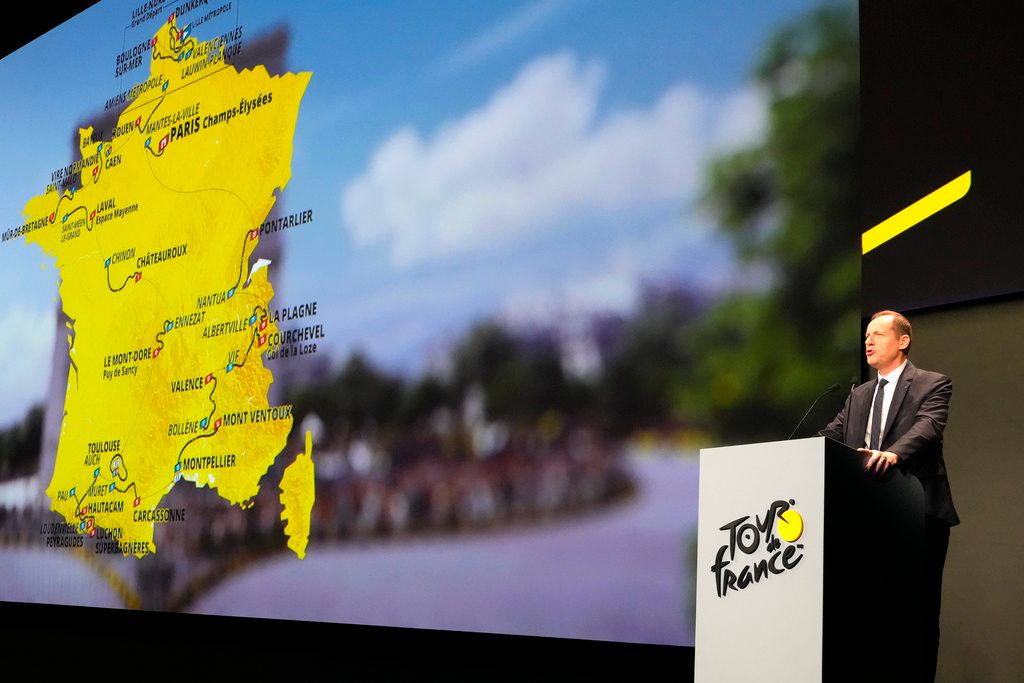
Tour de France director Christian Prudhomme unveils the 2025 Tour de France cycling race roadmap, Tuesday, Oct. 29, in Paris. (AP Photo/Michel Euler)

“Jonas Vingegaard couldn’t be here today, but I imagine he’ll be pleased with the route,” said Grischa Niermann, the head of racing for Vingegaard’s Team Visma-Lease a Bike. “But the same likely goes for riders like Tadej Pogacar, Primoz Roglic, and Remco Evenepoel.”

Following three consecutive starts from abroad, the 2025 Tour will be 100% French as riders won’t make any excursions beyond France’s borders.

The race starts from the city of Lille on July 5 and stays in cycling-mad northern France for three stages. The peloton will then head south, via Brittany and the Massif Central.

Riders will tackle a second individual time trial in the Pyrenees mountains, and the final week of the race will feature three mountain-top finishes at the Mont Ventoux, the Col de la Loze — the highest point of the race at 2,304 meters — and the ski resort of La Plagne in the Alps.

Last year’s final stage was held outside Paris for the first time since 1905 because of a clash with the Olympics, moving instead to Nice.

Because of security and logistical reasons, the French capital did not have its traditional Tour finish on the Champs-Elysees. The world famous avenue is back on the program and will host the final stage for the 50th time at the conclusion of the 3,320-kilometer (2,063-mile) odyssey.

Organizers said the “the milestone of turning 50 serves as a central theme,” as the 2025 edition also marks the 50th anniversary of the polka-dot jersey for best climber and the best young rider classification.

The women’s race will start on July 26 from the Brittany town of Vannes. Featuring nine stages for a total of 1,165 kilometers (724 miles), the fourth edition of the race will go through the Massif Central and finishes in the Alps as the peloton will climb blockbuster mountains such as the Col de Joux-Plane and the Col de la Madeleine.

Among the highlights of the men’s route are a trio of Pyrenean stages including the race against the clock to Peyragudes on Stage 13 and a return to Luchon-Superbagnères.

The climbing of the Mont Ventoux, the punishing ascent on which British rider Tom Simpson died in 1967, promises to test tired legs during Stage 16. Ventoux is a huge moonscape of rock in Provence with little shade or grass. French philosopher Roland Barthes called it “a god of evil.”

The Alps will then likely decide the winner.

Related Tags

Tour de France
ADVERTISEMENT
.most-popular .layout-ratio{ padding-bottom: 79.13%; } @media (min-width: 768px) and (max-width: 1024px) { .widget-title { font-size: 15px !important; } }

{{ articles_filter_1561_widget.title }}

.most-popular .layout-ratio{ padding-bottom: 79.13%; } @media (min-width: 768px) and (max-width: 1024px) { .widget-title { font-size: 15px !important; } }

{{ articles_filter_1562_widget.title }}

.most-popular .layout-ratio{ padding-bottom: 79.13%; } @media (min-width: 768px) and (max-width: 1024px) { .widget-title { font-size: 15px !important; } }

{{ articles_filter_1563_widget.title }}

{{ articles_filter_1564_widget.title }}

.mb-article-details { position: relative; } .mb-article-details .article-body-preview, .mb-article-details .article-body-summary{ font-size: 17px; line-height: 30px; font-family: "Libre Caslon Text", serif; color: #000; } .mb-article-details .article-body-preview iframe , .mb-article-details .article-body-summary iframe{ width: 100%; margin: auto; } .read-more-background { background: linear-gradient(180deg, color(display-p3 1.000 1.000 1.000 / 0) 13.75%, color(display-p3 1.000 1.000 1.000 / 0.8) 30.79%, color(display-p3 1.000 1.000 1.000) 72.5%); position: absolute; height: 200px; width: 100%; bottom: 0; display: flex; justify-content: center; align-items: center; padding: 0; } .read-more-background a{ color: #000; } .read-more-btn { padding: 17px 45px; font-family: Inter; font-weight: 700; font-size: 18px; line-height: 16px; text-align: center; vertical-align: middle; border: 1px solid black; background-color: white; } .hidden { display: none; }
function initializeAllSwipers() { // Get all hidden inputs with cms_article_id document.querySelectorAll('[id^="cms_article_id_"]').forEach(function (input) { const cmsArticleId = input.value; const articleSelector = '#article-' + cmsArticleId + ' .body_images'; const swiperElement = document.querySelector(articleSelector); if (swiperElement && !swiperElement.classList.contains('swiper-initialized')) { new Swiper(articleSelector, { loop: true, pagination: false, navigation: { nextEl: '#article-' + cmsArticleId + ' .swiper-button-next', prevEl: '#article-' + cmsArticleId + ' .swiper-button-prev', }, }); } }); } setTimeout(initializeAllSwipers, 3000); const intersectionObserver = new IntersectionObserver( (entries) => { entries.forEach((entry) => { if (entry.isIntersecting) { const newUrl = entry.target.getAttribute("data-url"); if (newUrl) { history.pushState(null, null, newUrl); let article = entry.target; // Extract metadata const author = article.querySelector('.author-section').textContent.replace('By', '').trim(); const section = article.querySelector('.section-info ').textContent.replace(' ', ' '); const title = article.querySelector('.article-title h1').textContent; // Parse URL for Chartbeat path format const parsedUrl = new URL(newUrl, window.location.origin); const cleanUrl = parsedUrl.host + parsedUrl.pathname; // Update Chartbeat configuration if (typeof window._sf_async_config !== 'undefined') { window._sf_async_config.path = cleanUrl; window._sf_async_config.sections = section; window._sf_async_config.authors = author; } // Track virtual page view with Chartbeat if (typeof pSUPERFLY !== 'undefined' && typeof pSUPERFLY.virtualPage === 'function') { try { pSUPERFLY.virtualPage({ path: cleanUrl, title: title, sections: section, authors: author }); } catch (error) { console.error('ping error', error); } } // Optional: Update document title if (title && title !== document.title) { document.title = title; } } } }); }, { threshold: 0.1 } ); function showArticleBody(button) { const article = button.closest("article"); const summary = article.querySelector(".article-body-summary"); const body = article.querySelector(".article-body-preview"); const readMoreSection = article.querySelector(".read-more-background"); // Hide summary and read-more section summary.style.display = "none"; readMoreSection.style.display = "none"; // Show the full article body body.classList.remove("hidden"); } document.addEventListener("DOMContentLoaded", () => { let loadCount = 0; // Track how many times articles are loaded const offset = [1, 2, 3, 4, 5, 6, 7, 8, 9, 10]; // Offset values const currentUrl = window.location.pathname.substring(1); let isLoading = false; // Prevent multiple calls if (!currentUrl) { console.log("Current URL is invalid."); return; } const sentinel = document.getElementById("load-more-sentinel"); if (!sentinel) { console.log("Sentinel element not found."); return; } function isSentinelVisible() { const rect = sentinel.getBoundingClientRect(); return ( rect.top < window.innerHeight && rect.bottom >= 0 ); } function onScroll() { if (isLoading) return; if (isSentinelVisible()) { if (loadCount >= offset.length) { console.log("Maximum load attempts reached."); window.removeEventListener("scroll", onScroll); return; } isLoading = true; const currentOffset = offset[loadCount]; window.loadMoreItems().then(() => { let article = document.querySelector('#widget_1690 > div:nth-last-of-type(2) article'); intersectionObserver.observe(article) loadCount++; }).catch(error => { console.error("Error loading more items:", error); }).finally(() => { isLoading = false; }); } } window.addEventListener("scroll", onScroll); });

Sign up by email to receive news.