ADVERTISEMENT

Signal No. 1 may be raised due to tropical storm 'Leon'

Published Oct 27, 2024 12:04 am
IMG_4454.png
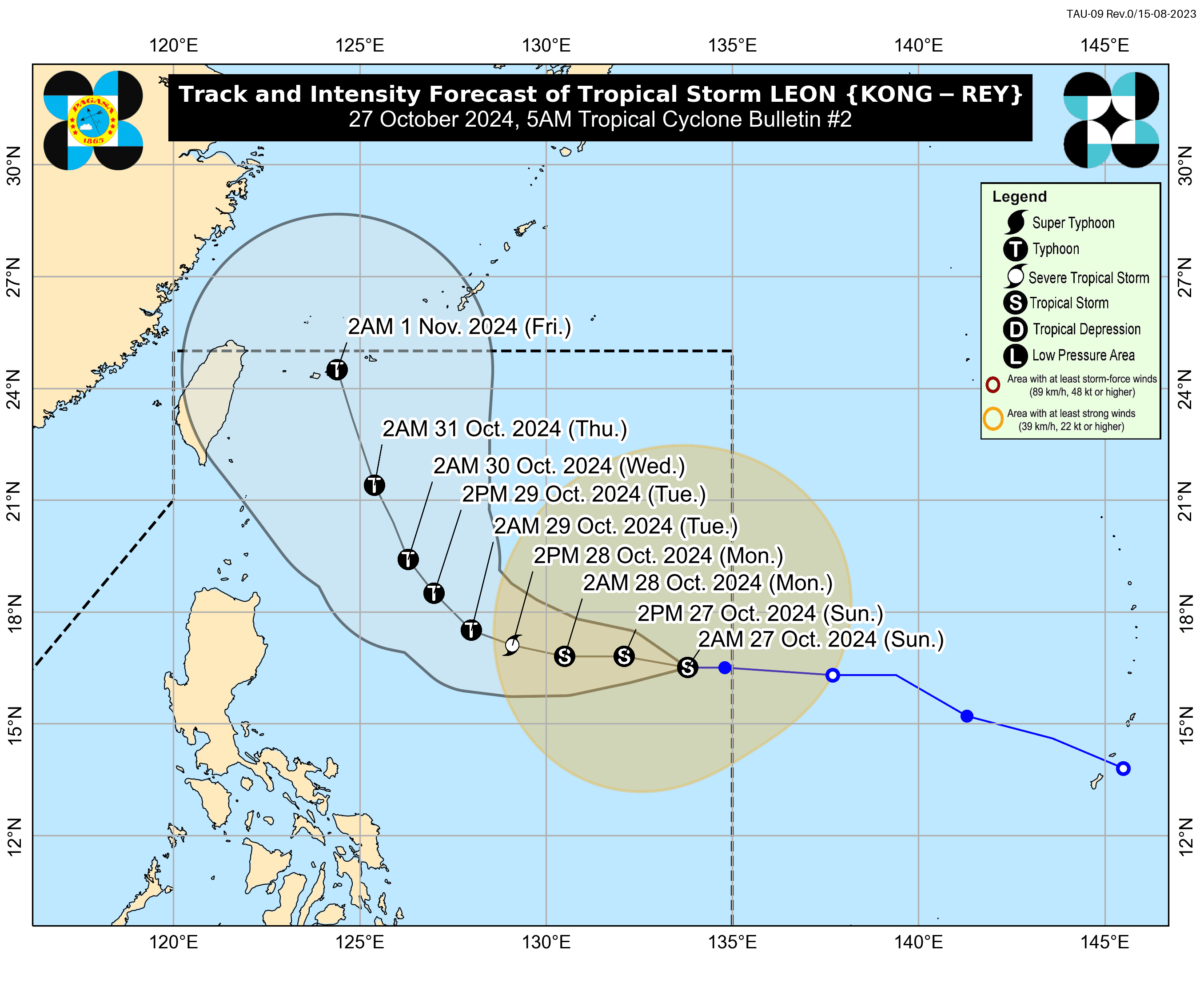
Forecast track and intensity of Tropical Storm “Leon” (international name: Kong-rey) as of 5 a.m., Oct. 27, 2024 (Courtesy of PAGASA)

The Philippine Atmospheric, Geophysical and Astronomical Services Administration (PAGASA) is likely to issue Wind Signal No. 1 over parts of Cagayan Valley and Bicol Region by Sunday evening, Oct. 27, following the entry of Tropical Storm “Leon” (international name: Kong-rey) into the Philippine Area of Responsibility (PAR) on Saturday evening, Oct. 26.

In its 5 a.m. bulletin on Sunday, PAGASA said the highest wind signal that may be raised as Leon approaches is Signal No. 2, depending on how much the storm’s forecast track shifts westward.

While it is unlikely to directly impact the country’s weather in the next few days, Leon’s outer rainbands may affect extreme Northern Luzon, depending on its proximity during its "recurvature" over the Philippine Sea.

The storm may also enhance the southwesterly wind flow, initially triggered by Severe Tropical Storm “Trami” (formerly Kristine), which could affect the western sections of Southern Luzon, Visayas, and Mindanao.

Cloudy skies with scattered rains and thunderstorms are expected in Western Visayas, Negros Island Region, Zamboanga Peninsula, Bangsamoro Autonomous Region in Muslim Mindanao, Occidental Mindoro, and Palawan due to the southwesterly wind flow.

Meanwhile, Metro Manila and the rest of the country will experience partly cloudy to cloudy conditions with isolated rain showers from localized thunderstorms.

PAGASA warned of possible flash floods and landslides throughout the archipelago.

Forecast track, intensity

As of 5 a.m., PAGASA said the center of Leon was located 1,195 kilometers east of Central Luzon, with maximum sustained winds of 65 kilometers per hour (kph) near the center and gustiness reaching 80 kph. It was moving westward at 20 kph.

Leon is expected to continue moving westward until early Monday morning to early Tuesday morning, Oct. 28 to 29.

After that, it may turn northwestward to north northwestward and make landfall over the Ryukyu Islands in Okinawa, Japan, early Friday morning, Nov. 1.

Although Leon is seen to remain far from the Philippine landmass, PAGASA has not ruled out a potential shift in the storm’s track further westward, particularly in the fourth and fifth days of the forecast.

The storm is expected to intensify over the next 24 hours gradually and may reach severe tropical storm strength by early Monday morning. 

PAGASA said Leon could experience rapid intensification from Monday to Wednesday, potentially reaching typhoon strength by Monday evening or early Tuesday morning.

Related Tags

Signal No. 1 PAGASA Kong-rey Tropical Storm Leon
ADVERTISEMENT
.most-popular .layout-ratio{ padding-bottom: 79.13%; } @media (min-width: 768px) and (max-width: 1024px) { .widget-title { font-size: 15px !important; } }

{{ articles_filter_1561_widget.title }}

.most-popular .layout-ratio{ padding-bottom: 79.13%; } @media (min-width: 768px) and (max-width: 1024px) { .widget-title { font-size: 15px !important; } }

{{ articles_filter_1562_widget.title }}

.most-popular .layout-ratio{ padding-bottom: 79.13%; } @media (min-width: 768px) and (max-width: 1024px) { .widget-title { font-size: 15px !important; } }

{{ articles_filter_1563_widget.title }}

{{ articles_filter_1564_widget.title }}

.mb-article-details { position: relative; } .mb-article-details .article-body-preview, .mb-article-details .article-body-summary{ font-size: 17px; line-height: 30px; font-family: "Libre Caslon Text", serif; color: #000; } .mb-article-details .article-body-preview iframe , .mb-article-details .article-body-summary iframe{ width: 100%; margin: auto; } .read-more-background { background: linear-gradient(180deg, color(display-p3 1.000 1.000 1.000 / 0) 13.75%, color(display-p3 1.000 1.000 1.000 / 0.8) 30.79%, color(display-p3 1.000 1.000 1.000) 72.5%); position: absolute; height: 200px; width: 100%; bottom: 0; display: flex; justify-content: center; align-items: center; padding: 0; } .read-more-background a{ color: #000; } .read-more-btn { padding: 17px 45px; font-family: Inter; font-weight: 700; font-size: 18px; line-height: 16px; text-align: center; vertical-align: middle; border: 1px solid black; background-color: white; } .hidden { display: none; }
function initializeAllSwipers() { // Get all hidden inputs with cms_article_id document.querySelectorAll('[id^="cms_article_id_"]').forEach(function (input) { const cmsArticleId = input.value; const articleSelector = '#article-' + cmsArticleId + ' .body_images'; const swiperElement = document.querySelector(articleSelector); if (swiperElement && !swiperElement.classList.contains('swiper-initialized')) { new Swiper(articleSelector, { loop: true, pagination: false, navigation: { nextEl: '#article-' + cmsArticleId + ' .swiper-button-next', prevEl: '#article-' + cmsArticleId + ' .swiper-button-prev', }, }); } }); } setTimeout(initializeAllSwipers, 3000); const intersectionObserver = new IntersectionObserver( (entries) => { entries.forEach((entry) => { if (entry.isIntersecting) { const newUrl = entry.target.getAttribute("data-url"); if (newUrl) { history.pushState(null, null, newUrl); let article = entry.target; // Extract metadata const author = article.querySelector('.author-section').textContent.replace('By', '').trim(); const section = article.querySelector('.section-info ').textContent.replace(' ', ' '); const title = article.querySelector('.article-title h1').textContent; // Parse URL for Chartbeat path format const parsedUrl = new URL(newUrl, window.location.origin); const cleanUrl = parsedUrl.host + parsedUrl.pathname; // Update Chartbeat configuration if (typeof window._sf_async_config !== 'undefined') { window._sf_async_config.path = cleanUrl; window._sf_async_config.sections = section; window._sf_async_config.authors = author; } // Track virtual page view with Chartbeat if (typeof pSUPERFLY !== 'undefined' && typeof pSUPERFLY.virtualPage === 'function') { try { pSUPERFLY.virtualPage({ path: cleanUrl, title: title, sections: section, authors: author }); } catch (error) { console.error('ping error', error); } } // Optional: Update document title if (title && title !== document.title) { document.title = title; } } } }); }, { threshold: 0.1 } ); function showArticleBody(button) { const article = button.closest("article"); const summary = article.querySelector(".article-body-summary"); const body = article.querySelector(".article-body-preview"); const readMoreSection = article.querySelector(".read-more-background"); // Hide summary and read-more section summary.style.display = "none"; readMoreSection.style.display = "none"; // Show the full article body body.classList.remove("hidden"); } document.addEventListener("DOMContentLoaded", () => { let loadCount = 0; // Track how many times articles are loaded const offset = [1, 2, 3, 4, 5, 6, 7, 8, 9, 10]; // Offset values const currentUrl = window.location.pathname.substring(1); let isLoading = false; // Prevent multiple calls if (!currentUrl) { console.log("Current URL is invalid."); return; } const sentinel = document.getElementById("load-more-sentinel"); if (!sentinel) { console.log("Sentinel element not found."); return; } function isSentinelVisible() { const rect = sentinel.getBoundingClientRect(); return ( rect.top < window.innerHeight && rect.bottom >= 0 ); } function onScroll() { if (isLoading) return; if (isSentinelVisible()) { if (loadCount >= offset.length) { console.log("Maximum load attempts reached."); window.removeEventListener("scroll", onScroll); return; } isLoading = true; const currentOffset = offset[loadCount]; window.loadMoreItems().then(() => { let article = document.querySelector('#widget_1690 > div:nth-last-of-type(2) article'); intersectionObserver.observe(article) loadCount++; }).catch(error => { console.error("Error loading more items:", error); }).finally(() => { isLoading = false; }); } } window.addEventListener("scroll", onScroll); });

Sign up by email to receive news.