ADVERTISEMENT

Nobel economics prize goes to 3 economists who found that freer societies are more likely to prosper

Published Oct 15, 2024 07:18 am

NOBEL PHOTO.jpg

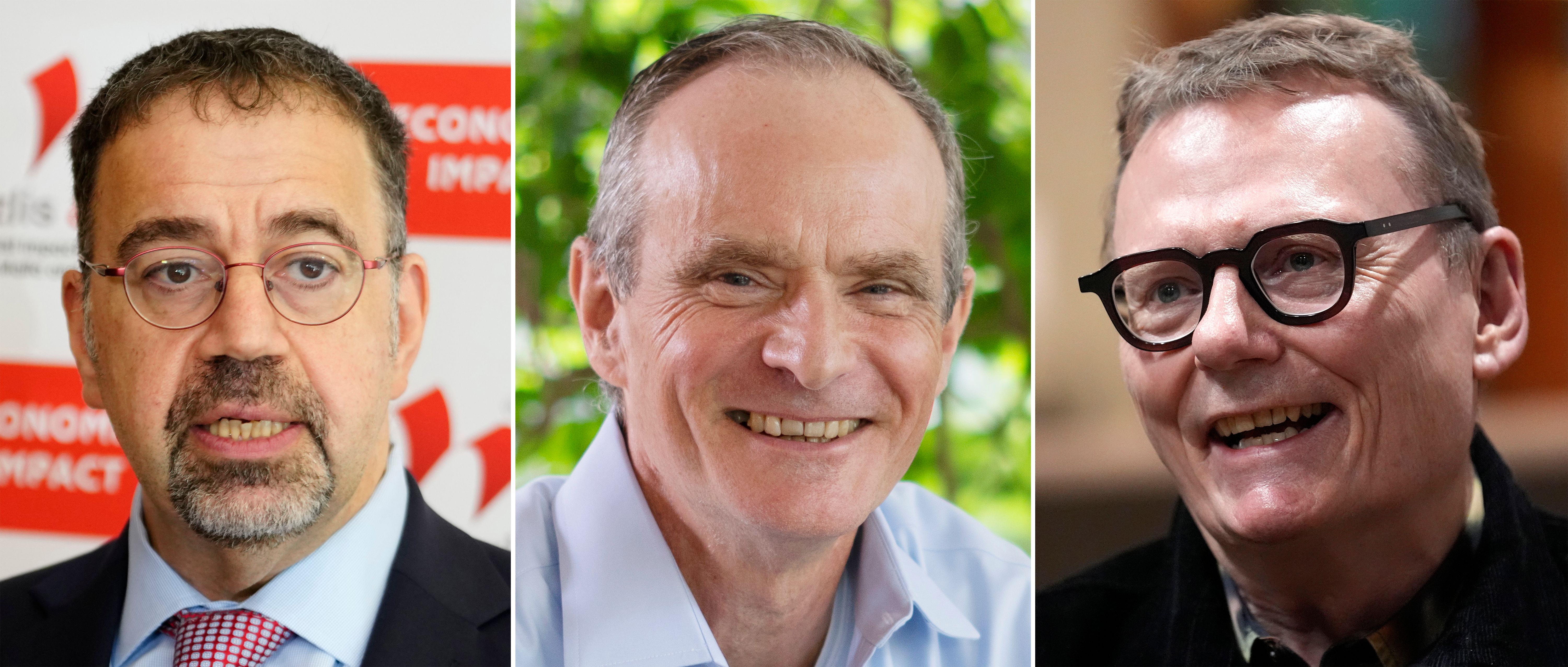
In this combination image left to right; Economist Daron Acemoglu in Athens Greece, Oct. 14, 2024, Economist Simon Johnson in Washington, Oct. 14, 2024, and Economist James A. Robinson in Chicago, Oct. 14, 2024. (AP Photo)


STOCKHOLM (AP) — The Nobel memorial prize in economics was awarded Monday to three economists who have studied why some countries are rich and others poor and have documented that freer, open societies are more likely to prosper.

The work by Daron Acemoglu, Simon Johnson and James A. Robinson “demonstrated the importance of societal institutions for a country’s prosperity,” the Nobel committee of the Royal Swedish Academy of Sciences said at the announcement in Stockholm.

Acemoglu and Johnson work at the Massachusetts Institute of Technology, while Robinson does his research at the University of Chicago.

Jakob Svensson, chair of the Committee for the Prize in Economic Sciences, said their analysis has provided "a much deeper understanding of the root causes of why countries fail or succeed.”

Reached by the academy in Athens, Greece, where he was to speak at a conference, the Turkish-born Acemoglu, 57, said he was astonished by the award.

“You never expect something like this," he said.

Acemoglu said the research honored by the prize underscores the value of democratic institutions.

“I think broadly speaking the work that we have done favors democracy,” he said in a telephone call with the Nobel committee and reporters in Stockholm.

But he added: “Democracy is not a panacea. Introducing democracy is very hard. When you introduce elections, that sometimes creates conflict.”

In an interview with The Associated Press, Robinson, 64, said he doubts that China can sustain its economic prosperity as long as it keeps a repressive political system.

“There’s many examples in world history of societies like that that do well for 40, 50 years," Robinson said by phone. “What you see is that’s never sustainable. ... The Soviet Union did well for 50 or 60 years.''

Robinson said many societies have successfully made the transition to what he, Acemoglu and Johnson call an “inclusive society.’’

“Look at the United States," Robinson said. “This was a country of slavery, of privilege, where women were not allowed to take part in the economy or vote.”

“Every country that is currently relatively inclusive and open made that transition," he added. "In the modern world, you’ve seen that in South Korea, in Taiwan, in Mauritius.’’


Related Tags

WORLDNEWS
ADVERTISEMENT
.most-popular .layout-ratio{ padding-bottom: 79.13%; } @media (min-width: 768px) and (max-width: 1024px) { .widget-title { font-size: 15px !important; } }

{{ articles_filter_1561_widget.title }}

.most-popular .layout-ratio{ padding-bottom: 79.13%; } @media (min-width: 768px) and (max-width: 1024px) { .widget-title { font-size: 15px !important; } }

{{ articles_filter_1562_widget.title }}

.most-popular .layout-ratio{ padding-bottom: 79.13%; } @media (min-width: 768px) and (max-width: 1024px) { .widget-title { font-size: 15px !important; } }

{{ articles_filter_1563_widget.title }}

{{ articles_filter_1564_widget.title }}

.mb-article-details { position: relative; } .mb-article-details .article-body-preview, .mb-article-details .article-body-summary{ font-size: 17px; line-height: 30px; font-family: "Libre Caslon Text", serif; color: #000; } .mb-article-details .article-body-preview iframe , .mb-article-details .article-body-summary iframe{ width: 100%; margin: auto; } .read-more-background { background: linear-gradient(180deg, color(display-p3 1.000 1.000 1.000 / 0) 13.75%, color(display-p3 1.000 1.000 1.000 / 0.8) 30.79%, color(display-p3 1.000 1.000 1.000) 72.5%); position: absolute; height: 200px; width: 100%; bottom: 0; display: flex; justify-content: center; align-items: center; padding: 0; } .read-more-background a{ color: #000; } .read-more-btn { padding: 17px 45px; font-family: Inter; font-weight: 700; font-size: 18px; line-height: 16px; text-align: center; vertical-align: middle; border: 1px solid black; background-color: white; } .hidden { display: none; }
function initializeAllSwipers() { // Get all hidden inputs with cms_article_id document.querySelectorAll('[id^="cms_article_id_"]').forEach(function (input) { const cmsArticleId = input.value; const articleSelector = '#article-' + cmsArticleId + ' .body_images'; const swiperElement = document.querySelector(articleSelector); if (swiperElement && !swiperElement.classList.contains('swiper-initialized')) { new Swiper(articleSelector, { loop: true, pagination: false, navigation: { nextEl: '#article-' + cmsArticleId + ' .swiper-button-next', prevEl: '#article-' + cmsArticleId + ' .swiper-button-prev', }, }); } }); } setTimeout(initializeAllSwipers, 3000); const intersectionObserver = new IntersectionObserver( (entries) => { entries.forEach((entry) => { if (entry.isIntersecting) { const newUrl = entry.target.getAttribute("data-url"); if (newUrl) { history.pushState(null, null, newUrl); let article = entry.target; // Extract metadata const author = article.querySelector('.author-section').textContent.replace('By', '').trim(); const section = article.querySelector('.section-info ').textContent.replace(' ', ' '); const title = article.querySelector('.article-title h1').textContent; // Parse URL for Chartbeat path format const parsedUrl = new URL(newUrl, window.location.origin); const cleanUrl = parsedUrl.host + parsedUrl.pathname; // Update Chartbeat configuration if (typeof window._sf_async_config !== 'undefined') { window._sf_async_config.path = cleanUrl; window._sf_async_config.sections = section; window._sf_async_config.authors = author; } // Track virtual page view with Chartbeat if (typeof pSUPERFLY !== 'undefined' && typeof pSUPERFLY.virtualPage === 'function') { try { pSUPERFLY.virtualPage({ path: cleanUrl, title: title, sections: section, authors: author }); } catch (error) { console.error('ping error', error); } } // Optional: Update document title if (title && title !== document.title) { document.title = title; } } } }); }, { threshold: 0.1 } ); function showArticleBody(button) { const article = button.closest("article"); const summary = article.querySelector(".article-body-summary"); const body = article.querySelector(".article-body-preview"); const readMoreSection = article.querySelector(".read-more-background"); // Hide summary and read-more section summary.style.display = "none"; readMoreSection.style.display = "none"; // Show the full article body body.classList.remove("hidden"); } document.addEventListener("DOMContentLoaded", () => { let loadCount = 0; // Track how many times articles are loaded const offset = [1, 2, 3, 4, 5, 6, 7, 8, 9, 10]; // Offset values const currentUrl = window.location.pathname.substring(1); let isLoading = false; // Prevent multiple calls if (!currentUrl) { console.log("Current URL is invalid."); return; } const sentinel = document.getElementById("load-more-sentinel"); if (!sentinel) { console.log("Sentinel element not found."); return; } function isSentinelVisible() { const rect = sentinel.getBoundingClientRect(); return ( rect.top < window.innerHeight && rect.bottom >= 0 ); } function onScroll() { if (isLoading) return; if (isSentinelVisible()) { if (loadCount >= offset.length) { console.log("Maximum load attempts reached."); window.removeEventListener("scroll", onScroll); return; } isLoading = true; const currentOffset = offset[loadCount]; window.loadMoreItems().then(() => { let article = document.querySelector('#widget_1690 > div:nth-last-of-type(2) article'); intersectionObserver.observe(article) loadCount++; }).catch(error => { console.error("Error loading more items:", error); }).finally(() => { isLoading = false; }); } } window.addEventListener("scroll", onScroll); });

Sign up by email to receive news.