ADVERTISEMENT

Half of Filipinos think PH economy will remain the same in next 6 months — OCTA

But survey shows optimism growing

Published Jan 29, 2024 05:04 am
IMG_3554.jpeg
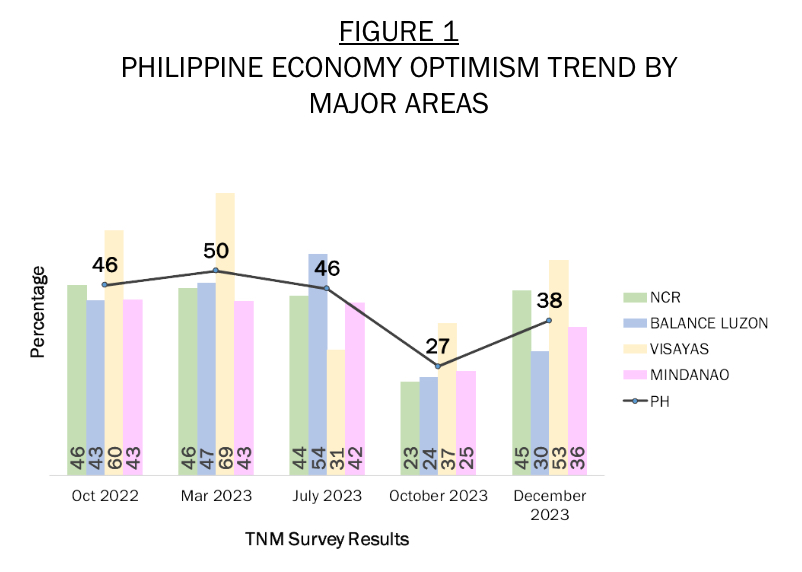
OCTA Research’s December 2023 “Tugon ng Masa” Survey (OCTA)

OCTA Research's December 2023 "Tugon ng Masa" survey found that half of Filipinos expect the Philippine economy to remain unchanged over the next six months.

The survey results released on Monday, Jan. 29 revealed that 51 percent think that the economy will remain the same, 38 percent believe it will improve, and 8 percent think it will worsen.

Although slightly more than half of Filipinos believe the economy will remain stable, OCTA noted that the percentage of those who believe it will improve has increased for the first time in three quarters.

“Optimism regarding the country’s economy among adult Filipinos increased from 27 percent in October 2023 to 38 percent in December 2023. While pessimism regarding the economy decreased, from 14 percent in October to 8 percent in December 2023,” OCTA said in its report.

Across major areas, the percentage of adult Filipinos who expect the Philippine economy to improve in the next six months ranges from 30 to 53 percent.

The highest percentage is in Visayas (53 percent), while the lowest is in Balanced Luzon (30 percent).

In contrast, the percentage of adult Filipinos who expect the Philippine economy to worsen in the next six months ranges from 6 percent to 13 percent, with Metro Manila having the highest percentage (13 percent).

Nearly half of Filipinos optimistic on quality of life

In the same survey period, OCTA found that 49 percent of adult Filipinos expect their quality of life to improve in the next six months.

Meanwhile, about 45 percent believe that their quality of life will remain unchanged, with only 4 percent believing that it will worsen.

Across major areas, the percentage of adult Filipinos who believe their quality of life will improve over the next six months ranges from 40 percent to 58 percent, with Visayas having the highest percentage (58 percent) and Mindanao having the lowest (40 percent).

Meanwhile, the percentage of adult Filipinos who believe their quality of life will worsen in the next six months varied by region, with Mindanao having the highest percentage at 10 percent and Balance Luzon having the lowest at 1 percent.

The Fourth Quarter 2023 Tugon ng Masa survey was fielded from Dec. 10 to 14 through face-to-face interviews of 1,200 adult respondents nationwide.

It has a ±3 percent margin of error at a 95 percent confidence level, with subnational estimates for Metro Manila, Balance Luzon, Visayas, and Mindanao at a ±6 percent margin of error.

Related Tags

quality of life tugon ng masa survey OCTA Philippine economy
ADVERTISEMENT
.most-popular .layout-ratio{ padding-bottom: 79.13%; } @media (min-width: 768px) and (max-width: 1024px) { .widget-title { font-size: 15px !important; } }

{{ articles_filter_1561_widget.title }}

.most-popular .layout-ratio{ padding-bottom: 79.13%; } @media (min-width: 768px) and (max-width: 1024px) { .widget-title { font-size: 15px !important; } }

{{ articles_filter_1562_widget.title }}

.most-popular .layout-ratio{ padding-bottom: 79.13%; } @media (min-width: 768px) and (max-width: 1024px) { .widget-title { font-size: 15px !important; } }

{{ articles_filter_1563_widget.title }}

{{ articles_filter_1564_widget.title }}

.mb-article-details { position: relative; } .mb-article-details .article-body-preview, .mb-article-details .article-body-summary{ font-size: 17px; line-height: 30px; font-family: "Libre Caslon Text", serif; color: #000; } .mb-article-details .article-body-preview iframe , .mb-article-details .article-body-summary iframe{ width: 100%; margin: auto; } .read-more-background { background: linear-gradient(180deg, color(display-p3 1.000 1.000 1.000 / 0) 13.75%, color(display-p3 1.000 1.000 1.000 / 0.8) 30.79%, color(display-p3 1.000 1.000 1.000) 72.5%); position: absolute; height: 200px; width: 100%; bottom: 0; display: flex; justify-content: center; align-items: center; padding: 0; } .read-more-background a{ color: #000; } .read-more-btn { padding: 17px 45px; font-family: Inter; font-weight: 700; font-size: 18px; line-height: 16px; text-align: center; vertical-align: middle; border: 1px solid black; background-color: white; } .hidden { display: none; }
function initializeAllSwipers() { // Get all hidden inputs with cms_article_id document.querySelectorAll('[id^="cms_article_id_"]').forEach(function (input) { const cmsArticleId = input.value; const articleSelector = '#article-' + cmsArticleId + ' .body_images'; const swiperElement = document.querySelector(articleSelector); if (swiperElement && !swiperElement.classList.contains('swiper-initialized')) { new Swiper(articleSelector, { loop: true, pagination: false, navigation: { nextEl: '#article-' + cmsArticleId + ' .swiper-button-next', prevEl: '#article-' + cmsArticleId + ' .swiper-button-prev', }, }); } }); } setTimeout(initializeAllSwipers, 3000); const intersectionObserver = new IntersectionObserver( (entries) => { entries.forEach((entry) => { if (entry.isIntersecting) { const newUrl = entry.target.getAttribute("data-url"); if (newUrl) { history.pushState(null, null, newUrl); let article = entry.target; // Extract metadata const author = article.querySelector('.author-section').textContent.replace('By', '').trim(); const section = article.querySelector('.section-info ').textContent.replace(' ', ' '); const title = article.querySelector('.article-title h1').textContent; // Parse URL for Chartbeat path format const parsedUrl = new URL(newUrl, window.location.origin); const cleanUrl = parsedUrl.host + parsedUrl.pathname; // Update Chartbeat configuration if (typeof window._sf_async_config !== 'undefined') { window._sf_async_config.path = cleanUrl; window._sf_async_config.sections = section; window._sf_async_config.authors = author; } // Track virtual page view with Chartbeat if (typeof pSUPERFLY !== 'undefined' && typeof pSUPERFLY.virtualPage === 'function') { try { pSUPERFLY.virtualPage({ path: cleanUrl, title: title, sections: section, authors: author }); } catch (error) { console.error('ping error', error); } } // Optional: Update document title if (title && title !== document.title) { document.title = title; } } } }); }, { threshold: 0.1 } ); function showArticleBody(button) { const article = button.closest("article"); const summary = article.querySelector(".article-body-summary"); const body = article.querySelector(".article-body-preview"); const readMoreSection = article.querySelector(".read-more-background"); // Hide summary and read-more section summary.style.display = "none"; readMoreSection.style.display = "none"; // Show the full article body body.classList.remove("hidden"); } document.addEventListener("DOMContentLoaded", () => { let loadCount = 0; // Track how many times articles are loaded const offset = [1, 2, 3, 4, 5, 6, 7, 8, 9, 10]; // Offset values const currentUrl = window.location.pathname.substring(1); let isLoading = false; // Prevent multiple calls if (!currentUrl) { console.log("Current URL is invalid."); return; } const sentinel = document.getElementById("load-more-sentinel"); if (!sentinel) { console.log("Sentinel element not found."); return; } function isSentinelVisible() { const rect = sentinel.getBoundingClientRect(); return ( rect.top < window.innerHeight && rect.bottom >= 0 ); } function onScroll() { if (isLoading) return; if (isSentinelVisible()) { if (loadCount >= offset.length) { console.log("Maximum load attempts reached."); window.removeEventListener("scroll", onScroll); return; } isLoading = true; const currentOffset = offset[loadCount]; window.loadMoreItems().then(() => { let article = document.querySelector('#widget_1690 > div:nth-last-of-type(2) article'); intersectionObserver.observe(article) loadCount++; }).catch(error => { console.error("Error loading more items:", error); }).finally(() => { isLoading = false; }); } } window.addEventListener("scroll", onScroll); });

Sign up by email to receive news.