







Senate issues manifesto vs People's Initiative


The Senate has formally issued a manifesto strongly expressing their opposition to the ongoing attempts to change the 1987 Constitution through a People’s Initiative describing such moves as a “brazen attempt to violate the Constitution, the country, and our people.”
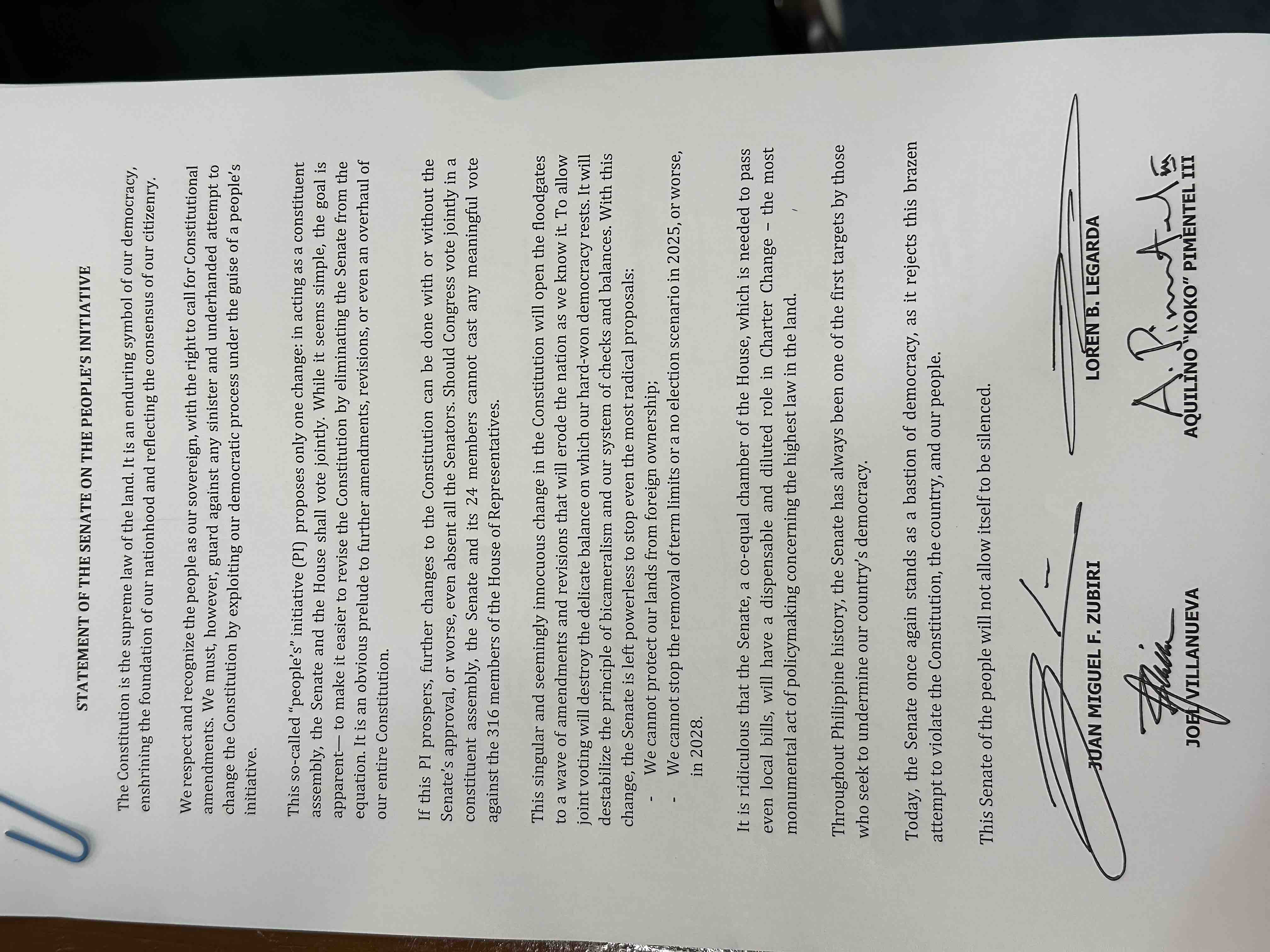

The manifesto is signed by all 24 senators. Senate President Juan Miguel “Migz” Zubiri, Senate President Pro Tempore Loren Legarda, Senate Majority Leader Joel Villanueva and Senate Minority Leader Aquilino “Koko” Pimentel III took the lead in the signature.
Even Sen. Robinhood Padilla, who initially said he will not sign the Senate's manifesto, signed the document.
The Senate’s manifesto was released a day after senators conducted a closed-door meeting on Monday, January 22.
Prior to this, the Senate leadership also referred Resolution of Both Houses No. 6, which seeks to amend several economic provisions in the 1987 Constitution, to the Senate Committee on Constitutional Amendments, Revision of Codes chaired by Sen. Robinhood Padilla.
Zubiri had earlier said that President Marcos has tasked the Senate to lead discussions on Charter change despite the ongoing public signature campaign.
The Senate leadership has also said that a subcommittee on constitutional amendments, to be chaired by Sen. Juan Edgardo “Sonny” Angara, will lead discussions on RBH No. 6.
In the manifesto, the Senate expressed strong objections to eliminate the Upper Chamber’s role in introducing amendments or even overhauling the Constitution.
"The Constitution is the Supreme law of the land. It is an enduring symbol of our democracy and the foundation of our nationhood and reflecting the consensus of our citizenry. We respect and recognize the people as our sovereign, with the right to call for Constitutional amendments," Zubiri said reading the Senate’s manifesto.
"We must, however, guard against any sinister and underhanded attempt to change the Constitution by exploiting our democratic process under the guise of a people's initiative," he said.
“This so-called People’s Initiative (PI) proposes only one change: in acting as a constituent assembly, the Senate and the House shall vote jointly. While it seems simple, the goal is apparent—to make it easier to revise the Constitution by eliminating the Senate from the equation,”
“If this PI prospers, further changes to the Constitution can be done with or without the Senate’s approval, or worse, even absent all the senators. Should Congress vote jointly in a constituent assembly, the Senate and its 24 members cannot cast any meaningful vote against the 316 members of the House of Representatives,” the senators stated through the manifesto.
For the senators, such “singular and seemingly innocuous change” in the Charter “will open the floodgates” to a wave of amendments and revisions that would erode the nation.
“To allow joint voting will destroy the delicate balance on which our hard-won democracy rests. It will destabilize the principle of bicameralism and our system of checks and balances,” they further said.
The Senate warned that should the PI push through, the Senate is left powerless to stop even the most radical proposals: “we cannot protect our lands from foreign ownership; we cannot stop the removal of term limits or a no-election scenario in 2025, or worse, in 2028.”
“It is ridiculous that the Senate, as a co-equal chamber of the House, which is needed to pass even local bills, will have a dispensable and diluted role in Charter change—the most monumental act of policymaking concerning the highest law in the land,” they stated.
Senators pointed out that throughout Philippine history, the Senate has always been one of the first targets by those who seek to undermine the country’s democracy, that’s why the “Senate of the people will not allow itself to be silenced.”