

ADVERTISEMENT

Hundreds of thousands protest against far right in Germany

Published Jan 22, 2024 01:13 am

MUNICH, Germany— Hundreds of thousands joined rallies against the far-right AfD party in Germany on Sunday, capping a week-long wave of protest that has seen demonstrators turn out in unusually large numbers across the country.
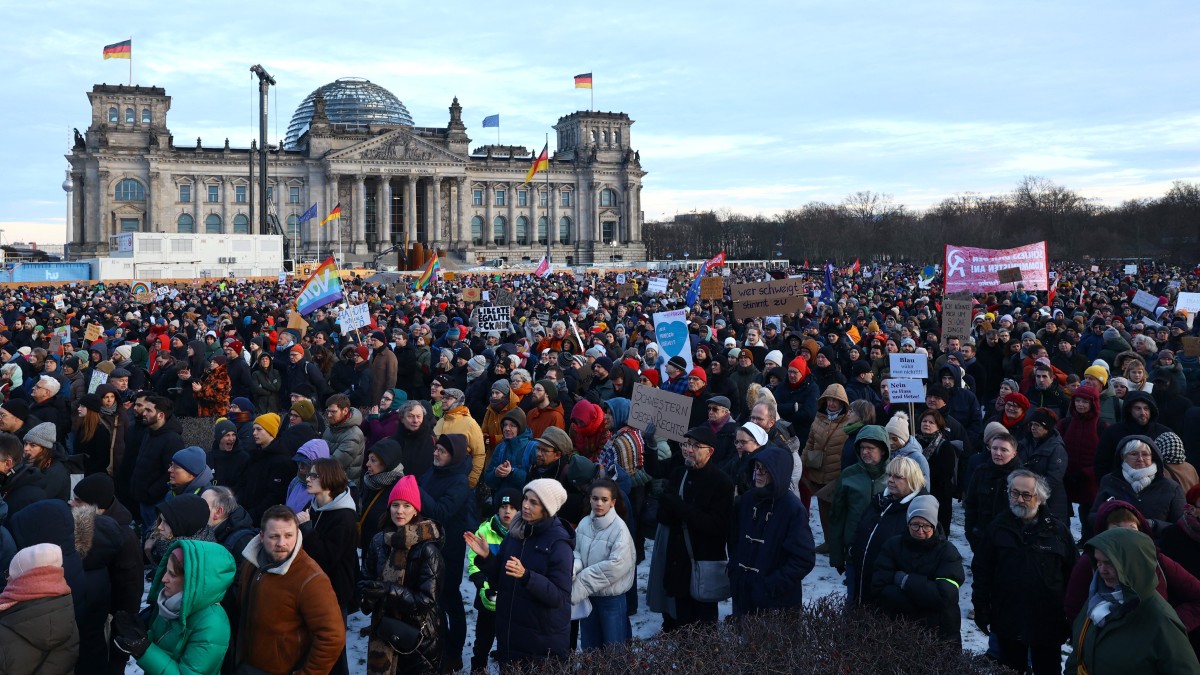
AFP__20240121__34G88Y6__v3__Preview__GermanyPoliticsPartiesMigrationRacismDemo.jpg
Participants gather during a demonstration against racism and far right politics in front of the Reichstag building in Berlin, Germany on January 21, 2024. Tens of thousands of people were expected to turn out again on January 21 to protest against the far-right AfD, after it emerged that party members discussed mass deportation plans at a meeting of extremists. (Photo by CHRISTIAN MANG / AFP)

Between Friday and Sunday alone, protests were organised in some 100 locations, with organisers Campact and Fridays for Future estimating that over 1.4 million people had gone out into the streets to send a "signal against the AfD and the rightwards drift in German society".

The influx of demonstrators was so large in Munich on Sunday that organisers were forced to cancel a planned march and ask people to disperse for safety reasons.

Around 100,000 had turned up for the protest, according to local police, four times as many as were registered for the event.

Another 100,000 people gathered to protest in Berlin on Sunday evening, according to police figures cited by regional broadcaster RBB.

The wave of mobilisation against the far-right party was sparked by a January 10 report by investigative outlet Correctiv, which revealed that AfD members had discussed the expulsion of immigrants and "non-assimilated citizens" at a meeting with extremists.

Among the participants at the talks was Martin Sellner, a leader of Austria's Identitarian Movement, which subscribes to the "great replacement" conspiracy theory that claims there is a plot by non-white migrants to replace Europe's "native" white population.

Nationwide protests 


News of the gathering sent shockwaves across Germany at a time when the AfD is soaring in opinion polls, just months ahead of three major regional elections in eastern Germany where their support is strongest.

The anti-immigration party confirmed the presence of its members at the meeting, but has denied taking on the "remigration" project championed by Sellner.

Protests against the AfD and the far-right thinking behind the deportation plan first came together last weekend in Berlin and Potsdam, where the extremist meeting was held, and have gathered pace since.

On Sunday, demonstrators in the capital carried signs with slogans such as "no place for Nazis", and waved their phone lights together in front of the German parliament.

"It's good that something finally happened, that the silent majority isn't so silent anymore," IT worker Lydia Steffenhagen told AFP at the protest in Berlin.

In Dresden, the capital of the eastern region of Saxony, where the far-right party is leading in the polls, authorities had to alter the course of a protest march.

The procession was lengthened to make space for an "enormous number of participants", police said on X, formerly Twitter.

Organisers estimated 70,000 people had joined a protest in Cologne, while in Bremen, local police said 45,000 people had turned out in the centre to demonstrate.

'Take a stand' 


Katrin Delrieux, 53, said she hoped the protests against the far right would "make a lot of people rethink" their positions.

"Some might not be sure whether they will vote for the AfD or not, but after this protest they simply cannot," she told AFP in Munich.

Politicians, as well as church leaders and Bundesliga football managers have called on people to take a stand against the far right.

Chancellor Olaf Scholz, who joined a demonstration last weekend, said any plan to expel immigrants or citizens alike amounted to "an attack against our democracy, and in turn, on all of us".

He urged "all to take a stand -- for cohesion, for tolerance, for our democratic Germany".

Interior Minister Nancy Faeser went so far as to say in the newspapers of the Funke press group that the far-right meeting was reminiscent of "the horrible Wannsee conference", where the Nazis planned the extermination of European Jews in 1942.

The protests against the far right could "restore trust in democratic conduct", Josef Schuster, the head of the Central Council of Jews in Germany, told broadcaster Welt TV.

Jews in the country had felt "huge uncertainty" added to by a wave of anti-Semitic incidents following the start of the Israel-Hamas war, Schuster said.

Related Tags

WORLDNEWS
ADVERTISEMENT
.most-popular .layout-ratio{ padding-bottom: 79.13%; } @media (min-width: 768px) and (max-width: 1024px) { .widget-title { font-size: 15px !important; } }

{{ articles_filter_1561_widget.title }}

.most-popular .layout-ratio{ padding-bottom: 79.13%; } @media (min-width: 768px) and (max-width: 1024px) { .widget-title { font-size: 15px !important; } }

{{ articles_filter_1562_widget.title }}

.most-popular .layout-ratio{ padding-bottom: 79.13%; } @media (min-width: 768px) and (max-width: 1024px) { .widget-title { font-size: 15px !important; } }

{{ articles_filter_1563_widget.title }}

{{ articles_filter_1564_widget.title }}

.mb-article-details { position: relative; } .mb-article-details .article-body-preview, .mb-article-details .article-body-summary{ font-size: 17px; line-height: 30px; font-family: "Libre Caslon Text", serif; color: #000; } .mb-article-details .article-body-preview iframe , .mb-article-details .article-body-summary iframe{ width: 100%; margin: auto; } .read-more-background { background: linear-gradient(180deg, color(display-p3 1.000 1.000 1.000 / 0) 13.75%, color(display-p3 1.000 1.000 1.000 / 0.8) 30.79%, color(display-p3 1.000 1.000 1.000) 72.5%); position: absolute; height: 200px; width: 100%; bottom: 0; display: flex; justify-content: center; align-items: center; padding: 0; } .read-more-background a{ color: #000; } .read-more-btn { padding: 17px 45px; font-family: Inter; font-weight: 700; font-size: 18px; line-height: 16px; text-align: center; vertical-align: middle; border: 1px solid black; background-color: white; } .hidden { display: none; }
function initializeAllSwipers() { // Get all hidden inputs with cms_article_id document.querySelectorAll('[id^="cms_article_id_"]').forEach(function (input) { const cmsArticleId = input.value; const articleSelector = '#article-' + cmsArticleId + ' .body_images'; const swiperElement = document.querySelector(articleSelector); if (swiperElement && !swiperElement.classList.contains('swiper-initialized')) { new Swiper(articleSelector, { loop: true, pagination: false, navigation: { nextEl: '#article-' + cmsArticleId + ' .swiper-button-next', prevEl: '#article-' + cmsArticleId + ' .swiper-button-prev', }, }); } }); } setTimeout(initializeAllSwipers, 3000); const intersectionObserver = new IntersectionObserver( (entries) => { entries.forEach((entry) => { if (entry.isIntersecting) { const newUrl = entry.target.getAttribute("data-url"); if (newUrl) { history.pushState(null, null, newUrl); let article = entry.target; // Extract metadata const author = article.querySelector('.author-section').textContent.replace('By', '').trim(); const section = article.querySelector('.section-info ').textContent.replace(' ', ' '); const title = article.querySelector('.article-title h1').textContent; // Parse URL for Chartbeat path format const parsedUrl = new URL(newUrl, window.location.origin); const cleanUrl = parsedUrl.host + parsedUrl.pathname; // Update Chartbeat configuration if (typeof window._sf_async_config !== 'undefined') { window._sf_async_config.path = cleanUrl; window._sf_async_config.sections = section; window._sf_async_config.authors = author; } // Track virtual page view with Chartbeat if (typeof pSUPERFLY !== 'undefined' && typeof pSUPERFLY.virtualPage === 'function') { try { pSUPERFLY.virtualPage({ path: cleanUrl, title: title, sections: section, authors: author }); } catch (error) { console.error('ping error', error); } } // Optional: Update document title if (title && title !== document.title) { document.title = title; } } } }); }, { threshold: 0.1 } ); function showArticleBody(button) { const article = button.closest("article"); const summary = article.querySelector(".article-body-summary"); const body = article.querySelector(".article-body-preview"); const readMoreSection = article.querySelector(".read-more-background"); // Hide summary and read-more section summary.style.display = "none"; readMoreSection.style.display = "none"; // Show the full article body body.classList.remove("hidden"); } document.addEventListener("DOMContentLoaded", () => { let loadCount = 0; // Track how many times articles are loaded const offset = [1, 2, 3, 4, 5, 6, 7, 8, 9, 10]; // Offset values const currentUrl = window.location.pathname.substring(1); let isLoading = false; // Prevent multiple calls if (!currentUrl) { console.log("Current URL is invalid."); return; } const sentinel = document.getElementById("load-more-sentinel"); if (!sentinel) { console.log("Sentinel element not found."); return; } function isSentinelVisible() { const rect = sentinel.getBoundingClientRect(); return ( rect.top < window.innerHeight && rect.bottom >= 0 ); } function onScroll() { if (isLoading) return; if (isSentinelVisible()) { if (loadCount >= offset.length) { console.log("Maximum load attempts reached."); window.removeEventListener("scroll", onScroll); return; } isLoading = true; const currentOffset = offset[loadCount]; window.loadMoreItems().then(() => { let article = document.querySelector('#widget_1690 > div:nth-last-of-type(2) article'); intersectionObserver.observe(article) loadCount++; }).catch(error => { console.error("Error loading more items:", error); }).finally(() => { isLoading = false; }); } } window.addEventListener("scroll", onScroll); });

Sign up by email to receive news.