







DOH reports 212 new cases of fireworks-related injury


The Department of Health on Tuesday, Jan. 2 confirmed 212 new cases of fireworks-related injuries, bringing the total to 443. This includes the first stray bullet injury and first death.
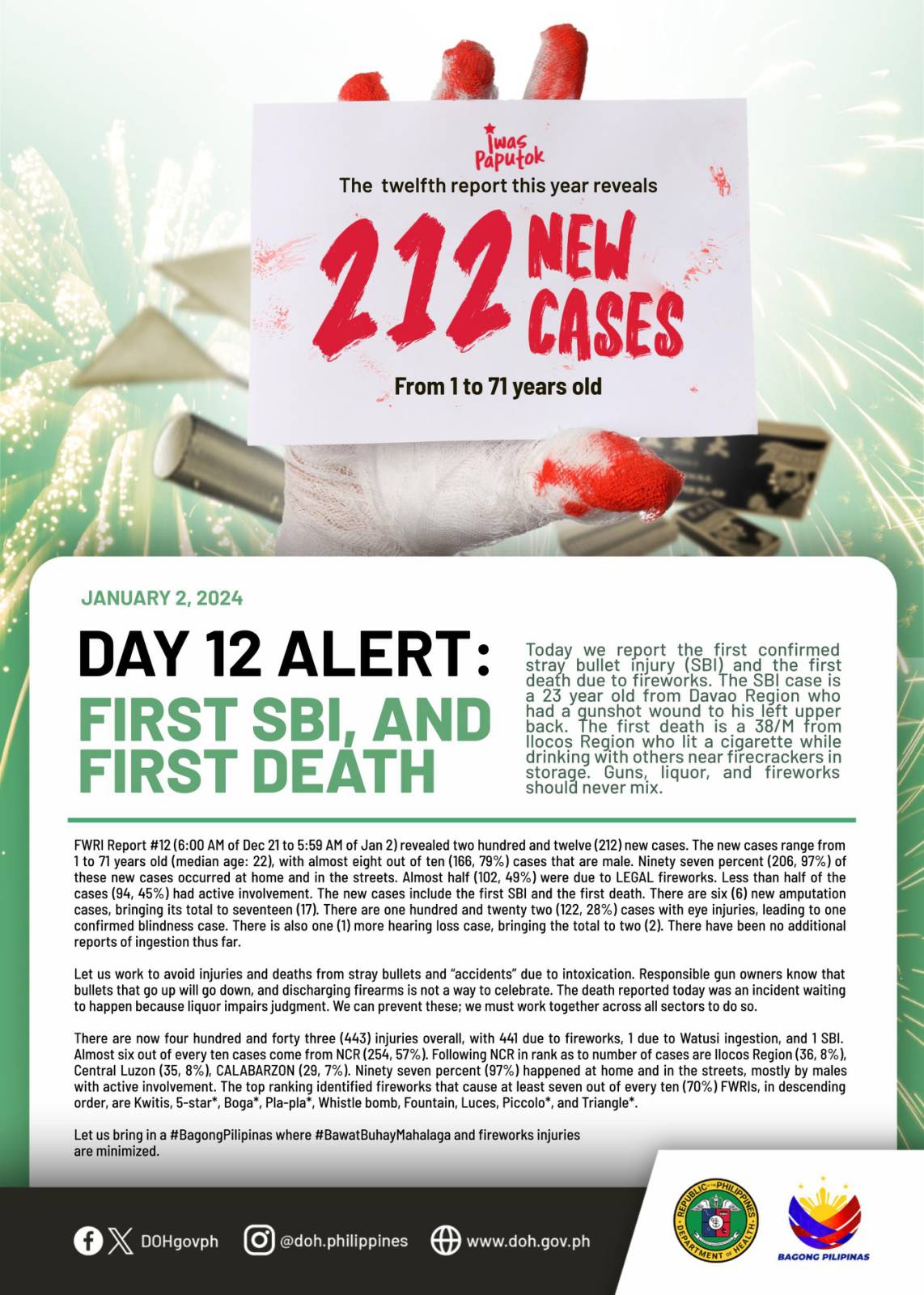
It said the newly reported cases, with a median age of 22 and ages ranging from one to 71 years old, highlight the severity of the problem.
From Dec. 21 to Jan. 2, the DOH reported the first confirmed stray bullet injury and the first death directly attributed to fireworks.
The stray bullet injury victim, a 23-year-old from the Davao Region, suffered a gunshot wound to the left upper back, while the first recorded death was a 38-year-old male from the Ilocos Region who tragically lit a cigarette near firecrackers while consuming alcohol.
"Guns, liquor, and fireworks should never mix,” DOH said as it emphasized the need for responsible behavior during festivities.
"Responsible gun owners know that bullets that go up will go down, and discharging firearms is not a way to celebrate," it added.
The DOH urged the public to take preventive measures, especially regarding stray bullets and accidents caused by intoxication.
Six additional amputation cases were also reported, bringing the total to 17.
The DOH also highlighted that approximately 79 percent of the cases were “males,” and a significant 97 percent occurred either at home or in the streets.
Of the new cases, 49 percent were attributed to "legal" fireworks, with only 45 percent involving active participation.
A breakdown of the injuries revealed that 28 percent of cases involved eye injuries, resulting in one confirmed case of “blindness.”
Hearing loss cases increased to two, while there have been no additional reports of ingestion.
Geographically, it said that almost 60 percent of cases originate from the National Capital Region (NCR), with 254 cases.
Other regions with notable figures include Ilocos Region and Cagayan Valley with eight percent, and Calabarzon with seven percent.
It said that the majority of incidents, or 97 percent of these, occurred at home or in public spaces, predominantly involving males with active participation.
Furthermore, the DOH identified the top fireworks responsible for 70 percent of FWRI cases as "kwitis," "5-star," "boga," "pla-pla," "whistle bomb," "fountain," "luces," "piccolo," and "triangle."
Illegal fireworks accounted for only 39 percent of cases, with legal fireworks causing more injuries.