






 Philippines
National
Transport execs debunk projected P50-fare due to PUV modernization
Philippines
National
Transport execs debunk projected P50-fare due to PUV modernization
Transport execs debunk projected P50-fare due to PUV modernization
By Raymund Antonio and Raymund Antonio


Office of Transportation Cooperatives (OTC) Chairperson Jesus Ortega and Land Transportation Franchising and Regulatory Board-National Capital Region (LTFRB-NCR) Regional Director Zona Russet Tamayo called as “baseless” reports that commuters would soon need to shell out as much as P50 for a ride in electric jeepneys (e-jeep) under the country’s jeepney modernization program.
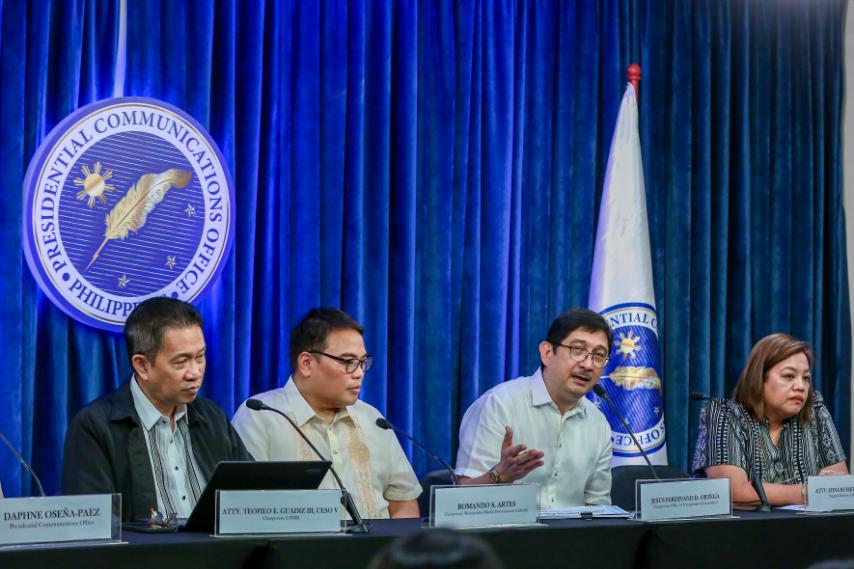 (From left) LTFRB Chairperson Teofilo Guadiz III, MMDA Chairperson Romando Artes, OTC Chairperson Jesus Ortega, and LTFRB-NCR Regional Director Zona Russet Tamayo speak to the media during Palace briefing. (Noel B. Pabalate/MANILA BULLETIN)
During a media briefing in Malacañang on Monday, Jan. 15, the official maintained that there will only be a P2 difference in the fare of traditional and modern jeepneys.
“Yung tungkol po sa sabi nila, P30, P40, P50 in five years wala pong basehan iyon (What they were saying, P30, P40, P50 in five years, that has no basis),” Ortega said.
He said further that six years ago, the fare in modern jeeps was P11 for every commuter as opposed to P9 in a traditional jeepney. The P2 difference is maintained today when fare in traditional jeeps cost P13 and modern jeeps cost P15.
“So, iyong dalawang pisong difference ng traditional at modern ay hindi nagbago but if you look at the percentage, mas bumaba pa nga from 9 to 11, 13 to 15 (So, the P2 difference between traditional and modern did not change but if you look at the percentage, it even decreased from 9 to 11, 13 to 15),” he stressed.
Ortega also debunked claims that modern jeepney operators can pass on to their commuters the cost of procuring and maintaining the e-jeeps.
“So, even now with two million plus na ‘yung iba natin modern vehicle wala rin po hinihinging extra ang mga gumagamit ng modern vehicle (using the modern vehicle, they are not asking for extra),” Ortega said, adding that the P2 difference in the minimum asking fare was “all in.”
“Considered na lahat ng (all of the) expenses and they never asked any rate outside of it because it’s already incorporated sa kanilang pagpapatakbo (in their operations).”
The official explained that the basis of a fare hike is fuel increase and the decision of the Land Transportation Franchising and Regulatory Board (LTFRB) after consultation with commuters, transport sector, and the National Economic and Development Authority (NEDA).
LTFRB-NCR Regional Director Zona Russet Tamayo agreed with Ortega refuting the fare hike reports.
“Kaya (That’s why)we have to coordinate with NEDA because we all know the transport cost would have that effect even in terms of inflation. That’s why we are careful in determining fares and we have to really seek guidance with NEDA so that we will have a wholistic approach,” she said.
Any increase or reduction on fares have to go through the LTFRB because drivers and operators cannot decide on their own.
“Kami ang magsasabi ng minimum fare at (We will determine the minimum fare and) percentage of increase per succeeding kilometer,” she added.