

ADVERTISEMENT

Ecuador regains control of prisons after hostages freed

Published Jan 15, 2024 12:57 am

QUITO, Ecuador— Ecuador's security forces on Sunday took back control of several prisons that had fallen into the hands of gang members, after securing the release of more than 200 officials held hostage inside the jails.
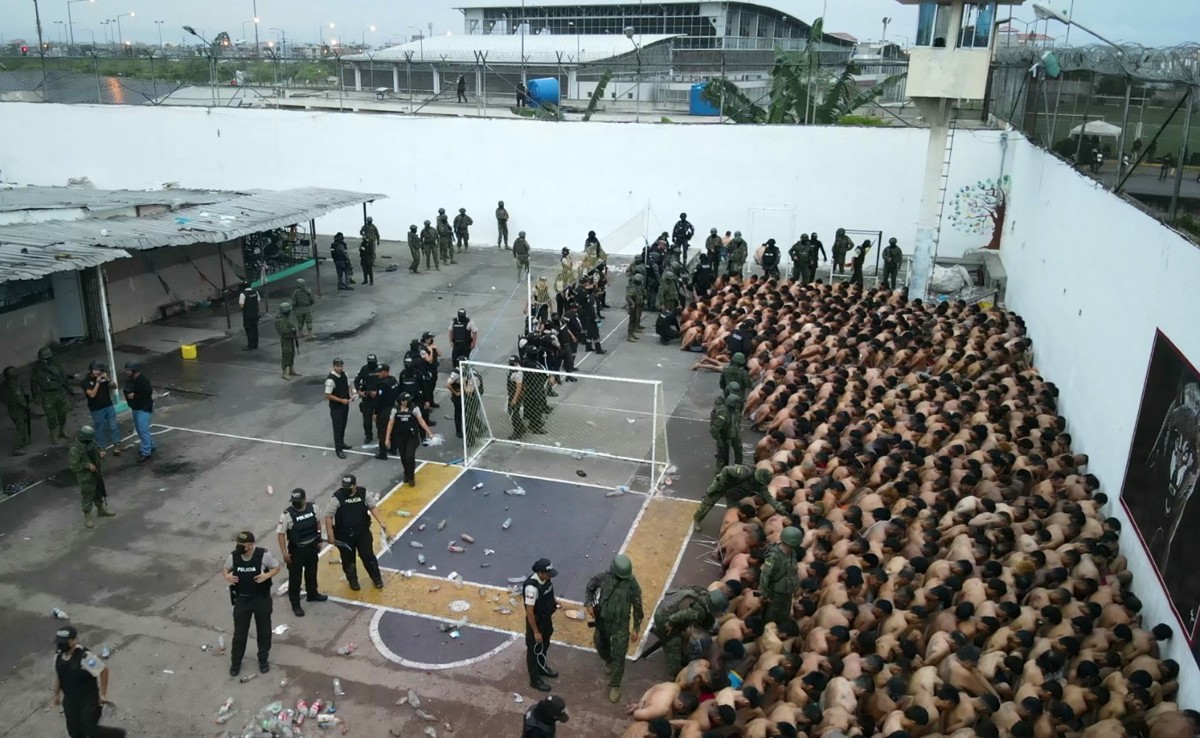
34EZ6TA-Preview.jpg
Handout picture released by the Ecuadorean Armed Forces showing security forces keeping watch over inmates after regaining control of a prison in Machala, Ecuador, on January 14, 2024. Ecuador's security forces worked Sunday to regain control of prisons that had fallen into the hands of gang members, after securing the release of nearly 180 officials held hostage inside the jails. The country's simmering security crisis erupted last week as the government and powerful narco gangs declared all-out war on each other, after the prison escape of a dangerous drug lord.
(Photo by Ecuadorean Armed Forces / AFP)

The country's simmering security crisis erupted last week as the government and powerful narco gangs declared all-out war on each other, after the prison escape of a dangerous drug lord.

Inmates rioted in jails where gangs wield outsize control, taking prison guards and administrative workers hostage, while on the streets a wave of violence has left 19 people dead.

Unverified images on social media of looting, brutal murders and other attacks have struck terror into the population.

On Sunday the army shared videos of prison walls being blown up, and declared "total control" of a prison in the city of Cuenca where 61 employees had been held hostage, according to the mayor.

They also shared images of hundreds of cowed inmates, shirtless and barefoot, lying on the ground at several prisons.

"We have resumed control of six centers" and are busy taking control of a final prison in Cotopaxi, which has seen brutal massacres in recent years, General Pablo Velasco told Caracol TV.

Authorities announced the release of 201 prison guards and administrative officials, from prisons across seven provinces.

President Daniel Noboa celebrated the releases in a post on X, the former Twitter.

"Congratulations to the patriotic, professional and courageous work of the armed forces, national police and the SNAI... for achieving the release of the prison guards and administrative staff held in the detention centers of Azuay, Canar, Esmeraldas, Cotopaxi, Tungurahua, El Oro and Loja," he wrote.

Images broadcast by the police showed the guards, many in tears, exhausted and supported by their colleagues shortly after their release.

"We are free... Thank God we all got out safely," a prison employee said in a video posted on social media, waving the Ecuadoran flag and standing in front of one prison in southern Cotopaxi province.

- State of emergency -

Once a bastion of peace situated between major cocaine producers, Ecuador has been plunged into crisis after years of expansion by the transnational cartels that use its ports to ship the drug to the United States and Europe.

The latest crisis was triggered by the escape from Guayaquil prison of one of the country's most powerful narcotics gang bosses, Jose Adolfo Macias, known by the alias "Fito," who headed the country's main gang "Los Choneros."

The government declared a state of emergency and curfew, infuriating gangsters who declared "war" against civilians and security forces.

Noboa in turn said the country was "in a state of war" against 22 gangs.

He deployed to the streets over 22,000 security forces, who have frisked and stripped down young men in search of the tattoos identifying them as a member of one of the gangs.

Authorities have reported more than 1,300 arrests, eight "terrorists" killed and 27 escaped prisoners recaptured in the operation.

Two police officers have also been killed.

- 'We are going to win' -
Noboa has vowed not to bow before the violence, giving orders to "neutralize" the criminal groups responsible.

"I believe we are going to win and I will not stop fighting until we do," he told the BBC on Friday.

Narco gangs often use prisons as criminal offices, from where they manage drug trafficking, order assassinations, administer the proceeds of crime and fight to the death with rivals for power.

It is in the prisons that much of the gang wars are fought, with brutal clashes between inmates leaving more than 460 dead, many beheaded or burned alive, since February 2021.

Ecuador's murder rate quadrupled between 2018 and 2022, as the criminal gangs found a foothold in the country.

Last year was the worst yet, with 7,800 murders and a record 220 tons of drugs seized.

Noboa has announced he plans to build two "super maximum" security prisons with a capacity for more than 3,000 people, with proposals for future "prison ships" also on the table.

Related Tags

WORLDNEWS
ADVERTISEMENT
.most-popular .layout-ratio{ padding-bottom: 79.13%; } @media (min-width: 768px) and (max-width: 1024px) { .widget-title { font-size: 15px !important; } }

{{ articles_filter_1561_widget.title }}

.most-popular .layout-ratio{ padding-bottom: 79.13%; } @media (min-width: 768px) and (max-width: 1024px) { .widget-title { font-size: 15px !important; } }

{{ articles_filter_1562_widget.title }}

.most-popular .layout-ratio{ padding-bottom: 79.13%; } @media (min-width: 768px) and (max-width: 1024px) { .widget-title { font-size: 15px !important; } }

{{ articles_filter_1563_widget.title }}

{{ articles_filter_1564_widget.title }}

.mb-article-details { position: relative; } .mb-article-details .article-body-preview, .mb-article-details .article-body-summary{ font-size: 17px; line-height: 30px; font-family: "Libre Caslon Text", serif; color: #000; } .mb-article-details .article-body-preview iframe , .mb-article-details .article-body-summary iframe{ width: 100%; margin: auto; } .read-more-background { background: linear-gradient(180deg, color(display-p3 1.000 1.000 1.000 / 0) 13.75%, color(display-p3 1.000 1.000 1.000 / 0.8) 30.79%, color(display-p3 1.000 1.000 1.000) 72.5%); position: absolute; height: 200px; width: 100%; bottom: 0; display: flex; justify-content: center; align-items: center; padding: 0; } .read-more-background a{ color: #000; } .read-more-btn { padding: 17px 45px; font-family: Inter; font-weight: 700; font-size: 18px; line-height: 16px; text-align: center; vertical-align: middle; border: 1px solid black; background-color: white; } .hidden { display: none; }
function initializeAllSwipers() { // Get all hidden inputs with cms_article_id document.querySelectorAll('[id^="cms_article_id_"]').forEach(function (input) { const cmsArticleId = input.value; const articleSelector = '#article-' + cmsArticleId + ' .body_images'; const swiperElement = document.querySelector(articleSelector); if (swiperElement && !swiperElement.classList.contains('swiper-initialized')) { new Swiper(articleSelector, { loop: true, pagination: false, navigation: { nextEl: '#article-' + cmsArticleId + ' .swiper-button-next', prevEl: '#article-' + cmsArticleId + ' .swiper-button-prev', }, }); } }); } setTimeout(initializeAllSwipers, 3000); const intersectionObserver = new IntersectionObserver( (entries) => { entries.forEach((entry) => { if (entry.isIntersecting) { const newUrl = entry.target.getAttribute("data-url"); if (newUrl) { history.pushState(null, null, newUrl); let article = entry.target; // Extract metadata const author = article.querySelector('.author-section').textContent.replace('By', '').trim(); const section = article.querySelector('.section-info ').textContent.replace(' ', ' '); const title = article.querySelector('.article-title h1').textContent; // Parse URL for Chartbeat path format const parsedUrl = new URL(newUrl, window.location.origin); const cleanUrl = parsedUrl.host + parsedUrl.pathname; // Update Chartbeat configuration if (typeof window._sf_async_config !== 'undefined') { window._sf_async_config.path = cleanUrl; window._sf_async_config.sections = section; window._sf_async_config.authors = author; } // Track virtual page view with Chartbeat if (typeof pSUPERFLY !== 'undefined' && typeof pSUPERFLY.virtualPage === 'function') { try { pSUPERFLY.virtualPage({ path: cleanUrl, title: title, sections: section, authors: author }); } catch (error) { console.error('ping error', error); } } // Optional: Update document title if (title && title !== document.title) { document.title = title; } } } }); }, { threshold: 0.1 } ); function showArticleBody(button) { const article = button.closest("article"); const summary = article.querySelector(".article-body-summary"); const body = article.querySelector(".article-body-preview"); const readMoreSection = article.querySelector(".read-more-background"); // Hide summary and read-more section summary.style.display = "none"; readMoreSection.style.display = "none"; // Show the full article body body.classList.remove("hidden"); } document.addEventListener("DOMContentLoaded", () => { let loadCount = 0; // Track how many times articles are loaded const offset = [1, 2, 3, 4, 5, 6, 7, 8, 9, 10]; // Offset values const currentUrl = window.location.pathname.substring(1); let isLoading = false; // Prevent multiple calls if (!currentUrl) { console.log("Current URL is invalid."); return; } const sentinel = document.getElementById("load-more-sentinel"); if (!sentinel) { console.log("Sentinel element not found."); return; } function isSentinelVisible() { const rect = sentinel.getBoundingClientRect(); return ( rect.top < window.innerHeight && rect.bottom >= 0 ); } function onScroll() { if (isLoading) return; if (isSentinelVisible()) { if (loadCount >= offset.length) { console.log("Maximum load attempts reached."); window.removeEventListener("scroll", onScroll); return; } isLoading = true; const currentOffset = offset[loadCount]; window.loadMoreItems().then(() => { let article = document.querySelector('#widget_1690 > div:nth-last-of-type(2) article'); intersectionObserver.observe(article) loadCount++; }).catch(error => { console.error("Error loading more items:", error); }).finally(() => { isLoading = false; }); } } window.addEventListener("scroll", onScroll); });

Sign up by email to receive news.